Smartest Companies of the Year 2026
Ridge Street Capital: Where Smarter Capital Meets Real Estate Opportunity
The Silicon Review
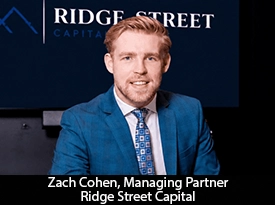
In its pursuit of identifying the private lenders redefining performance, reliability, and execution in an increasingly complex real estate financing environment, The Silicon Review examined companies navigating rising capital costs, evolving investor needs, and more sophisticated property transactions. Through this evaluation, Ridge Street Capital emerged as one of the Smartest Companies of the Year 2026, recognized for its ability to align financing with the realities of investment property performance. Led by Managing Partner Zach Cohen, Ridge Street Capital has built its lending model around DSCR loans, hard money fix-and-flip financing, and investment property lending, addressing a market where traditional underwriting often struggles to accommodate the needs of today’s real estate investors. The company’s approach reflects a practical understanding of how investors evaluate opportunities: financing needs to be responsive, transparent, commercially sensible, and capable of moving at the pace of a viable deal. Rather than treating every borrower and property through a standardized lens, Ridge Street Capital focuses on understanding the transaction itself and structuring capital accordingly.
The company’s origins are rooted in a clear gap within the investment property financing market. As rental and short-term rental owners increasingly began operating their properties as businesses, conventional lending remained heavily dependent on personal income, agency guidelines, and standardized borrower profiles. Meanwhile, the growth of private lending brought new options but also saw larger platforms introduce higher loan minimums and increasingly standardized programs. Zach Cohen founded Ridge Street Capital to serve investors who could be overlooked by those structures, including small-balance acquisitions, first-time investors, short-term rentals without established lease history, and regional buyers building portfolios in markets they know well. Today, Ridge Street Capital lends across 36 states and has funded nearly $100 million in investment property loans. Its growth reflects a straightforward philosophy: understand the deal, identify potential challenges early, communicate terms clearly, and provide dependable execution from application through closing. That combination of flexibility, discipline, and investor-focused lending has positioned Ridge Street Capital as a notable force in private real estate finance and earned its place among The Silicon Review’s Smartest Companies of the Year 2026.
In conversation with Zach Cohen, Managing Partner of Ridge Street Capital
On your website, you mention that “We’re the Lender for Real Estate Entrepreneurs.” How does that reflect in your processes and communication?
Ridge Street Capital works with borrowers who approach real estate as an operating business. They purchase through LLCs, redeploy capital across projects, and measure a lending relationship by clarity, speed, and execution.
That mindset shapes the underwriting. Ridge Street Capital reviews each file around the same questions an investor has to answer: what the property can produce, how the exit works, and whether the return still holds after costs are fully counted. The firm’s lending philosophy, Finance Successful Projects, means capital goes to deals where the numbers support a profitable outcome. When the deal works, Ridge Street moves quickly and keeps fees low.
When the file does not meet that standard, the response is direct. Ridge Street Capital regularly turns down deals, but the decline comes with an explanation. The team identifies the part of the model that breaks, whether it is ARV, rehab budget, leverage, rent prices, or exit strategy, and explains what would need to change before the deal becomes financeable.
That transparency is what builds repeat relationships. Closing a loan while overlooking a weak assumption may create one transaction, but it can cost the investor far more than the fee was worth. Borrowers return because Ridge Street moves quickly on strong deals and explains clearly when the numbers do not work.
Can you explain your services in brief?
Ridge Street’s lending platform is built around four main products.
DSCR loans provide long-term financing for stabilized rental properties. These loans are typically structured on 30-year terms and qualify based on the property’s rental income, with loan amounts starting at $55,000 and rates from 6.0%.
Airbnb loans are DSCR loans designed for short-term rentals, including properties with no rental history. Instead of relying on long-term lease comparables, Ridge Street qualifies the property using projected nightly revenue.
Fix-and-flip loans finance the purchase and renovation of distressed properties. Loan amounts start at $50,000, with financing available up to 90% of the purchase price and 100% of the rehab budget. Ridge Street also offers a high-leverage option for first-time investors with strong credit, allowing qualified borrowers to finance a deal even without prior flipping experience.
Ground-up construction loans provide staged funding for new builds, with draws released as construction milestones are completed.
Several private lenders have built online application platforms, scaled quickly, and secured institutional capital behind them. How does a firm your size compete with players of that scale?
Large lending platforms often avoid smaller investment property loans. Many set minimum loan sizes at $100,000 or $150,000 because a $70,000 loan takes nearly the same work as a $500,000 loan but produces far less margin. The math makes sense for the lender, but it leaves part of the market without financing.
Ridge Street Capital serves that segment. Across much of the Southeast and Midwest, properties below $100,000 make up a real share of the rental stock investors actually buy. Financing those deals gives local investors access to capital that many larger programs will not provide.
Those loans require market judgment. Ridge Street Capital’s team knows the difference between a rural property with weak resale support and a location that can support rental or short-term rental demand. An automated screen or default appraisal response can reject a viable deal too early, so the Ridge Street team reviews the numbers, comparable sales, and exit strategy together with the borrower.
The same standard applies to larger deals. Every loan gets the same review, the same service, and the same commitment to closing on the timeline quoted.
You provide term sheets within 2 business hours and close loans in 7-10 days. What are the proprietary processes or technologies that make this speed possible without sacrificing accuracy or compliance?
The speed comes from specialization and discipline. Ridge Street works only on investment property loans, so the team sees the same property types, deal structures, state rules, and risk patterns every day. That makes the first review more accurate. Problems that might surface in week two with a general lender are often identified on the first pass.
Technology supports the process, but it does not replace judgment. Routine steps are automated where automation adds speed, while key milestones stay under human review. The team tracks market trends, watches states where conditions are softening, and adjusts underwriting when risk changes.
Every deal is still reviewed by a loan officer. Analytics help the team understand the numbers, but the decision is not handed to a scoring model. The goal is to know why the deal works, where it could break, and what needs to change before capital is committed.
You serve real estate investors in 36 states, offering everything from DSCR loans to fix-and-flip financing. How does your centralized intelligence on diverse markets allow you to assess risk and price loans so effectively across different regions?
The core underwriting standard does not change by state. The property has to produce income, the exit has to make sense, and the numbers have to support the loan. What changes is the local context around those fundamentals.
That is where Ridge Street Capital’s market experience matters. Rental demand, resale liquidity, contractor pricing, and short-term rental rules can change by metro, and sometimes by neighborhood. A single national leverage grid can miss those differences. Ridge Street tracks where markets are softening and adjusts leverage when risk changes, instead of applying the same terms everywhere. That judgment comes from closed-loan experience across many submarkets.
That structure is what makes fast execution possible. Term sheets go out within 2 business hours. Fix-and-flip loans can close in 7 to 10 days, and DSCR loans typically close in 21 to 25 days.
The same local knowledge applies to local regulations. Ridge Street advises clients whether the question is a recording tax, whether an LLC is required to close, or which costs can be avoided entirely.
On a recent New York refinance, that knowledge saved the client more than $25,000. If the loan had been structured as a standard refinance with a new lender, recording tax would have applied to the full loan amount. Ridge Street structured the transaction so the existing mortgage carried over, and the tax applied only to the new proceeds.
What do you think about short-term rentals? Is it still a sweet spot for investors in 2026?
The easy phase is over. Supply has caught up in many established markets, municipalities have tightened permitting, and the strongest returns now come from careful property selection, not from buying into a trend.
Short-term rentals can still work, but investors need to underwrite the specific address. That means checking the submarket, seasonality, permit rules, comparable revenue, and real operating costs before committing capital.
Ridge Street Capital underwrites short-term rentals every day, and the same discipline applies on the lending side. Many lenders still require 12 to 24 months of operating history or qualify the property using long-term lease comparables. That can understate the income, reduce the loan amount, or kill a deal that would work as a short-term rental.
Ridge Street takes a different approach. The team uses AirDNA data for the specific ZIP code and property type, including occupancy, average daily rate, and seasonal demand. It then applies projected operating expenses so the qualifying income reflects how the property is expected to perform, not just its gross revenue.
That allows Ridge Street to finance Airbnb and short-term rental properties with no rental history when the market data supports the income. The property is evaluated based on its intended use, not against a long-term lease comp that may not match the strategy.
You offer 90% LTC financing for first-time flippers. How does your intelligent tiered underwriting approach allow you to capture a wider range of qualified borrowers while managing risk?
Leverage follows proven experience. A first-time investor can qualify, but the renovation scope has to stay controlled. Ridge Street generally keeps first-time borrowers within moderate rehabs, with the renovation budget no greater than 50% of the purchase price. As borrowers complete projects, they can qualify for larger renovation scopes and more complex deals.
Credit works alongside experience. A borrower with strong credit can reach higher leverage earlier. Ridge Street’s first-time investor program allows qualified borrowers with strong credit to finance up to 90% of the purchase price and 100% of the rehab budget, even without prior flipping experience.
What does the future hold for your company and its customers? Are exciting things on the way?
Ridge Street Capital is expanding in the parts of the market where investors have the fewest financing options. That includes deeper DSCR coverage, more short-term rental financing, and continued support for small-balance investment property loans.
Geographically, the firm is working toward California, Arizona, Nevada, and Utah. Ridge Street also recently began lending in Illinois.
As deal volume grows, the firm is hiring and training new team members across underwriting and loan operations.
Technology will shape how the next stage of lending gets done, but Ridge Street does not use automation to replace the borrower relationship. Standardized systems can miss the details of a deal and make the process feel less transparent. Ridge Street puts technology behind the loan officer instead: data, market information, and tools that keep the process consistent from application through underwriting.
Investor strategies are also changing. Mid-term rentals, furnished corporate housing, shared-occupancy models, asset tokenization, blockchain settlement, and shared ownership all create structures that standard lease comparables do not always capture. Ridge Street tracks those shifts and builds better ways to measure them, while keeping its underwriting standards, communication, and pricing transparency intact.
“Ridge Street tracks where markets are softening and adjusts leverage when risk changes, instead of applying the same terms everywhere. That judgment comes from closed-loan experience across many submarkets.”
Search Magazine
Latest Listings