Datos Health Argues That Monitoring Was Never the Product, and Automation Is What Actually Frees Clinicians
Remote patient monitoring arrived with a promise and delivered a queue. Health systems bought platforms that tracked vitals and generated notifications then discovered that alerts without action pathways simply relocate the workload. Clinicians gained data streams and lost hours. Patients received reminders and, frequently, disengaged. Nearly a decade into the category, the original proposition reduce burden while improving outcomes remains unmet for most adopters.
Datos Health built its position on that unmet promise. Rather than selling another pre-built monitoring solution that dictates how care should be delivered, the company built an open platform with a no-code Design Studio that lets clinicians construct their own automated pathways. A cardiologist managing heart failure can design a workflow that adjusts medication reminders based on daily weight readings. A care manager overseeing post-discharge COPD patients can deploy surveys that trigger escalation protocols without human intervention. The platform does not replace clinical judgment; it removes the administrative friction surrounding it.
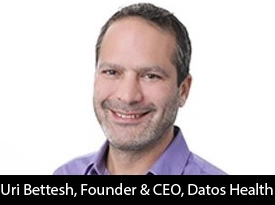
The company reports more than 500 care pathways and integrations with leading health systems, alongside recognition from KLAS Research and AVIA's Best in Virtual Visits designation. Its patient-facing AI assistant, Grace, handles multilingual communication, symptom logging and device connectivity, while AI Meeting Summary structures virtual visit notes directly into medical records. Uri Bettesh serves as Founder and Chief Executive Officer.
The Capacity Arithmetic That Justifies the Spend
Every monitoring vendor claims efficiency. Datos Health's claim is specific: clinician-to-patient ratios doubling. The mechanism is automation of the routine pre-visit intake, post-discharge check-ins, and medication adherence tracking so care managers concentrate on patients who need human attention. One health system partner documented a 40% to 70% reduction in pre-appointment preparation time after deploying the platform for chronic condition management.
The revenue consequence is direct. A care team previously managing 200 active patients can oversee 400 without additional headcount, halving cost per monitored patient. For organizations operating on thin margins against capitated or value-based contracts, that arithmetic determines whether a program is viable.
Where Payer Economics Change
For Medicare Advantage plans and value-based care organizations, the financial stakes sit in star ratings and readmission penalties rather than operational efficiency. Datos Health's automated care plans for congestive heart failure and COPD target the events that drive Hospital Readmissions Reduction Program scores, with each point carrying defined reimbursement consequences under CMS models.
The platform's early warning detection draws on vitals, survey responses and medication adherence data without requiring manual chart review. That combination automated detection with automated response is what distinguishes a monitoring deployment from a care management program.
AI Applied Where Labor Cost Lives
Datos Health's approach to artificial intelligence is deliberately unglamorous. Grace handles patient communication across languages, logs symptoms and manages device connectivity while performing risk detection and sentiment analysis. AI Meeting Summary transcribes and structures visit notes into records. Appointment Preparation automates referral and lab-result chasing, cutting physician wait times by up to 50%.
Each function targets labor cost, the largest expense line for care delivery organizations. None of them constitutes a feature designed to impress a procurement committee; all of them reduce hours.
Validation as the Trust Currency
Healthcare technology claims require external scrutiny because the cost of failure is measured in patient harm and regulatory exposure. Datos Health's standing rests on third-party assessment: KLAS Research recognition, AVIA's Best in Virtual Visits designation, and published outcomes across hundreds of pathways.
The operational results cited are similarly concrete early discharge capabilities that free hospital beds, hospital-at-home programs reporting cost reductions of up to two-thirds without new infrastructure, and EHR integration designed to avoid the adoption friction that stalls comparable deployments.
The Economics of Doing More With Less
Healthcare organizations face a structural squeeze: demand rising, labor scarce, reimbursement tightening. Technology that adds monitoring capacity without adding workflow capacity worsens the problem it claims to solve. Datos Health's proposition is that automation not observation is the only mechanism that changes the ratio. With an open architecture, clinician-configurable pathways and a decade of category experience behind its thesis, the company has positioned itself where the pressure is greatest. Whether that position holds depends on continued validation, but the underlying argument is difficult to dispute: alerts are cheap, and capacity is not.
Uri Bettesh, Founder & Chief Executive Officer
"The healthcare industry was sold a promise that digital tools would revolutionize care. Instead, they created more work. Datos exists because automation, not monitoring, is the only path to sustainable hybrid care that reduces clinician burden while improving patient outcomes."
Search Magazine
Latest Listings












