>>
Industry>>
Startups>>
Self-Improving AI: Ex-Meta Sta...Self-Improving AI: Ex-Meta Star Researcher Launches $4.6B China Startup
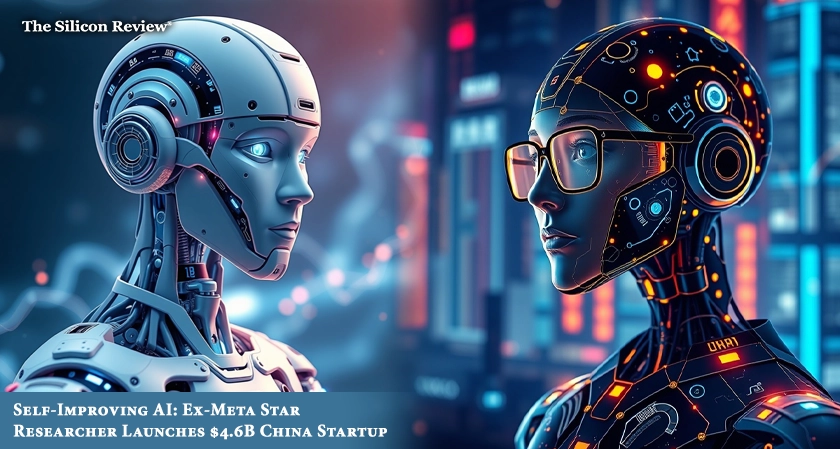
A star Chinese AI researcher who led Meta's fundamental AI research has launched a $4.6 billion self-improving AI startup. The Silicon Review reports on the race to build models that can recursively optimize themselves without human intervention.
A star Chinese AI researcher who served as head of fundamental artificial intelligence research at Meta has launched a self-improving AI startup in China, securing a staggering $4.6 billion valuation before shipping its first product.
The researcher, who asked not to be named due to ongoing contractual obligations with Meta, is building what the industry calls recursive self-improvement AI systems capable of optimizing their own architecture, training data selection, and hyperparameters without human intervention .
The startup has already raised $1.2 billion in seed funding from a consortium including state-backed funds, top-tier venture capital firms, and strategic investors from China's tech sector. The valuation places the year-old company among China's most valuable AI startups, rivaling DeepSeek and Zhipu.
Self-improving AI represents the next frontier after large language models. While current LLMs require human data scientists to curate training sets, tune hyperparameters, and debug architectures, self-improving systems are designed to perform these tasks autonomously through meta-learning and automated reinforcement learning loops.
The researcher‘s work at Meta focused on meta-learning and few-shot generalization techniques that enable models to learn from minimal examples and adapt to new tasks without retraining. Applying these principles to recursive self-improvement has been a long-standing goal of the researcher, who left Meta after becoming frustrated with the company’s cautious pace in deploying fundamental research to production.
China‘s AI ecosystem is particularly receptive to self-improving AI because of the country’s relative abundance of computing power and scarcity of top-tier AI talent. If a model can improve itself, it reduces the need for armies of human data scientists a structural advantage for China, which produces fewer PhDs in machine learning than the United States.
By the fourth quarter of 2026, the startup expects to release a research preview of its first self-improving model, initially for code generation and scientific discovery tasks. A commercial product is targeted for late 2027.
The Silicon Review’s analysis indicates that the launch of a $4.6 billion self-improving AI startup represents a bet that the next AI breakthrough will come not from scaling models larger, but from teaching them to scale themselves. If successful, recursive self-improvement could break the logjam of diminishing returns on larger datasets and more compute fundamentally changing the economics of AI development.
Q: What is self-improving AI?
A: Self-improving AI refers to systems capable of optimizing their own architecture, training data selection, and hyperparameters without human intervention, using meta-learning and automated reinforcement learning loops.
Q: Who is the researcher behind the $4.6 billion self-improving AI startup in China?
A: The researcher is a star Chinese AI scientist who served as head of fundamental artificial intelligence research at Meta. They asked not to be named due to ongoing contractual obligations with the company.
Q: How much funding has the self-improving AI startup raised?
A: The startup has raised 1.2 billion in seed funding from a consortium including state backedfunds, top−tier venture capital firms, and strategic investors from China‘s tech sector, achieving a 14.6 billion valuation.
Q: Why is self-improving AI particularly significant for China?
A: China has relative abundance of computing power but scarcity of top-tier AI talent. Self-improving AI reduces the need for armies of human data scientists, giving China a structural advantage over countries with more PhDs in machine learning.
Q: When will the startup release its first self-improving AI model?
A: The startup expects to release a research preview of its first self-improving model in the fourth quarter of 2026, initially for code generation and scientific discovery tasks, with a commercial product targeted for late 2027.
Q: What was the researcher’s focus at Meta before leaving?
A: The researcher‘s work at Meta focused on meta-learning and few-shot generalization techniques that enable models to learn from minimal examples and adapt to new tasks without retraining.