September Monthly Special 2026
Joe Faruqui Is Building a Faster, More Accountable Future for Aerospace and Defense Procurement
The Silicon Review
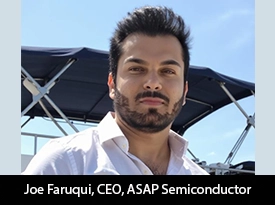
Named one of The Silicon Review’s Top CEOs to Watch in 2026, Joe Faruqui, CEO of ASAP Semiconductor has spent more than a decade transforming a complex sourcing challenge into a technology-enabled supply chain business built on speed, compliance, and trust.
When an aircraft is grounded, a defense platform is waiting for a critical component, or a manufacturer is facing an unexpected production delay, procurement is no longer a back-office function. It becomes an operational imperative. Yet across aerospace and defense, organizations can still spend days searching for components that may already be available somewhere in the global supply chain, buried in surplus inventory, produced by a diminishing manufacturing source, or sitting in a warehouse without easily accessible information. For Joe Faruqui, CEO of ASAP Semiconductor, that disconnect represents both a persistent industry challenge and a leadership opportunity.
Selected for The Silicon Review’s Top CEO’s to watch 2026 recognition and featured as part of its broader theme celebrating leaders shaping the future of their industries, Faruqui has spent more than a decade building ASAP Semiconductor around a simple but consequential idea: procurement becomes more effective when information, technology, human expertise, and accountability work together. Since launching the company in 2009 with just $5,000 in capital, Faruqui has expanded what began as a microelectronics components distributor into a business operating across five distinct verticals: aerospace and defense, civil aviation, information technology hardware, industrial automation parts, and aviation hardware. That evolution reflects more than business expansion; it reveals a leadership philosophy built around identifying where customers experience friction and then creating systems capable of removing it.
The central problem Faruqui set out to address was never simply whether a component existed. It was whether customers could identify the right component, establish its provenance, verify its quality, and obtain it quickly enough to meet an operational requirement. In aerospace and defense, where aging platforms, obsolete parts, extended lead times, diminishing manufacturing sources, and complex logistics can create significant procurement pressure, that distinction matters. ASAP Semiconductor has built its purchasing ecosystem to help customers identify and source difficult-to-find components in minutes rather than days, while pairing digital capabilities with dedicated professionals who understand the consequences of procurement delays.
Making Compliance a Competitive Advantage
That philosophy is at the heart of Faruqui’s approach to leadership. In many businesses, compliance is viewed primarily as a constraint, something that adds procedures and slows execution. Faruqui approaches it differently. His experience has led him to regard compliance and operational discipline as mechanisms that ultimately make the organization faster because they reduce uncertainty before a transaction reaches the customer. For a regulated aerospace or defense buyer, locating a part is only one stage of the process. The organization also needs confidence in where the component came from, whether the supplier is appropriately qualified, whether the documentation is complete, and whether the part can be traced through the required chain of custody. By embedding those considerations into sourcing and operational processes from the beginning, ASAP Semiconductor seeks to ensure that the fast answer is also the correct answer. That mindset requires leadership decisions that are not always commercially convenient. Faruqui has emphasized the importance of refusing business when the company cannot adequately stand behind a component’s provenance, recognizing that in a flight-critical environment, an inadequately sourced part can become far more than a procurement issue. It can become a safety and operational risk. The willingness to walk away from a transaction when the underlying standards cannot be satisfied illustrates an important dimension of Faruqui’s leadership: growth is valuable, but sustainable growth depends on preserving the trust that makes customers willing to return.
For Faruqui, compliance is therefore not an administrative function that sits on the sidelines of commercial activity. It is embedded into how the company thinks about sourcing, customer relationships, vendor qualification, documentation, and execution. By ensuring that employees understand their individual responsibilities within the compliance framework, ASAP Semiconductor aims to identify potential problems early and reduce bottlenecks that could otherwise create unnecessary delays.
Building Trust Where the Stakes Are High
That trust has become particularly important as ASAP Semiconductor has expanded its relationships with highly regulated organizations and secured supplier approvals and partnerships involving entities such as the U.S. Department of Defense, the Australian Department of Defense, RTX Corporation, and Austrian Airlines. Serving customers operating within demanding regulatory and operational environments requires more than competitive pricing. It requires an understanding of each customer’s requirements, risk profile, delivery expectations, documentation standards, and broader operational objectives.
Faruqui’s leadership approach is therefore centered on tailoring solutions to the end user rather than attempting to force every customer into the same procurement model. The strategy combines compliant sourcing, documentation, communication, and delivery discipline with the flexibility required to address different customer environments. This focus has helped shape a business model in which ASAP Semiconductor seeks to become a dependable extension of its customers’ procurement operations rather than simply another supplier competing for individual purchase orders.
The same principle has shaped the company’s approach to recognition within the industry. ASAP Semiconductor was named Aerospace and Aviation Parts Distributors Company of the Year for 2025, an acknowledgment that aligns with Faruqui’s emphasis on dependable sourcing and responsive service. For him, recognition is less about a single accolade than it is about the underlying relationship between consistency and trust. A supplier serving government organizations, airlines, major manufacturers, and other sophisticated buyers cannot rely on an occasional successful transaction. Its value is established through repeated execution, clear communication, and the ability to deliver against expectations when the stakes are high.
Developing People, Not Just Processes
Faruqui’s focus on people is equally central to that execution. Technology may accelerate how customers
identify requirements, but procurement remains dependent on people who understand specifications, supply chains, compliance requirements, customer priorities, and the practical consequences of delays. His approach to workforce development begins with identifying individual strengths and positioning employees where they can contribute most effectively, while supporting continued training and development as expertise evolves.
Consistent feedback, open communication, shared goals, and an emphasis on professional growth form the foundation of the company’s effort to build stable, high-performance teams. The result Faruqui seeks is not simply employee retention for its own sake, but a workforce whose accumulated expertise translates directly into greater reliability for customers. In a business where precision can determine whether a sourcing challenge is resolved quickly or becomes a prolonged operational issue, institutional knowledge becomes a strategic asset. This people-first philosophy also reflects Faruqui’s belief that scale should not come at the expense of personalized service. His vision has been to build an organization large enough to deliver consistently while retaining the ability to provide strategic, individualized support to customers. That balance between scale and responsiveness has become an important part of ASAP Semiconductor’s identity as it expands its reach across multiple verticals.
Anticipating the Next Supply Chain Disruption
ASAP Semiconductor’s people-first philosophy sits alongside an increasingly data-driven view of the market. As global aviation demand continues to recover and geopolitical conditions reshape supply chains, Faruqui believes open-market demand for aerospace and aviation components will continue to increase. Rather than responding only after shortages appear, ASAP Semiconductor is using data to inform procurement decisions and position high-demand products ahead of customer requirements.
The company has been expanding inventory around parts from major OEMs such as Honeywell and Collins, reflecting a broader strategy of anticipating where demand is moving rather than waiting for customers to encounter shortages before acting. For Faruqui, forward-looking leadership means understanding that supply chain resilience is increasingly determined before a shortage occurs. The ability to identify emerging demand patterns and prepare inventory accordingly can give customers an important advantage when traditional procurement channels become constrained. That approach becomes particularly relevant in aerospace and defense, where many platforms remain in service long after the original manufacturing cycle for their components has ended. Obsolescence, diminishing manufacturing sources, extended lead times, and complex international logistics can turn seemingly routine procurement requirements into difficult sourcing challenges. ASAP Semiconductor’s model is designed around that intersection of availability and intelligence, with digital purchasing capabilities supported by specialists who can take ownership of difficult requirements.
Technology That Works With the Customer
Faruqui’s vision for the next phase of ASAP Semiconductor extends that model further. The company is reaching what he describes as a critical point of scale, after which it anticipates acquisitions of manufacturers and increased manufacturing capacity. The strategic logic is straightforward: greater production capacity can potentially improve availability, accelerate deliveries, and create volume-based efficiencies for customers across global markets.
At the same time, the company is developing customer-specific platforms designed to work alongside customers’ existing ERP systems, with the goal of identifying and addressing long-lead-time, hard-to-find, and obsolete component requirements more efficiently. Rather than asking customers to abandon the systems they already use, the strategy is to make procurement technology work within those existing environments and create a more direct connection between customer requirements and available supply. This direction points toward a broader transformation in how Faruqui views procurement. The future is not simply about maintaining a larger inventory or processing purchase orders more quickly. It is about creating an interconnected ecosystem in which customer systems, market intelligence, supplier information, manufacturing capacity, compliance processes, and human expertise can work together to anticipate requirements before they become operational problems.
Leading Through Disciplined Growth
Faruqui’s journey from a $5,000 startup to the leader of a diversified organization illustrates the role of disciplined expansion in building a resilient business. Each of ASAP Semiconductor’s five verticals has introduced different market opportunities, customer requirements, and avenues for growth, allowing the company to diversify its sales and customer portfolio while strengthening its position across multiple industries. The company’s evolution also demonstrates how Faruqui has approached growth as a series of strategic opportunities rather than a single pursuit of scale. Beginning with microelectronics, ASAP Semiconductor expanded into aerospace and defense, civil aviation, information technology hardware, industrial automation parts, and aviation hardware. Each vertical has contributed to a broader customer portfolio and created additional opportunities to increase the company’s share of customer requirements.
The result is a business designed to withstand changes in individual markets while continuing to deepen its relationships with customers that depend on dependable sourcing. For Faruqui, diversification and specialization are not contradictory. They can reinforce one another when the underlying operating principles remain consistent.
The Leadership Equation: Speed, Rigor and Accountability
What ultimately distinguishes Faruqui’s leadership is the consistency of the principles connecting these different stages of growth. He has treated compliance not as an obstacle but as a foundation for speed, technology not as a substitute for people but as an accelerator of expertise, and customer service not as a transactional function but as a long-term strategic relationship. In an industry where a missing component can create consequences far beyond the purchasing department, those principles become commercially meaningful. Aerospace and defense organizations increasingly need suppliers that can respond quickly while maintaining the documentation, traceability, quality standards, and accountability that the industry demands.
As those pressures intensify, the companies capable of combining responsiveness with discipline will become increasingly important. Faruqui’s ambition for ASAP Semiconductor is to occupy that space by making procurement faster without making it less rigorous, and more technology-driven without losing the human expertise that gives the process its judgment. That is ultimately the leadership challenge Faruqui has chosen to address: not simply finding parts, but building the systems, people, and partnerships that allow customers to find the right parts with confidence when time matters most. From a startup founded with $5,000 to a diversified aerospace and defense supply chain organization, his story is increasingly defined not by how quickly ASAP Semiconductor has grown, but by the operating principles he believes must remain intact as the company grows further.
Search Magazine
Latest Listings