One Good Card Answers Seven Billion Paper Name Cards a Year with a Tap, a Profile and a CRM Record
Seven billion paper name cards are printed annually, a figure that resists intuition until you consider what happens to them. Most are handed over, glanced at, pocketed, and lost. The exchange carries a name and a number, but no record of interest, no signal of intent, and no path into the systems where relationships are actually managed. One Good Card was built on the observation that this ritual persists not because it works, but because nothing better had been placed in its path.
The Singapore-based company makes NFC business cards in matte PVC, sustainably sourced Sapele wood and stainless steel, alongside an NFC smart ring and adhesive stickers, paired with a fully customisable digital profile. A tap opens that profile in the recipient's browser with no app required, and every subsequent view, save and link click is recorded. Cards run from a standard non-customisable option upward through personalised finishes, with lifetime usage included.
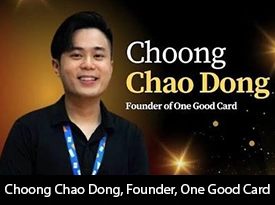
The scale claimed is specific: more than 200,000 professionals and 3,000 companies, including Mastercard, Hyatt, Visa, Fujifilm, Shiseido, Bosch, L'Oréal and BMW, with more than 2 million taps, scans and shares exchanged worldwide. Choong Chao Dong serves as Founder, and the company designs and manufactures in Singapore while shipping worldwide.
Beyond the Card: A Networking Platform
One Good Card's positioning rests on a distinction the company draws explicitly: competitors such as Linq, Popl and Blinq are framed as contact-sharing tools, while One Good Card is presented as a full platform. The difference is visible in the feature set.
The digital profile is widget-driven, supporting social feeds, business details and maps, product listings, portfolios and file sharing, embedded video, and lead capture forms connected to CRM. Multi-profile display allows one user to switch between cards for different roles or brands. An OCR scanner digitises paper cards received in return. Networking analytics track profile views, contact saves and link engagement.
On the sales side, the platform includes a contact manager, deal pipeline, invoicing with automated follow-ups, email verification, and integrations with HubSpot, Salesforce and comparable business platforms.
Where the Revenue Model Diverges
Most digital business card companies operate subscription models that gate features behind recurring fees. One Good Card inverts that structure. Physical NFC cards are a one-time purchase, OGC Pro unlocks premium digital profile features for a one-time fee, and a free plan supports individuals getting started. A card purchase includes OGC Pro.
The commercial consequence is that revenue depends on hardware volume and team contracts rather than recurring individual subscriptions. That makes the team and enterprise segment strategically important: team-branded cards, centralised administration, bulk profile creation, branded templates, admin restrictions, centralised lead capture and team-level analytics. When an employee joins or leaves, their profile is updated or deactivated centrally.
Enterprise Features That Justify the Contract
The enterprise tier extends beyond administration into brand governance: custom brand fonts, custom card domains and verified company badges. For organisations with distributed sales forces, that combination addresses a real problem ensuring every representative's digital presence matches corporate standards without manual oversight.
Additional services include NFC live printing at events, where personalised cards are produced on-site, and corporate gifting with custom branded items. Both convert one-time events into hardware revenue while deepening the client relationship.
Sustainability as an Operational Claim
The company's environmental positioning is unusually concrete for the category. Cards are available in sustainably sourced wood, the firm partners with One Tree Planted for global reforestation, and commitments span ethical sourcing, durability testing, fair employment and product longevity. Preferential pricing is offered to non-profits including SCAPE, AIESEC Singapore and Singapore Red Cross.
The sustainability argument has commercial weight because paper cards are, by definition, disposable. A durable card with lifetime profile updates eliminates reprinting entirely a claim that holds up under scrutiny rather than resting on sentiment.
Security and Data Ownership
One Good Card states that data is protected with AES-256 encryption, that the platform is CSA-certified and built with GDPR-ready practices, and that customers retain ownership of collected contacts, exportable at any time or synced to CRM.
That last point matters in enterprise procurement. A business that cannot extract its own contact data from a networking platform is exposed to vendor lock-in, and stating ownership explicitly removes an objection that stalls deals.
Why the Ritual Was Worth Rebuilding
The business card survived predictions of its demise because the exchange itself carries meaning. One Good Card does not ask professionals to abandon the ritual; it asks them to accept a card that updates itself, opens a profile, captures consent, and reports who came back. Whether that proposition scales depends on hardware reliability, CRM accuracy and event execution. The company's stated metrics and published client roster suggest the foundation is in place. For a market printing seven billion disposable cards a year, the addressable opportunity is less about novelty than about arithmetic.
Choong Chao Dong, Founder
"It started with a frustration: paper name cards were expensive to reprint, easy to lose and simply no longer fit the way businesses connect today. We believed businesses deserved a smarter way to connect."
Search Magazine
Latest Listings












