Fastest Growing Private Companies of the Year 2026
From Abandoned Inventory To An Indispensable Nuclear Partner: Park Nuclear
The Silicon Review
When the founders of Park Nuclear looked at the American nuclear industry in the 1980s, they saw something most people overlooked: value in what the industry had left behind. Nuclear projects were being cancelled, plants that had never entered operation were releasing inventories, and manufacturers were discontinuing components that still had years, and in many cases decades, of useful life ahead of them. To the industry, much of that material appeared obsolete or abandoned. To Park’s founders, it represented a future supply chain waiting to happen. Their thesis was straightforward: somewhere, someday, a nuclear plant would need the very component everyone else had decided was no longer worth keeping. That insight became the foundation of the Park Company in 1988 and eventually evolved into Park Nuclear Power Generation Solutions, a company built around a problem that has become increasingly important as the American nuclear fleet ages: how do you keep sophisticated plants operating when the parts they depend on are no longer readily available? Over more than 35 years, Park has turned that question into a specialized business spanning inventory, sourcing, engineering, repair and historical documentation. The company’s role has expanded well beyond selling surplus equipment. Today, Park Nuclear positions itself as a long-term reliability partner for utilities and nuclear operators that need a technically defensible solution when conventional procurement channels come up short.
The underlying mission, however, has remained remarkably consistent. Nuclear plants cannot simply wait for a manufacturer to restart an obsolete product line, nor can an outage always accommodate a lengthy system redesign. Park’s model is built around finding the right part, repairing it when practical, or engineering a replacement when the original is no longer available. In an industry where reliability, documentation and regulatory confidence matter as much as the physical component itself, that capability has transformed a warehouse of surplus material into something much more consequential: an institutional memory of the nuclear supply chain.
The value of knowing what others have forgotten
Park’s competitive advantage begins with an unusually large physical footprint. Its 125,000-square-foot warehouse in Pasco, Washington, holds more than 350,000 mechanical, electrical and instrumentation and control components, including original unused equipment associated with cancelled projects, retired facilities and discontinued OEM product lines. The scale of that inventory matters because nuclear procurement rarely resembles ordinary industrial purchasing. A plant may not simply need a component with a matching description; it may need a particular configuration, material specification, component history, form-fit-function match and documentation package that can withstand engineering and regulatory review. That is where inventory becomes only one part of Park’s value proposition. The company has accumulated decades of industry information that can help utilities make decisions when original documentation or conventional commercial channels are no longer sufficient. For a plant facing an outage, the difference between finding the right component quickly and initiating a major design modification can be measured in schedule, cost and operational risk. Park’s institutional knowledge allows its team to approach those situations as engineering and reliability challenges rather than simple purchasing transactions.
Patrick Jackson, Senior Director of Growth at Park Nuclear, describes that institutional knowledge as the company’s biggest driver of sustained success. The goal, he says, is not simply to fulfill the purchase order in front of the company but to solve the underlying problem confronting the plant. That distinction is important in an industry where a component that looks ordinary from the outside may carry an extraordinary amount of technical and regulatory context. Park’s people understand that context because many of them come from within the industry itself, giving the company an ability to speak the language of plant operators, engineers and procurement teams while understanding the urgency that accompanies an unexpected equipment problem.
A supply chain built around three answers
One of Park’s defining characteristics is the breadth of its response when a component becomes difficult to source. Rather than forcing utilities through a sequence of disconnected suppliers, the company offers three fundamental paths: repair the existing component, replace it with a suitable alternative, or reverse engineer a solution when neither option is practical. The approach creates what Park describes as a one-stop-shop model, with sourcing, engineering, quality assurance, testing and documentation operating within a common framework. That model becomes particularly valuable when an original manufacturer has disappeared or discontinued a product line. If a component can be restored, Park’s Oak Ridge, Tennessee operation can support repair and testing. If a replacement is available, the company can work through item equivalency and testing requirements. When no suitable commercial product exists, reverse engineering can recreate a defensible form-fit-function solution that allows the plant to preserve the existing system instead of undertaking an expensive and potentially disruptive design change. Because multiple nuclear facilities often operate similar equipment, one successful reverse-engineering effort can create value well beyond the original customer.
The company’s Commercial Grade Dedication and Equipment Qualification facility in Oak Ridge is central to that strategy. Park performs commercial-grade dedication, safety related repair and testing, and equipment qualification such as seismic and thermal aging under its NQA-1 and 10 CFR 50 Appendix B quality controls. The facility supports both Department of Energy and commercial nuclear requirements, allowing Park to connect physical inventory with the technical evidence required to put that inventory back to work. The result is greater technical confidence, reduced project risk, complete traceability, and a single accountable partner from the problem identification through delivery.
Two nuclear hubs, one national response
The decision to maintain operations in both Pasco and Oak Ridge reflects the geographic and technical realities of the nuclear industry. Pasco serves as the company’s strategic inventory and distribution center, giving Park a major West Coast base from which components can be shipped rapidly to plants around the country. During an outage, speed can be critical, and having a large inventory positioned for rapid response can provide an advantage that conventional manufacturing lead times cannot easily match.
Oak Ridge provides a different but complementary capability. As Park’s headquarters for engineering, commercial grade dedication and Equipment Qualification testing, the Tennessee operation places the company close to the Department of Energy complex and major nuclear stakeholders while giving customers access to specialized technical services. Commercial-grade dedication, equipment, qualification and safety related repair all reinforce the same objective: making sure that the solution is not only available but technically defensible.
The combination creates a two-part operating model in which inventory and logistics can move quickly from Pasco while engineering and qualification work progresses through Oak Ridge. That structure allows Park to serve both the immediate requirements of the existing nuclear fleet and the more complex technical demands emerging as the industry prepares for a new generation of reactors.
Nuclear power’s next bottleneck may be knowledge
The American nuclear sector is entering an unusual period in which the industry must solve two problems simultaneously. Existing reactors are being asked to operate longer, with plants pursuing license extensions that can take operating lifetimes toward 60, 80 years and beyond, while policymakers and developers are also looking toward new nuclear construction, advanced reactors and small modular reactors. That creates an extraordinary supply-chain challenge because the workforce supporting the existing fleet must increasingly overlap with the workforce needed to build and operate what comes next.
Park points to estimates from the Department of Energy indicating that a large-scale expansion of nuclear capacity could require hundreds of thousands of additional workers across construction, manufacturing and plant operations. At the same time, experienced personnel from the current fleet are retiring. The result is not simply a labor shortage. It is a knowledge-transfer problem.
Much of the expertise required to operate a nuclear facility has accumulated through years of experience with historical parts, legacy systems, analog equipment, digital systems and plant-specific procedures. That knowledge can be difficult to capture in conventional databases, particularly when information is scattered across departments, systems and individual employees. A task that an experienced operator can navigate through decades of familiarity may take substantially longer for someone new to the plant if the underlying information is difficult to find.
Park’s response is One Workspace, a data-aggregation platform designed to bring inventory, sourcing history, engineering records and obsolescence information into a single user-friendly view. The concept reflects a broader change in how Park sees its role. The company is no longer focused solely on preserving physical components; it is also working to preserve the information surrounding those components. By putting sourcing intelligence and historical knowledge into a more accessible digital environment, Park aims to help utilities identify what they have, understand what is becoming difficult to obtain and determine what options are available next.
In that sense, One Workspace represents Park’s attempt to apply modern technology to one of nuclear energy’s oldest problems: institutional memory. The objective is not technology for its own sake but a more usable connection between the people operating plants and the information required to keep those plants running.
Recognition from the utilities themselves
The credibility of a supplier in nuclear energy is ultimately determined by the operators it serves, making Park’s recent recognition as the Utilities Service Alliance Materials Supplier of the Year particularly meaningful. The award represents recognition from utility organizations for performance across areas including delivery, quality-tested material, obsolescence solutions and cost-saving strategies.
For Park, the significance goes beyond an accolade. It provides external validation for a business model that depends on trust, consistency and technical credibility. In nuclear procurement, customers need suppliers that communicate accurately about lead times, understand quality requirements and remain engaged when a seemingly straightforward purchase becomes technically complicated. The company believes the award reflects the cumulative value of those relationships and the ability to deliver solutions when plants need them most. That recognition also raises the standard Park sets for itself. As the nuclear industry moves into a period of renewed investment and increasing operational complexity, customers will expect suppliers to do more than react to component failures. They will expect them to anticipate obsolescence, understand supply-chain vulnerabilities and help reduce the likelihood that a critical part becomes an outage problem in the first place.
From last resort to long-term strategy
That evolution may ultimately define Park Nuclear’s next chapter. The company continues to invest in its obsolete-solutions warehouse and distribution capabilities while adding exclusive product lines, including the Micro-DCI controller family, designed to give plants a long-term source for discontinued systems. Its expanded NQA-1 capabilities in Oak Ridge are intended to create greater purchasing flexibility and competition for safety-related components, helping utilities make better use of limited maintenance and reliability budgets. But the larger opportunity lies in combining those physical and engineering capabilities with data. One Workspace is intended to turn Park’s accumulated knowledge into a resource that can be used across the nuclear supply chain, while AI-enabled tools could eventually make that information more accessible to plant personnel facing increasingly complex decisions. The company is effectively moving from inventory preservation to supply-chain intelligence, using decades of experience as the foundation for a more digital operating model.
Micheal Christianson, President of Park Nuclear, describes the shift as moving from being the company customers call when something breaks to becoming the partner they involve so it never does. That is a significant change in positioning, particularly as the nuclear sector prepares for simultaneous investment in aging plants, restarted facilities, advanced reactors and SMRs.
Park Nuclear began with a contrarian idea: that yesterday’s unused nuclear equipment could become tomorrow’s critical resource. More than three decades later, that bet has evolved into a broader thesis about the future of nuclear reliability. The industry will need hardware that is difficult to find, engineering expertise that is difficult to replace and institutional knowledge that is difficult to recreate. Park’s opportunity is to bring all three together. As the United States looks to nuclear power for dependable electricity in an increasingly power-hungry economy, the companies quietly maintaining the infrastructure behind that ambition may prove just as important as the companies building the reactors themselves.
Meet the leaders behind the success of Park Nuclear
Park Nuclear is directed by a management team that pairs detailed parts and testing knowledge and deep nuclear experience. This next generation team drives the company’s growth by treating every hard-to-find component as a shared problem to solve.
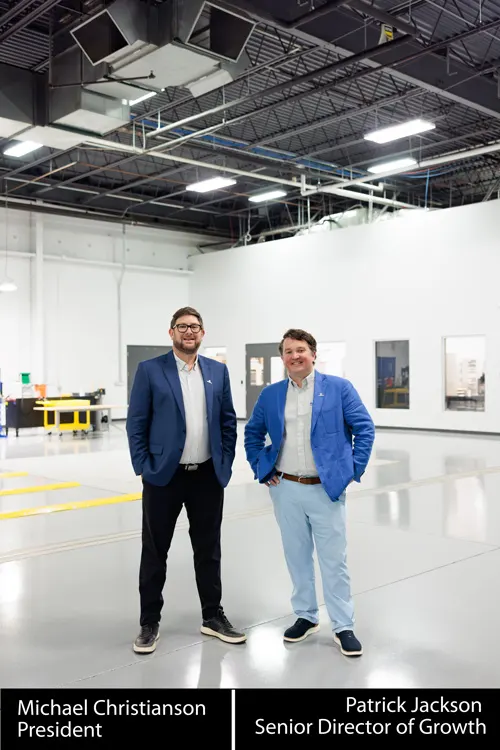
Michael Christianson, President, grew up in the industry. He started at a young age helping his father and learning the business from the warehouse floor up. That early education made him a parts guru—and it also revealed a gift for building a strong team.
Patrick Jackson, Senior Director of Growth, entered the nuclear industry nearly 20 years ago, learning and selling commercial-grade dedication. At Park Nuclear, he focused on innovation and finding the next hill to climb—new capabilities, new customers, and new ways for plants to stay reliable.
They now lead Park Nuclear’s evolution from the leading surplus-parts house into a full nuclear reliability and qualification partner. Their quality-first approach is straightforward: inventory that ships under outage pressure, engineering that stands up to scrutiny, and a culture that treats speed and nuclear QA as the same system not competing priorities. They also push the company to innovate. One Workspace, the intelligent dashboard that surfaces critical plant supply-chain data in one view, is a direct result of that encouragement.
Under their leadership, the company has expanded the Oak Ridge Engineering, Qualification & CGD Center, won back-to-back USA Supplier of the Year awards, and received recognition as 2026 Nuclear Power Plant Parts Supplier of the Year. Their message to the fleet is simple: let’s work together to find a solution to your toughest parts challenges.
Search Magazine
Latest Listings