Strategic Hotel Consulting Bridges the Gap between Investor Capital and Operational Reality
The Silicon Review
Hotel development is an exercise in reconciling two disciplines that rarely speak the same language. Investors evaluate projects through yield, exit multiples, and risk-adjusted returns. Operators think in occupancy, guest experience, and brand standards. When those perspectives diverge, the consequences appear years later: a property that performs below its pro forma, a management contract that locks ownership into misaligned incentives, a branded residence component that fails to sell because the rental program was never structured correctly. The cost of that misalignment is measured in millions and is almost always avoidable.
Strategic Hotel Consulting was founded in 2010 to close that gap. Based in Weggis, Switzerland, the firm operates as an independent, international consulting practice specializing in hotel investments. It advises owners, developers, investors, and operators on optimizing project investment, enhancing asset value, and maximizing profitability across hotels, resorts, serviced apartments, branded residences, and mixed-use developments. Its key markets span Europe, Asia, and the Middle East, and its work has covered hospitality projects valued in excess of $3 billion.
The firm's proposition is built on a specific capability that generalist consultancies cannot replicate: the combination of investment analysis with operational experience. Its founder and managing director, Tea Ros, spent years inside Four Seasons, Starwood, and Rosewood before moving into consulting with Jones Lang LaSalle Hotels and TRI Hospitality Consulting. That sequence matters because a feasibility study produced by someone who has never run a hotel will miss the operational constraints that determine whether the numbers are achievable. For developers and investors making capital commitments measured in tens of millions, that distinction between theoretical and executable analysis carries direct financial consequence.
Market Feasibility as the Foundation of Investment Decisions
Strategic Hotel Consulting's development practice begins with market opportunity assessments and financial feasibility studies that establish whether a project should proceed at all. The firm's work for a 185-key development in the Lake Geneva region illustrates the methodology: meticulous market research, financial assessment, concept development, positioning, space programming, and facilities specifications, followed by an operator search that secured an international management agreement. That sequence prevents the common failure mode where a developer commits capital to a concept before validating whether the market can support it. For investors, the feasibility study becomes the basis for underwriting decisions. For the firm, it establishes the analytical foundation on which every subsequent recommendation rests.
Management Contract Negotiation as Value Protection
One of the firm's most commercially significant services involves reviewing and critiquing hotel management contracts and negotiating terms on behalf of owners. Management agreements determine how revenue is split, how costs are allocated, how performance is measured, and what remedies exist when an operator underperforms. A contract weighted toward the operator can extract value from an asset for decades regardless of how well the property performs. Strategic Hotel Consulting's advisory work on a branded mountain resort in Leukerbad involved analyzing international benchmarks for management fees, revenue and cost splits, facilities management, FF&E, usage rights, and CAPEX. That analysis directly influences the owner's long-term return by ensuring the contract terms reflect market standards rather than operator-favorable defaults.
Operator Selection as a Revenue Determinant
The firm's operator search practice addresses a decision that shapes a property's trajectory for its entire operating life. For a lifestyle hotel and residences project in Davos, the firm's operator selection process generated eight offers and focused on upscale lifestyle brands, with negotiations conducted across international operators and boutique brands. The choice of operator determines brand positioning, distribution access, loyalty program contribution, and management capability. A misaligned operator-brand pairing can suppress rate potential and occupancy for years. Strategic Hotel Consulting's role is to match the asset's positioning with an operator whose brand architecture and commercial engine can deliver the returns the investment thesis requires.
Asset Management and Repositioning for Existing Hotels
Beyond development, the firm advises existing hotel owners on strategic reviews, operational assessments, asset management, restructuring, repositioning analysis, and benchmarking. An iconic city hotel portfolio in Lausanne engaged the firm to assess the viability of hotel apartments across four properties, determining the optimal room-to-residence mix for each asset. That assignment culminated in portfolio-wide strategic recommendations and a detailed conversion strategy for one property, covering positioning, configuration, and commercial implications. For owners holding stabilized assets, this work identifies where value can be extracted through reconfiguration rather than acquisition, which often produces higher risk-adjusted returns than new development.
Tea Ros, Founder and Managing Director
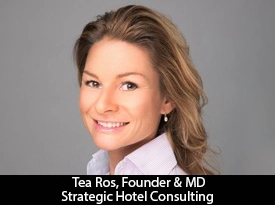
Tea Ros founded Strategic Hotel consulting in 2010 and serves as Managing Director. She brings more than 20 years of global consulting experience across Europe, Asia, the Middle East, and North America, and has advised on hospitality projects worth in excess of $3 billion. She is Chair Emeritus and a member of the International Society of Hospitality Consultants, serves on advisory boards including ENVI Lodges, and was ranked #13 on Hotelier Middle East's Power List of the most influential women in hospitality. Her operational background spans F&B, rooms division, revenue and yield management, sales and marketing, and Six Sigma process improvement at Four Seasons, Starwood, and Rosewood.
The Growth Logic of Independent Investment Advisory
Strategic Hotel Consulting's standing reflects sustained demand for independent analysis in a market where most consultants carry affiliations that compromise objectivity. With a track record spanning feasibility studies, operator searches, contract negotiations, asset management, and repositioning across Europe, Asia, and the Middle East, the firm has established itself among the hospitality sales solution providers worth watching in 2026. The commercial logic is direct: hotel investments fail when the analysis behind them is either too theoretical or too aligned with an operator's interests, and independent advisory is the mechanism that prevents both.
Tea Ros, Founder and Managing Director
"A feasibility study is only useful if the person who wrote it understands how a hotel actually operates. Numbers that look achievable on paper can be impossible in practice, and the difference between those two outcomes is measured in millions."
Search Magazine
Latest Listings












