Fastest Growing Companies of the Year 2026
Trackonomy: Building the Operating System for the Connected World
The Silicon Review
In an era where organizations can instantly analyze digital information but still struggle to understand what’s happening in the physical world, Trackonomy is changing the equation.
Founded in 2017, the Silicon Valley company has emerged as one of the world’s fastest-growing innovators in intelligent supply chain technology by making it practical—and affordable—to connect virtually any physical asset to real-time data. The company is recognized as the pioneer in smart labels by entities such as the World Economic Forum having received the Pioneer Award.
Unlike traditional IoT companies that focus on individual tracking devices, Trackonomy has built a fully integrated ecosystem spanning semiconductors, smart labels, sensors, software, robotics, artificial intelligence, and workflow automation. Its vision is ambitious: to become the operating system for the connected physical world.
Today, that vision is already taking shape. The company’s platform orchestrates approximately 20 million
shipments every day, is expanding across healthcare, aviation, manufacturing, government, and logistics, and is helping some of the world’s largest enterprises make faster, smarter operational decisions.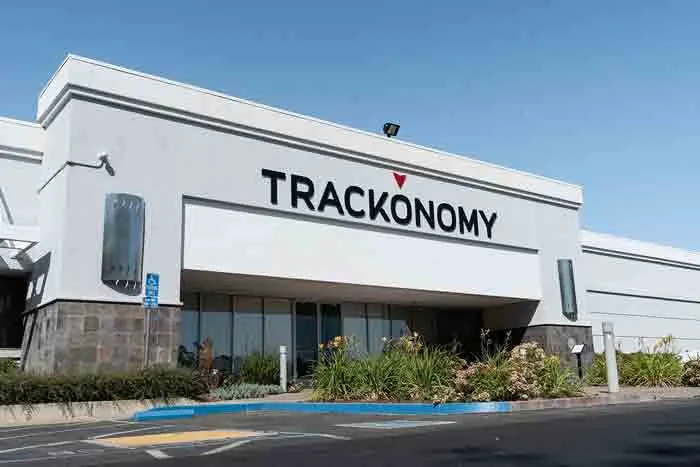
Rethinking IoT from First Principles
According to Founder and CEO Dr. Erik Volkerink, the company’s success came from questioning assumptions that had constrained the IoT industry for decades.
Traditional tracking solutions depended on expensive reusable hardware, charging infrastructure, reverse logistics, and recurring software subscriptions. Those hidden costs limited deployment at enterprise scale.
Trackonomy approached the problem differently. In their solutions business SmartTape™ technology transforms a simple adhesive label into an intelligent sensing platform capable of reporting GPS location, temperature, humidity, shock, and other critical environmental conditions in real time. Because the device is designed for single-use applications, organizations eliminate battery management, device recovery, and reverse logistics—dramatically lowering the total cost of ownership while simplifying deployment worldwide.
The result is a fundamentally different economic model that allows connected intelligence to be deployed at a scale previously considered impractical.
More Than Tracking—A Platform That Orchestrates Decisions
Trackonomy believes that visibility alone is no longer enough.
The company’s Sentient AI Platform connects intelligent edge devices with workflow orchestration and AI-powered decision-making, allowing organizations not only to see what is happening, but to automatically respond when operations deviate from plan. The platform integrates third-party hardware as well making Trackonomy also a big buyer of hardware solutions.
Whether improving on-time delivery, increasing asset utilization, protecting temperature-sensitive pharmaceuticals, or optimizing industrial operations, the platform continuously transforms physical events into business actions.
Proven at Global Scale
Few technology companies have validated their solutions under conditions as demanding as those Trackonomy has faced.
During the COVID-19 pandemic, the company partnered with UPS to help monitor more than 600 million vaccine shipments, providing real-time visibility into location, temperature, humidity, and handling throughout one of the largest and most critical cold-chain operations ever undertaken. That success helped establish Trackonomy as a trusted technology partner for mission-critical logistics and expanded its relationship across UPS Healthcare and broader UPS operations.
Today, Trackonomy technology supports large-scale deployments across logistics, healthcare, aviation, manufacturing, and government, with customers including UPS, Delta Air Lines, Jettainer, Georgia-Pacific, Koch Industries, and numerous public sector organizations as well as the U.S. Government.
Innovation Through Enterprise Complexity
Rather than targeting simple deployments, Trackonomy intentionally works with organizations operating some of the world’s most complex supply chains.
Supporting global transportation networks, healthcare systems, and industrial operations requires engineering solutions capable of operating reliably across hundreds of thousands of assets, thousands of facilities, and highly regulated environments.
Those challenges have driven the development of more than 100 patents covering sensor miniaturization, semiconductor technology, intelligent software, and automation. At the same time, the enormous volume of operational data flowing through the platform continuously strengthens its AI models, creating a competitive advantage that becomes more valuable with every deployment.
Building the Future of Smart Labels
Trackonomy’s recent acquisition of InPlay Technologies further extends its leadership by bringing ultra-low-power Bluetooth semiconductor technology in-house. The chips are sold to many manufacturers and integrators and InPlay operates as a separate, standalone subsidiary Combined with Trackonomy’s own manufacturing capabilities and vertically integrated platform, the acquisition enables improved semiconductor chips for the broader connectivity ecosystem accelerating the industry’s transition toward intelligent packaging and connected assets.
Connecting the Physical World
As digital transformation increasingly depends on understanding the physical movement of goods, equipment, and infrastructure, Trackonomy is positioning itself at the center of a new generation of enterprise operations.
Its mission extends beyond tracking objects. The company is building an intelligent platform where every package, pallet, medical device, aircraft container, or industrial asset becomes a source of real-time intelligence—enabling organizations to operate with greater efficiency, resilience, and automation than ever before.
For enterprises seeking to bridge the gap between the physical and digital worlds, Trackonomy is helping define what connected operations look like in the AI era.
Search Magazine
Latest Listings