Fastest Growing Companies of the Year 2026
Zoney Digital Signage: Challenging the Limits of Traditional Screen Management
The Silicon Review
The digital signage industry has undergone a remarkable transformation over the last decade as businesses increasingly replace static displays with intelligent digital screens capable of delivering real-time communication, personalized customer experiences, and data-driven engagement. From retail stores and restaurants to hospitals, fitness centers, hotels, grocery chains, and corporate offices, digital displays have evolved into strategic business assets rather than simple advertising tools. Yet despite the rapid growth of the market, many organizations continue to encounter the same barriers that have existed for years: expensive subscription models, fragmented software ecosystems, complicated deployment processes, and hardware limitations that make expansion increasingly costly. Against this backdrop, Zoney Digital Signage has positioned itself as a company determined to rethink the industry’s traditional business model. Founded in 2019, the cloud-based technology company has built its platform around a straightforward premise that digital signage should be easy to launch, simpler to manage, and more affordable to scale. Rather than asking businesses to combine multiple software applications, manage local device storage, and absorb recurring subscription costs, Zoney has developed an integrated ecosystem that combines software, hardware, cloud infrastructure, artificial intelligence, remote management, and content services into a single platform.
Today, with more than 2,500 completed projects, 500-plus customers, and deployments spanning industries as diverse as retail, healthcare, hospitality, restaurants, corporate communications, grocery, and fitness, Zoney is demonstrating that innovation in enterprise software does not always require reinventing the technology itself. Sometimes, the greater opportunity lies in simplifying how businesses experience it.
Solving an Industry Problem That Had Become the Industry Standard
Many technology sectors gradually accumulate complexity as new features are added over time, and digital signage has proven no exception. Businesses frequently find themselves purchasing separate software for content creation, another platform for scheduling, additional applications for social media integration, dedicated monitoring systems, and hardware that stores media locally, creating ongoing maintenance challenges.
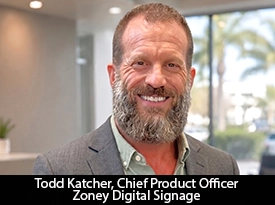
For Todd Katcher, Chief Product Officer, this growing complexity represented less of a competitive necessity and more of an opportunity for disruption. The founding vision behind Zoney emerged from recognizing that digital signage had become unnecessarily difficult for organizations that simply want to communicate more effectively through screens.
Instead of relying on locally stored media that must be manually updated across multiple devices, Zoney introduced a cloud-first architecture that centralizes every aspect of content management. Organizations can upload, organize, schedule, distribute, and modify content remotely without being constrained by the storage limitations of individual media players. This centralized approach allows businesses managing dozens or even hundreds of locations to operate from a single dashboard while maintaining location-specific flexibility whenever needed.
The result is a significantly lower operational burden for organizations that increasingly view digital displays as part of their daily communication strategy rather than standalone marketing assets.
Building a Complete Digital Signage Ecosystem
What differentiates many successful enterprise software companies is not simply the number of features they offer, but the extent to which those features work together seamlessly. Zoney has embraced this philosophy by building an end-to-end digital signage ecosystem rather than an isolated software product.
Zoney’s platform combines cloud-based digital signage software with commercial-grade media players, customizable templates, AI-assisted content creation, remote monitoring capabilities, onboarding services, and optional professional content creation. More than 150 applications and integrations further extend the platform’s functionality, enabling businesses to incorporate live dashboards, weather updates, news feeds, Google Reviews, Canva designs, social media content, RSS feeds, calendars, Dropbox files, Google Workspace assets, and other operational data into their displays.
This broad integration strategy reflects a growing reality within enterprise technology. Businesses increasingly expect software platforms to fit naturally into existing workflows rather than forcing employees to adopt entirely new operational processes. By connecting with familiar business applications, Zoney transforms digital signage from a static presentation system into an extension of an organization’s daily operations.
The platform’s versatility also allows businesses to use screens for promotional campaigns, restaurant menu boards, employee communications, customer information, entertainment, performance dashboards, event schedules, internal announcements, and operational messaging without requiring separate systems for each application.
Challenging the Economics of Software Subscriptions
Zoney’s competitive edge isn’t just in its technology—it’s in its pricing philosophy. Software-as-a-Service subscriptions have become the dominant revenue model across enterprise technology, particularly within digital signage. While recurring subscriptions create predictable revenue streams for software providers, they often introduce escalating costs for customers as additional screens, users, or locations are added. Zoney chose a different approach through its Zoney+ plan, offering lifetime platform access for a one-time fee of $695 instead of ongoing monthly subscription charges.
This pricing model fundamentally alters the financial equation for businesses planning long-term digital signage deployments. Instead of calculating perpetual monthly expenses for every display across multiple locations, organizations can make a single investment and expand their network without facing continuously increasing software costs.
For Zoney, this strategy serves as a competitive differentiator in an increasingly crowded market where pricing has become as important as product functionality. Rather than competing solely on technical specifications, the company is challenging the industry’s more common subscription model.
Growth Fueled by Simplicity Rather Than Complexity
Enterprise technology often falls into the trap of equating sophistication with complexity. Yet customer adoption frequently follows the opposite pattern. Zoney attributes much of its rapid growth to removing the friction that discourages businesses from adopting digital signage in the first place. Organizations rarely reject digital displays because they doubt their value. Instead, they hesitate because implementation appears technically intimidating, financially burdensome, or operationally complicated.
By simplifying deployment while maintaining enterprise-grade functionality, Zoney has lowered the entry barrier for organizations ranging from single-location businesses to large multi-site enterprises. This emphasis on usability extends beyond software design into customer support, onboarding, hardware reliability, and ongoing platform management. Businesses can begin with a single screen and gradually expand into larger networks without replacing infrastructure or fundamentally changing workflows. Such scalability creates a natural growth path that aligns with how businesses actually invest in technology rather than forcing them into large, upfront enterprise deployments.
Hardware That Expands Rather Than Limits Creativity
In digital signage, software capabilities ultimately depend on the hardware responsible for rendering content. Many low-cost media players restrict businesses to basic layouts, limited multimedia support, or static presentations that fail to maximize screen potential. Zoney addresses this limitation through commercial-grade media players engineered to support advanced multi-zone layouts, high-quality video playback, dynamic content, live information feeds, announcements, menus, social media integrations, and other rich multimedia experiences simultaneously. This technical flexibility becomes increasingly valuable as organizations mature in their digital communication strategies. Instead of outgrowing their hardware, customers can continuously develop more sophisticated display experiences while remaining within the same ecosystem.
Such long-term adaptability naturally contributes to customer retention. Businesses rarely replace platforms that continue evolving alongside their operational requirements, particularly when the transition costs associated with migration are minimal. The quality of finished displays also becomes a referral mechanism in itself, as visually engaging installations often prompt inquiries from customers, partners, and neighboring businesses.
Creating a Platform That Becomes Part of Daily Operations
One of the strongest indicators of software success is not simply adoption but integration into everyday workflows. Zoney’s expanding ecosystem of over 150 apps and integrations reflects an understanding that businesses produce enormous amounts of valuable content every day across multiple digital platforms. Instead of recreating information specifically for signage, organizations can choose from an ever-growing collection of apps and widgets to display.
Marketing teams can showcase social media updates and customer reviews. Human resources departments can display internal announcements and employee recognition. Restaurant operators can update menu boards. Healthcare organizations can display appointment information and patient communications. Retailers can synchronize promotions across multiple stores. Corporate offices can publish dashboards and performance metrics in real-time. AI tools further accelerate content production by helping businesses create display-ready messaging more efficiently, reducing the time traditionally required for content development.
Enterprise Scalability Without Sacrificing Local Flexibility
Multi-location organizations face a familiar challenge in enterprise communications. Corporate leadership requires consistent branding and centralized governance, while local managers need flexibility to address regional promotions, events, and customer needs.
Zoney’s cloud architecture attempts to reconcile these competing priorities through centralized administration combined with localized content management. Corporate teams can distribute standardized messaging across every location while granting authorized local personnel the ability to customize displays for individual markets, departments, or facilities. This balance proves especially valuable for franchises, healthcare systems, fitness chains, retail networks, hospitality brands, and other organizations operating across geographically dispersed locations. Because customers can expand gradually from individual displays to enterprise-wide deployments without changing platforms, Zoney creates an adoption pathway that supports long-term account growth while minimizing implementation risk.
A “No Limits” Culture Driving Continuous Innovation
Technology companies often emphasize innovation, but sustainable innovation typically begins with organizational culture rather than engineering alone. Zoney’s internal philosophy, described as “No Limits,” centers on the belief that technology should adapt to customer requirements instead of forcing customers to conform to predefined limitations. This mindset influences product development, hardware compatibility, software integrations, and customer support. Rather than dismissing unusual client requests as outside of the product scope, the company approaches new requirements as opportunities to expand platform capabilities.
With a team of more than 30 professionals supported by over a decade of collective innovation experience in the digital signage industry, Zoney has steadily broadened its platform beyond conventional display management into a flexible communication ecosystem capable of serving numerous industries and use cases. Customer feedback plays a central role in this evolution, enabling new functionality to emerge directly from real-world operational challenges rather than theoretical product roadmaps.
Looking Beyond Digital Displays
As artificial intelligence, automation, predictive analytics, and connected enterprise platforms continue reshaping business technology, digital signage itself is evolving from passive display infrastructure into intelligent communication systems. Zoney’s future roadmap reflects this broader transformation. The company plans continued investment in AI-assisted content generation, expanded integrations, advanced analytics, enterprise controls, remote device management, and increasingly personalized messaging driven by audience, location, scheduling, and real-time operational data. These capabilities point toward a future in which digital displays function less as electronic billboards and more as responsive communication networks that automatically adapt to changing business conditions.
For organizations seeking greater efficiency in customer engagement and internal communications, this evolution could significantly reduce the manual effort traditionally associated with content management while increasing message relevance across every screen.
The Bottom Line
The digital signage market has no shortage of software providers, yet relatively few challenge the assumptions that have shaped the industry’s economics and user experience for years. Zoney Digital Signage has built its strategy around precisely that opportunity. By combining cloud-native architecture, enterprise scalability, advanced hardware, AI-powered content tools, extensive integrations, and an unconventional one-time pricing model, the company is addressing the operational and financial barriers that have historically limited digital signage adoption.
Zoney’s growth across multiple industries suggests that businesses increasingly value simplicity as much as sophistication, particularly when technology must scale across numerous locations and users. As organizations continue to search for more connected, intelligent, and cost-effective ways to communicate, Zoney’s approach positions it as more than just another digital signage vendor. It represents a company attempting to redefine how enterprise communication platforms are delivered, managed, and valued in an increasingly connected business landscape.
Meet the leader behind the success of Zoney Digital Signage
Todd Katcher is the Chief Product Officer of Zoney with more than a decade of experience developing digital signage technology. Known for his hands-on approach to product innovation, Todd focuses on identifying real-world challenges and building practical solutions. Todd believes technology should solve problems, not create frustration through poor design and confusing interfaces. His “No Limits” mindset continues to guide Zoney’s product development, customer experience, and long-term vision.
for more contact: info@zoney.com
Zoney Digital Signage’s Socials: