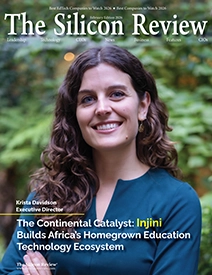
The Continental Catalyst: Injini Builds Africa’s Homegrown Education Technology Ecosystem
The Silicon Review

In a continent where youth demographic growth outpaces any other, the challenge of education is not merely about building more schools; it is about fundamentally reimagining how learning is delivered at scale. Sub-Saharan Africa faces the world’s highest rate of education exclusion, a complex crisis of overcrowded classrooms, teacher shortages, and infrastructure gaps. While global EdTech solutions exist, they often fail to account for Africa’s unique contextual realities: connectivity constraints, linguistic diversity, and local curriculum demands. A nascent wave of African entrepreneurs is rising to meet this challenge with contextual innovations, yet they frequently lack the specialized support, evidence base, and network to scale.
Injini was founded in 2017 as a direct response to this ecosystem gap. Operating from Cape Town as a registered non-profit, Injini positions itself not as a simple startup accelerator, but as the continent’s only EdTech-specialized organization dedicated to holistic ecosystem building. Its mission is to unlock Africa’s development by identifying, nurturing, and scaling the most promising education technology innovations born on the continent itself. The organization believes that sustainable solutions for Africa’s education crisis will be developed by Africans, for Africans, with technology as the lever.
The organization’s operational model is a three-pillar structure: EdTech Acceleration, Ecosystem Development, and Research & Advisory. Its revenue is generated not through equity or direct sales, but by attracting grant funding and partnership income from major foundations, government bodies, and development organizations convinced by its focused mission. Strategic partnerships with entities like the Mastercard Foundation, the Michael & Susan Dell Foundation, and the Western Cape Government provide the core funding for its fellowship programs and research initiatives. Injini’s financial sustainability is thus tied to its demonstrable impact and its unique position as the central node in the African EdTech network.
Forging the Founders: The Mastercard Foundation EdTech Fellowship
At the heart of Injini’s work is its flagship six-month, equity-free acceleration program, the Mastercard Foundation EdTech Fellowship. This initiative meticulously selects high-impact African startups and provides them with far more than capital. The program delivers specialized support in pedagogy, impact measurement, inclusive design, and investment readiness. A critical strategic emphasis is placed on solutions that reach marginalized groups, including young women, people with disabilities, and rural youth. By focusing on both commercial viability and deep, equitable impact, the fellowship cultivates companies that are attractive to both impact investors and government procurement programs. This focus on high-potential, socially-driven ventures is what attracts Injini’s cornerstone grant funding, allowing it to offer transformative support without taking founder equity.
Connecting the Continent: The Ecosystem Development Imperative
Injini recognizes that startups cannot thrive in isolation. Its Ecosystem Development pillar is designed to orchestrate the entire African education innovation landscape. This involves hosting pivotal events like South African EdTech Week, running bootcamps and hackathons, and facilitating online courses that bring together entrepreneurs, policymakers, investors, and academics. By creating these vital forums for collaboration and knowledge exchange, Injini increases the collective intelligence of the sector and de-risks investment for funders. This convener role establishes Injini as an indispensable authority, which in turn attracts further partnership and sponsorship revenue from organizations seeking legitimate access to the continent’s most promising EdTech pipeline and thought leadership.
Grounding Growth in Evidence: The Injini Think Tank
What truly distinguishes Injini is its commitment to grounding innovation in localized evidence. Through its Research & Advisory arm, the Injini Think Tank produces critical market analyses, impact reports, and practical toolkits such as its EdTech Procurement Process Toolkit that are tailored to the African context. This research serves a dual purpose. For entrepreneurs, it provides the data and insights needed to build stronger, more relevant products. For funders and governments, it offers the rigorous analysis required to direct capital and policy effectively. This evidence-generation capability elevates Injini from a program manager to a strategic advisor, enabling it to command consulting fees and commissioned research contracts, thereby diversifying its income streams beyond foundational grants.
Injini’s model represents a sophisticated blueprint for sector-building in an emerging market. It operates on the understanding that transformative change requires more than funding startups; it requires building the entire supporting infrastructure of knowledge, networks, and legitimacy around them. By simultaneously accelerating founders, connecting stakeholders, and generating locally relevant evidence, Injini is systematically lowering the barriers to impact for African EdTech. Its success is measured not in its own profit, but in the amplified success of the 79 startups it has supported, the 2.8 million learners they reach, and the steadily strengthening conviction that Africa’s educational future will be built on its own innovation.
Krista Davidson, Executive Director