>>
Technology>>
Security>>
Top 4 Providers for Stablecoin...Top 4 Providers for Stablecoin Quantum Risk Assessment Services & Security Audits

The Silicon Review
19 February, 2026
Author:
The Silicon Review Team
Imagine waking up to find the dollar-pegged coins you rely on—your payroll, trading float, or savings—have doubled in supply overnight. No hack alert sounded; a future quantum computer simply cracked the elliptic-curve admin key, minted billions of unbacked tokens, and vanished.
Cryptographers put the odds of such a breach at roughly 20 percent before 2030. With more than $230 billion in stablecoins moving each day, the math that secures Tether, USDC, and DAI could become an open book the moment Shor's algorithm scales.
Regulators already urge “post-quantum” defenses, and security firms now offer quantum risk assessments so issuers can rotate keys and harden contracts ahead of the curve.
We reviewed the crowded vendor landscape and narrowed it to four partners who can keep a stablecoin safe today—and quantum-ready tomorrow. In the next sections you’ll see how we scored them, what each offers, and which option fits your roadmap.
How we picked the winners
Before we talk providers, you should see our playbook.
We began with a long list of auditors, custodians, and post-quantum startups that market “blockchain security.” From that pool we shortlisted eight names with real traction on stablecoin projects or published quantum research.
Each contender was then graded against seven requirements: cryptographic depth, quantum-specific tooling, track record, solution scope, compliance alignment, ease of integration, and transparency on process and price. Those pillars mirror the questions a stablecoin issuer raises during due-diligence calls, so the matrix stays rooted in day-to-day buyer needs.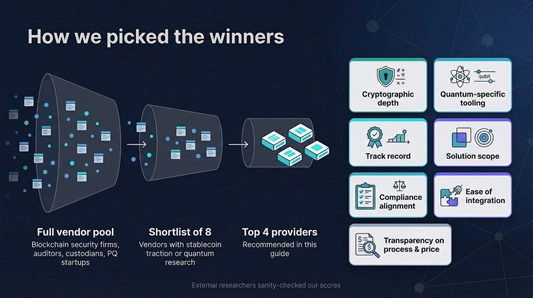
Numbers alone cannot decide everything. We read public audit reports, investor decks, GitHub commits, and press releases. We checked for NIST or ISO working-group participation and verified whether client wins align with regulated markets. Finally, two external researchers who vet crypto security vendors sanity-checked our scores.
Four providers rose above the rest. Each excels in a different area, giving you clear options whether you want a surgical code review, an enterprise-wide sweep, or a plug-in dual-signature layer.
Time to meet the first pick.
1. Project Eleven – post-quantum pioneers
Project Eleven launched in 2023 with one goal: move digital assets off today’s breakable math and onto quantum-safe rails.
Project Eleven post-quantum stablecoin security website screenshot.
The team combines ex-Layer-1 core developers with PhD cryptographers.
Their 2025 research paper, Quantum Vulnerabilities of Stablecoins, points out that the moment an admin address signs its first transaction, the full public key lands on-chain—handing a future quantum computer everything it needs to recover the private key and mint unlimited unbacked tokens.
That step-by-step breakdown of the attack surface is exactly why Project Eleven traces every line of code, key, and governance process against a timeline of quantum capability, so you see not just what fails but when. Instead of generic audits, they trace every line of code, key, and governance process against a timeline of quantum capability, so you see not just what fails but when.
They have proof. In late 2025 they deployed a Solana testnet that used NIST-selected lattice signatures. Validators, wallets, and a demo stablecoin processed blocks with only a small performance hit, showing that full-stack quantum safety is possible well before Ethereum or Bitcoin switch curves. Project 11’s own benchmarks for its open-source ML-DSA-B signature suite report up to 20 percent faster signing and 30 percent faster verification compared with unoptimized Dilithium, so the performance gap continues to close as the tooling matures.
For clients, the engagement is consultative. We sit together, list each cryptographic primitive in play, then walk through a migration plan that covers testnet trials, key-rotation ceremonies, and user rollouts. Deliverables include a “Q-day countdown” dashboard that tracks how long each component stays safe at projected qubit growth.
Project Eleven also speaks the language of compliance. Reports map findings to NIST guidance and pending stablecoin rules, so risk officers can paste them straight into registers. That mix of deep math and executive clarity is why we ranked them first.
If you want to lead the quantum transition instead of scrambling later, Project Eleven is the partner we’d call.
2. Trail of Bits – elite code surgeons
Trail of Bits approaches security the way a neurosurgeon approaches an operating table: steady hands, zero shortcuts, and an eye for hidden nerves.
Trail of Bits blockchain security audit website screenshot.
For more than a decade they have dissected everything from Ethereum clients to zero-knowledge proof systems. When a stablecoin team hires them, the engagement begins with a white-glove walkthrough of the codebase: every modifier, every library, every cryptographic primitive. If one function locks you into an elliptic-curve sunset, they mark it in red and explain why quantum attackers would target it first.
Depth is their signature. Senior engineers pair automated tools such as Slither and Manticore with painstaking manual review, then add formal verification for the parts that move serious money. The final report reads like a future-proofing blueprint: swap this signature scheme, shorten that upgrade window, move multisig keys into hardware enclaves today so a PQC rotation tomorrow is painless.
Trail of Bits also speaks the language of compliance. Findings map to ISO and NIST controls, letting risk officers drop evidence straight into audit portals. That matters when regulators start asking, “Show us your quantum plan.”
You will not get a packaged product. Trail of Bits uncovers every weakness and recommends fixes, but your engineers still own the refactor. For teams with strong developer bandwidth, and a mandate to leave no stone unturned, their rigor is worth every line item.
In short, Trail of Bits is the choice when you need confidence that the code running your peg will stand up today and in a post-quantum tomorrow.
3. Halborn – enterprise 360° security
Halborn looks beyond contract bugs. The team audits the full organism that keeps a stablecoin running: cloud instances, CI pipelines, employee laptops, and the Solidity that mints and burns tokens.
Halborn enterprise blockchain security website screenshot.
Their track record proves that scope. In 2023 Halborn flagged the “Rab13s” vulnerability in peer-to-peer libraries across more than 200 blockchains. The case showed two things: they spot issues others miss, and they coordinate disclosures without creating chaos.
That breadth pays off in the quantum context. A quantum thief may harvest off-chain backups today and decrypt them later. Halborn traces those data paths, checks encryption strength, and builds runbooks for rapid key rotation once post-quantum algorithms reach production wallets.
Engagements feel like a security boot camp. Day one starts with an adversarial workshop where both sides map worst-case scenarios. The following weeks combine code review, social-engineering drills, and infrastructure scans. Reports arrive in plain English, cross-referenced to NIST and forthcoming stablecoin rules, so compliance teams can act without translation.
Halborn also offers a retainer. Your developers gain a dedicated Slack channel to senior researchers, quarterly reassessments, and proactive alerts on emerging exploits. That cadence matters because the quantum threat curve is steep; you want experts ready when IBM or Google announces another qubit milestone.
Choose Halborn if your stablecoin operates like a regulated financial institution. They cover gaps, drill your team on incident response, and show regulators that you treat quantum risk as a board-level issue, not a DevOps chore.
4. BTQ – plug-in quantum safety
Some teams need protection now, not after a multi-year refactor. BTQ provides that option.

BTQ Quantum Stablecoin Settlement Network website screenshot.
Its Quantum Stablecoin Settlement Network wraps every transfer in two signatures: the familiar ECDSA plus Falcon-512, a lattice scheme already selected by NIST. A transaction clears only when both signatures verify, so a quantum thief must break two unrelated math problems at once. The user experience stays the same while security improves.
BTQ pairs the network with a hardware module called CASH that generates, stores, and rotates the new keys. Integration is light: a smart-contract upgrade on chain and a secure API call off chain. Early pilots moved USDC, USDT, and JPM Coin without breaking wallet compatibility or liquidity flows.
The company is young and still gathering third-party audits, and that risk matters. Yet early movers gain first-mover proof, and global banks are already testing the system. If you need quantum resilience this quarter, BTQ’s plug-and-play route is the quickest road there.
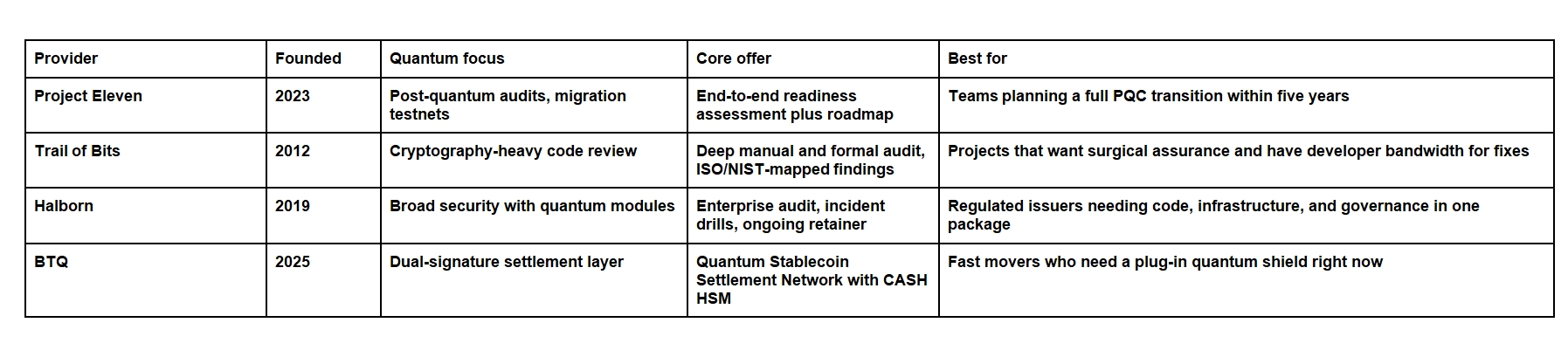
At-a-glance comparison
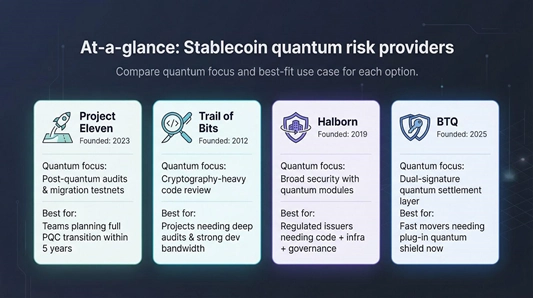
FAQ: your quantum-safe game plan
What exactly is a “quantum risk assessment”?
Think of it as a time-lapse audit. We catalogue every private key, smart contract, and off-chain channel you use, then forecast when each will slip below safe entropy as quantum computers mature. The deliverable is a migration calendar that says, “Swap this signature in 2027, rotate that key by 2029.”
How soon do stablecoins need to act?
Today. Attackers can harvest encrypted traffic now and decrypt it later. Waiting for a headline breakthrough leaves no runway for testing, user comms, or regulatory sign-off. Starting early lets you phase upgrades without service disruption.
Will post-quantum algorithms slow my token down?
Yes, but the hit is modest. Early testnets show a 10 to 15 percent dip in throughput, roughly the gap between rush-hour and off-peak traffic. Smart batching, dual-signature schemes, and hardware acceleration narrow the gap further.
Do we have to rewrite everything?
No. Most teams tackle the highest-risk keys first, such as admin multisigs, custodial wallets, and oracle channels, while leaving user wallets on legacy curves until the base chain supports PQC. Providers like BTQ can layer quantum safety on top of existing chains, buying you time for deeper refactors.
How much will this cost?
Budgets mirror scope. A focused key-management review lands around $150,000 to $250,000. A full-stack audit plus migration toolkit ranges from $400,000 to $700,000. Hardware-backed solutions price as subscriptions or per-transaction fees. Stack those numbers against the $230 billion in circulating stablecoin value and the math sells itself.
Conclusion
Still have questions? Reach out to the providers above—or drop us a note. We’ll keep the coffee hot and the jargon cold.