The Socratic Algorithm: Kyron Learning's AI Tutors Foster Mastery Over Memorization
The Silicon Review
In the crowded arena of AI-assisted education, a fundamental conflict persists between automation and pedagogy. Most platforms prioritize rapid information delivery, offering students quick answers from vast databases. This approach, while efficient, often bypasses the critical cognitive work of learning: the struggle to reason, connect concepts, and construct understanding. Kyron Learning was founded on the conviction that artificial intelligence, when properly designed, should be a catalyst for thinking, not a shortcut around it. The company’s platform rejects the standard chatbot model in favor of "AI-Powered Instruction," using conversational AI to guide students through a structured, Socratic dialogue. This transforms passive content consumption into an active, constructive learning experience grounded in cognitive science.
The company's commercial model is built on serving higher education institutions and corporate learning departments seeking to improve student engagement, retention, and completion rates. Revenue is generated through enterprise licensing agreements, with value anchored in solving the costly problem of student attrition. Kyron’s business grows as it demonstrably improves pass rates and provides scalable instructional support without proportionally increasing faculty workload.
The Pedagogical Engine: Where AI Meets Instructional Design
Kyron’s core innovation is its deliberate fusion of advanced AI with rigorous learning science. The platform is engineered not as a general-purpose language model but as a specialized instructional partner. Every interaction is designed to keep the learner within their "Zone of Proximal Development" the space between what they can do independently and what they can achieve with guided support. The AI analyzes student input for conceptual gaps and tailors its next prompt to challenge those specific areas, whether offering a simpler hint, asking for an elaboration, or presenting a analogous problem. This dynamic, responsive dialogue is what the company monetizes, selling not just software, but a measurable improvement in the quality and outcome of instructional time.
The Trust Architecture: Guardrails for Academic Integrity
A primary barrier to AI adoption in formal education is concern over accuracy, safety, and academic integrity. Kyron directly addresses this by building what it calls an "AI You Can Trust" framework. This involves multiple layers of operational guardrails. The AI is constrained to operate within educator-defined learning objectives and approved content, preventing off-topic or unvetted digressions. Continuous monitoring benchmarks the system for performance drift and learning alignment. Crucially, the platform is designed to be educator-driven; instructors create or approve all lesson content and conversational pathways, ensuring the AI amplifies their teaching rather than replacing their judgment. This focus on trust and control is a key competitive differentiator that enables sales into risk-averse institutional environments, directly influencing contract value and adoption speed.
The Data-Driven Intervention Model
Beyond direct student instruction, Kyron generates significant value for educators through its analytics dashboard. The platform surfaces rich, real-time data on student learning journeys, highlighting points of widespread confusion, engagement drops, and individual misconceptions. This allows instructors to move from reactive grading to proactive intervention, addressing knowledge gaps before high-stakes assessments. For institution leaders, this data provides empirical evidence of program effectiveness and areas for curricular improvement. This dual-layered value serving both the immediate learner and the administering institution strengthens Kyron’s position. The platform becomes not only a teaching tool but an essential component of an institution's learning analytics and student success infrastructure, justifying its ongoing subscription cost as a strategic investment.
The Commercial Pathway: Scaling Quality Instruction
Kyron’s growth strategy hinges on proving that its method delivers superior educational outcomes at scale. Early case studies cite dramatic results, such as a 50% increase in learner retention in courses using Kyron compared to those without. Metrics showing 86% of learners feeling more confident and 87% reporting effective learning facilitation provide tangible evidence for sales conversations. The company targets institutions grappling with the challenges of large-enrollment courses, online degree programs, and supporting underprepared students. By framing its solution as a force multiplier for faculty extending their reach and impact without diluting instructional quality Kyron aligns its commercial success with the core mission of its clients. Its revenue model is thus directly tied to enabling educational institutions to achieve their own success metrics more efficiently and effectively.
For an education sector increasingly skeptical of AI's role, Kyron Learning presents a compelling counter-narrative. It demonstrates that the technology's highest value may not lie in automating answers, but in meticulously automating the guided questioning that leads to true understanding. By prioritizing pedagogical integrity over conversational fluency, the company is carving out a defensible niche at the intersection of learning science and artificial intelligence. Its future will be determined by its continued ability to prove that this approach doesn't just create more engaging software, but fosters more capable, confident, and persistent learners.
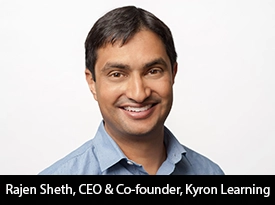
Rajen Sheth, CEO & Co-Founder