>>
Other>>
Sports and fitness>>
From Boxer to Elite Coach: How...From Boxer to Elite Coach: How Edgar Khanoyan Merges Science and Discipline to Transform Athletes into Global Contenders
By Akanksha Harsh
It’s a long way from the sweaty gyms of amateur boxing to the global stage of championship fights. Yet that is exactly the journey taken by Edgar Khanoyan, a Belgian physical conditioning coach whose athletes now compete for world titles. Born in Moscow in 1996, Khanoyan grew up in Belgium and first fell in love with boxing as a teenager. He stepped through the ropes as a fighter himself, learning firsthand the technical and mental demands of the sport. But in 2019, he made a pivotal decision: instead of chasing belts, he would help others win them. Today, as the founder and head coach of EK Performance, he is renowned for merging scientific training methods with unwavering discipline to transform local prospects into international contenders.
Khanoyan’s coaching philosophy grew out of his own desire to understand what separates good athletes from great ones. After retiring from competition, he pursued a bachelor’s degree in sport coaching in 2020 to deepen his knowledge of physiology, biomechanics, and periodization. “Science matters in sport,” he often tells his athletes. By grounding his programs in evidence‑based principles, he aims to optimize every facet of performance while avoiding the overtraining and injuries that derail careers. His plans emphasize long‑term development, injury‑free performance, and precision training. Each athlete’s program is customized around their style, strengths, and fight calendar, balancing power, endurance, speed, and recovery.
This meticulous approach has earned Khanoyan the trust of elite boxers and national team members. Rasul Tisayev and Arigon Avdimetaj, for instance, have worked with him to prepare for international competitions. “I’m not here to run fighters into the ground,” he said. “I’m here to help them peak at the right time and stay healthy for the long haul.”
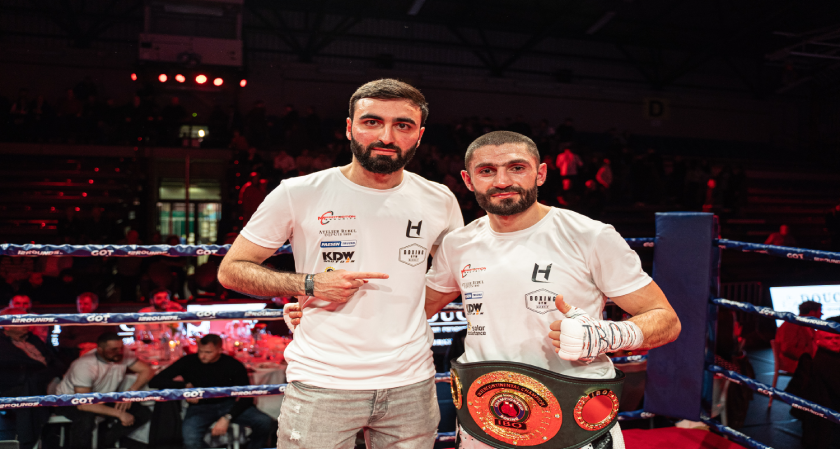
Khanoyan’s first major project was Miko Khatchatryan, a super‑featherweight talent from Belgium. Under his guidance since 2019, Khatchatryan amassed an impressive record, capturing multiple regional belts. They ticked off win after win: technical knockouts over Filip Poturovic and Nadzir Bakhshyien, unanimous decisions against Brayan Mairena and Nukri Gamgebeli, and knockout victories that secured the IBO International and IBF International titles. Even in defeat, Khatchatryan’s conditioning stood out. When he faced Welsh star Joe Cordina for the WBA Continental title in Liverpool in December 2021, he went ten rounds and pushed the future world champion to earn a hard‑fought unanimous decision. The World Boxing Association described Cordina’s win as a “tough test”, noting that Khatchatryan remained competitive thanks to his stamina and resilience.
Another testament to Khanoyan’s method is Hovhannes Martirosyan, a super‑lightweight ranked among the world’s top 50. Khanoyan took over Martirosyan’s physical preparation in 2020 and watched him collect titles across Europe: the Belgian Boxing Federation Welter title, the BeNeLux and WBC Francophone belts, and the IBO International and Inter‑Continental crowns. In March 2024, Martirosyan vacated his IBO belt to challenge Ireland’s Pierce O’Leary for the WBC International title. Although he was stopped in the ninth round, Martirosyan’s explosiveness and conditioning drew praise from UK commentators. Less than a year later, he reclaimed the IBO Inter‑Continental title, knocking down Salimu Jengo twice en route to a third‑round stoppage. The Sportaran report noted that Martirosyan “regained the belt he had held until February 2024,” highlighting his resilience and the effectiveness of his preparation.
What sets Khanoyan apart is his insistence that discipline is the bedrock of progress. He often tells his fighters that talent is nothing without discipline, and progress is nothing without patience. He has witnessed world champions lose everything and rebuild from scratch, and underdogs rise to the top because they refused to quit. These experiences inform his approach: training is purposeful repetition, not glamorous shortcuts. When athletes struggle with fatigue or minor injuries, Khanoyan adjusts their programs to strengthen weak areas and prevent serious damage. The goal is to keep them in the gym consistently, building both physical and mental resilience.
His methods are not static. They evolve with each athlete. For Khatchatryan, he emphasized explosive power and stamina, integrating plyometrics and interval training to ensure the Belgian could maintain pace in championship rounds. For Martirosyan, who fights at a heavier weight, he balanced anaerobic bursts with aerobic endurance to sustain power into the later rounds. Both fighters benefit from a scientific measurement of workloads, heart rates, and recovery times, allowing Khanoyan to tweak training variables with precision. “Every fighter is a different equation,” he said. “My job is to solve it.”

Khanoyan’s track record has not gone unnoticed. Specialists at international tournaments have remarked on the physical strength and endurance of his athletes, noting how rarely they sustain injuries. His explosiveness and endurance method has begun to attract interest beyond Belgium, with coaches and promoters seeking to incorporate elements of his program. This recognition positions him as a thought leader in a sport that is increasingly embracing data and sports science. He is proud that his work demonstrates the value of a precise, disciplined system; after each high‑profile fight, more people ask about the person behind the conditioning.
Despite his success, Khanoyan is candid about the challenges he faces. Preparing athletes for combat sports means navigating injuries, weight cuts, and psychological pressure. “Each fight camp is a major challenge,” he admits. The toughest moments come when athletes feel pain close to fight night; he must adapt their training quickly to avoid career-jeopardizing injuries. These experiences reinforce his belief that the body follows the mind: showing up on days when motivation is low and working with purpose is what builds champions. His advice to aspiring athletes and coaches is to stay consistent, stay humble, and never stop learning. “You don’t need motivation every day,” he said. “You need vision.”
Khanoyan’s ambitions extend beyond his current stable of fighters. He envisions creating a high‑performance center that blends science, discipline, and passion. This facility would bring together athletes, coaches, and researchers from around the world to push their limits and share knowledge. He wants to mentor the next generation of coaches, cultivating a culture where boxing’s art meets the rigor of sports science. Success, he believed, is measured not just in belts but in the impact he makes on athletes’ lives. Whether developing world champions or helping young prospects realize their potential, he remains driven by a desire to educate, inspire, and elevate the culture of athletic preparation.
Edgar Khanoyan’s journey from boxer to elite coach illustrates how science and discipline can transform raw talent into world‑class performance. By grounding his programs in evidence and pairing them with an unwavering commitment to patience and perseverance, he has guided fighters like Miko Khatchatryan and Hovhannes Martirosyan to championship stages. His influence reaches beyond the ring: national team athletes trust his expertise, fellow coaches seek his insights, and fans recognize his role when his athletes display extraordinary endurance and explosiveness. As he looks to the future, Khanoyan’s goal is to build a legacy that endures, one where the science of human performance and the spirit of boxing converge to create the next generation of global contenders.