>>
Industry>>
Healthcare>>
Top HIPAA Compliance Software ...Top HIPAA Compliance Software for Healthcare and Health Tech Companies

The Silicon Review
27 January, 2026
HIPAA compliance software is no longer optional. In 2024, cyber-attacks exposed the medical records of roughly 82 percent of Americans, and each breach now costs U.S. providers about $7.42 million, according to IBM’s 2025 Cost of a Data Breach report. Regulators also shave penalties for organizations that can document 12 months of “recognized security practices,” which turns continuous oversight into real dollars saved.
In this guide, we cut through vendor noise and match the right platform to your environment, whether you run a telehealth startup, a rural dental office, or a 20-hospital system. The goal is simple: make HIPAA feel routine, not ruinous.
How we chose the tools
HIPAA compliance software helps healthcare organizations continuously monitor safeguards and stay audit-ready as breach risks rise
We started with one non-negotiable: Could the platform keep your team audit-ready on an ongoing basis? If the answer was “maybe,” it did not make the cut.
From there, we scored each contender against six pillars the Office for Civil Rights (OCR) returns to again and again during enforcement. According to HHS HIPAA enforcement data, 67 percent of the 46,752 investigations closed since 2003 ended with mandatory corrective action. Missing even one pillar can turn a manageable gap into an expensive remediation cycle.
-
Comprehensive coverage – privacy, security, and breach response live in one workspace.
-
Continuous automation – live control monitoring that spots drift at 2 a.m.
-
Plug-and-play integrations – connects to cloud, EHR, and IAM stacks in hours, not weekends.
-
Vendor oversight – stores BAAs and scores third-party risk.
-
Friction-free training – policies and reminders staff finish on time.
-
Framework breadth – maps HIPAA controls to SOC 2, ISO 27001, and more to avoid duplicate work.
Products that cleared all six tests, and backed their claims with measurable time savings, customer outcomes, or third-party attestations, advanced to our final review. For compliance, security, and IT leaders, this keeps the focus on what matters most: defensible evidence, lower manual effort, and fewer surprises when scrutiny shows up.
Automation-first platforms for tech start-ups
Cloud-native health apps ship code daily. Your HIPAA program has to keep up, especially across cloud, identity, and collaboration tools where small configuration changes can create big exposure. The strongest automation-first platforms plug into the stack you already run, collect evidence continuously, and surface drift fast enough that it becomes a backlog item, not a breach headline.
Modern Health reports it saves more than 100 engineer hours a year and cuts audit evidence collection from months to under a week after switching to an always-on HIPAA compliance automation platform like Vanta.
According to data Vanta publishes for healthcare customers, teams using automation and cross-mapping features spend 82 percent less time on audits overall, with much of the work they do for frameworks like SOC 2 carrying over automatically to HIPAA.
For fast-moving health tech teams, that kind of reuse is often the difference between treating HIPAA as a one-off project and running it as a continuous part of the software development lifecycle.
If your release cadence is faster than your compliance checklist, start here.
Vanta: always-on compliance for teams that ship fast
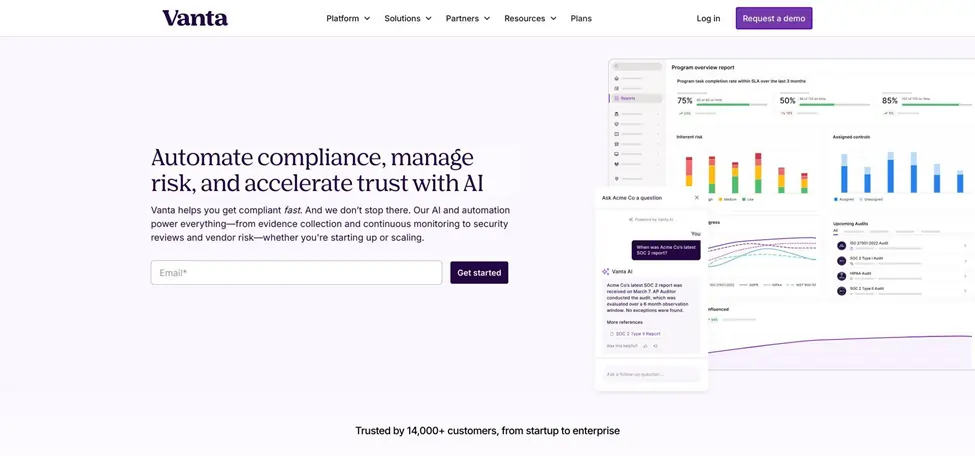
Designed to automate up to 85 percent of HIPAA audit evidence while reusing controls you already mapped for frameworks like SOC 2 or ISO 27001, the Vanta HIPAA compliance automation platform gives organizations continuous visibility across their technical controls and a clear path to staying audit-ready as the environment changes. It is commonly used when a health tech team needs HIPAA coverage and expects to expand into additional frameworks as the business grows.
Core HIPAA coverage: Vanta supports HIPAA with a mapped control set, policy workflows, training, and evidence collection built around keeping documentation current, not rebuilding it once a year. It also cross-maps controls to other frameworks, which matters if HIPAA is only one requirement on your roadmap.
Automation and integrations: The platform connects to common cloud and identity systems and continuously collects evidence so drift shows up quickly. Vanta states it automates up to 85 percent of the evidence needed for HIPAA audits. An IDC study highlighted that customers complete security questionnaires 81 percent faster after adoption.
Vendor risk and BAAs: For most health tech teams, vendor oversight becomes painful right when enterprise buyers start asking for proof. In this category, the practical question is not whether you can store a BAA, it is whether your system can keep vendor status and supporting evidence organized as your vendor count grows. If vendor risk management is a primary driver, confirm exactly how BAAs and vendor evidence are managed in your plan during the demo.
Audit and reporting: HIPAA has no formal federal certification, so “passing HIPAA” is really about maintaining defensible evidence, mapped controls, and clear reporting you can share with customers, partners, and auditors. Vanta’s value is in keeping that proof current through continuous collection, so audits and customer diligence do not become last-minute fire drills.
Security and data handling: As with any automation platform, confirm how connected-system data is handled for your use case, especially if you are sensitive to PHI exposure in evidence artifacts.
Pricing and time to value: Pricing sits in the mid-market range relative to SMB checklist tools. The ROI case is strongest when you quantify reclaimed engineering time and reduced audit prep work, especially if you are supporting multiple frameworks over time.
Strengths: Always-on evidence collection, strong multi-framework mapping, and clear support for fast-moving engineering teams.
Tradeoffs and what to validate: Confirm the exact monitoring cadence, scope of automated HIPAA evidence in your specific stack, and how vendor and BAA workflows operate at your scale.
Buyer questions to ask
-
Which HIPAA controls can we auto-test in our cloud and identity stack today, and how often are they checked?
-
How do you help us demonstrate HIPAA alignment to customers, given there is no official HIPAA certification?
-
What does vendor oversight look like at 50, 100, or 200 vendors, including BAAs and renewals?
Scytale: guided compliance that prioritizes speed
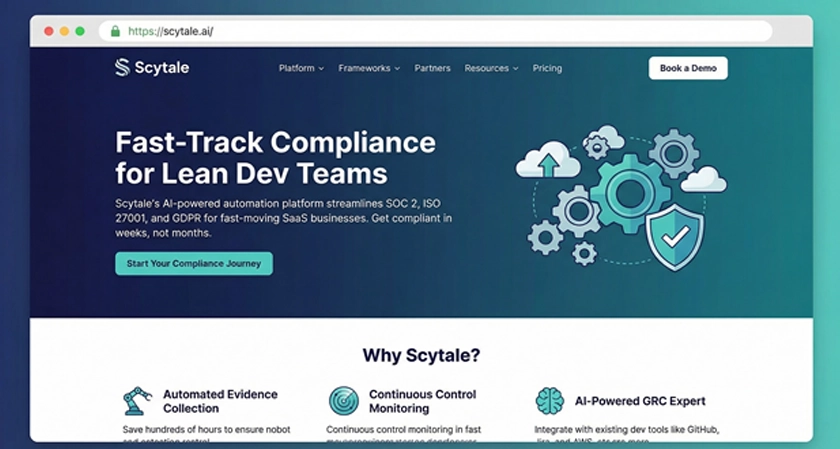
Scytale is a compliance automation platform that emphasizes fast time-to-readiness for lean teams. It is positioned for organizations that want a structured path through HIPAA requirements without building a heavyweight GRC program first.
Core HIPAA coverage: Scytale frames HIPAA as a guided program with controls and workflow to move from gaps to completion. The product pitch is centered on compressing timelines and keeping teams focused on what to fix next.
Automation and integrations: The company says its platform can get teams audit-ready up to 90 percent faster than manual spreadsheets and screenshots. In practice, the key evaluation point is how much of your evidence can be collected automatically from your specific tools, versus being uploaded and maintained by hand. Validate evidence cadence and connector depth in the demo.
Vendor risk and BAAs: Public detail on BAA and vendor-risk workflows is limited. If vendor oversight is a major requirement for your organization, ask Scytale to walk through the end-to-end process, including where BAAs live, how renewals are tracked, and how risk is scored.
Audit and reporting: Speed-to-ready is valuable, but buyers should still confirm how Scytale maps requirements to defensible outputs for customers and auditors, especially since HIPAA does not come with an official certification you can simply “pass.”
Security and data handling: Confirm third-party attestations and how evidence data is secured, including any data residency constraints your organization has.
Pricing and time to value: Pricing is not publicly listed. It is typically a fit decision based on how quickly you need to stand up a HIPAA program and how much ongoing automation you expect after the first push to readiness.
Strengths: Clear focus on speed, guided workflows, and a straightforward way to see progress without drowning a small team in compliance admin.
Tradeoffs and what to validate: Because public documentation is thinner in areas like integrations, evidence cadence, and vendor oversight, plan to validate these capabilities directly with the vendor.
Buyer questions to ask
-
What evidence is collected automatically from our stack, and what still requires manual uploads?
-
How do you handle BAAs and third-party oversight as our vendor count scales?
-
What reporting do we get that is ready for enterprise customer diligence, not just internal tracking?
Guided all-in-one suites for small and mid-size providers
A solo practice pays the same HIPAA fines as a hospital. Penalties can reach $71,162 per violation for willful neglect in 2025, but most small providers do not have a dedicated compliance officer. Consulting firms often charge $4,000–$12,000 up front for a basic risk assessment and policy kit. In contrast, guided HIPAA platforms like Accountable or Compliancy Group start around $99 a month.
These suites focus on the fundamentals. They help you complete a risk analysis, publish policies, train staff, track vendors and BAAs, and keep documentation together so you can respond quickly when someone asks, “Can you prove it?”
Accountable: a guided HIPAA program that stays readable
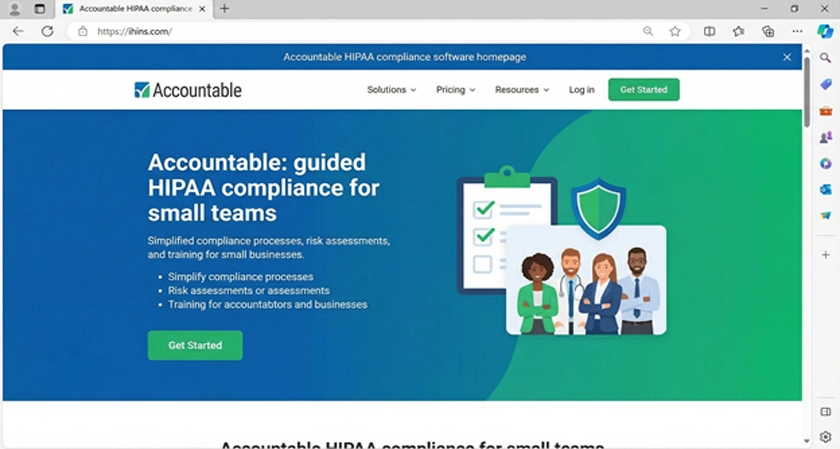
Accountable is HIPAA compliance software built for small practices and business associates that want structure without a heavyweight GRC rollout. It prioritizes clarity. You get a guided workflow, due dates, and an audit log that keeps evidence in one place.
Core HIPAA coverage: The platform centers on a guided risk assessment, policy workflows, training, and documentation. Accountable’s Risk Assessment module breaks a long questionnaire into smaller prompts, explains why each safeguard matters, then scores exposure and produces a remediation plan you can hand to IT.
Vendor risk and BAAs: If BAAs are one of your biggest sources of “HIPAA homework,” Accountable also offers a Business Associate Agreement management system to create, send, track, and store BAAs centrally.
Automation and reporting: Accountable leans toward reminders and guided completion, not deep technical control testing across cloud infrastructure. For most small providers, that tradeoff is acceptable. The key is that policy sign-offs, device checks, training certificates, and incident documentation land in an exportable audit trail.
Support and pricing: Support is embedded in the product. Live chat sits inside the app alongside a “Compliance Copilot” bot, with human escalation by email when needed. Pricing starts at $99 per month for the Essential tier and scales by headcount.
Best for: Clinics that want HIPAA to feel like a guided checklist they will actually finish.
What to confirm in a demo: How vendor oversight scales if you manage a large vendor list, and what automated technical checks (if any) are included versus handled externally.
Compliancy Group: structured workflows plus hands-on coaching
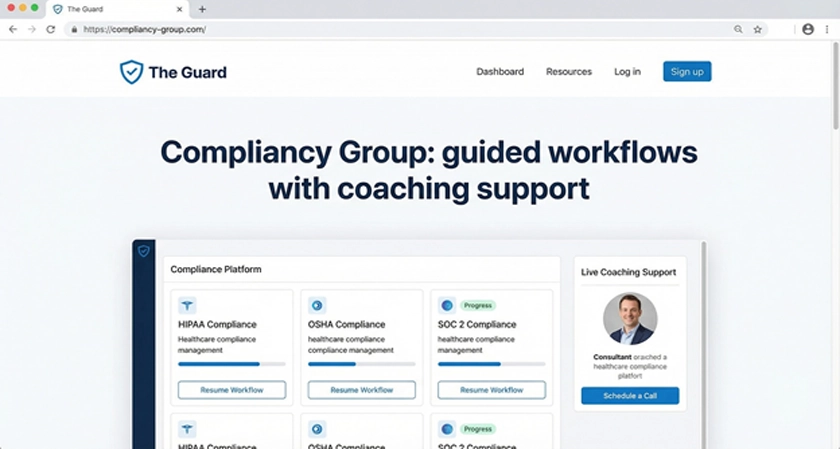
Compliancy Group’s platform, The Guard, combines HIPAA workflows with a human support layer. It is designed for busy practices that want clear guard rails and someone to call when the rules get messy.
Core HIPAA coverage: The Guard wraps risk analysis, policy management, staff training, incident logging, and vendor oversight into a guided sequence. Complete the program and you earn a verifiable badge. Compliancy Group positions this as its Seal of Compliance program, now offered as a Trust Badge.
Vendor oversight and BAAs: Vendor tracking is built into the workflow. Upload a BAA, assign questionnaires, and track signature status. If a vendor lags, your compliance status shifts until the documentation is complete.
Coaching and proof points: The defining feature is the included Compliance Coach, who reviews your work, helps interpret requirements, and answers real-time questions. Customers also point to this support model as the reason they do not feel stuck when OCR guidance turns legalistic. The Guard holds a 4.7-star rating across 88 reviews on G2.
Pricing: Even the entry Foundation plan starts at $99 per month when billed annually and includes coaching and the Trust Badge.
Best for: Small and mid-size providers that want a guided HIPAA program and a live partner, not just software.
What to confirm in a demo: The depth of automation (beyond guided tasks), plus the current “Seal” vs. “Trust Badge” terminology and what, exactly, the badge represents for customer trust.
HIPAAMATE: low-cost coverage for micro practices
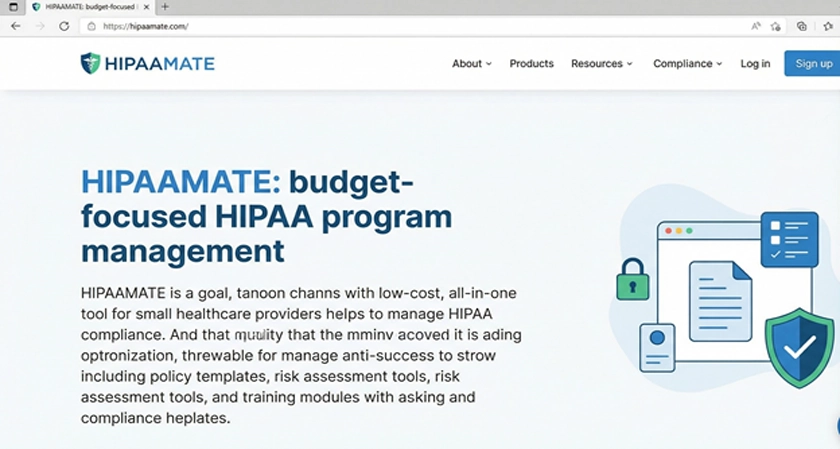
HIPAAMATE is built for micro practices that need HIPAA essentials without enterprise pricing. The tool starts at $30 a month and covers core HIPAA workflows end-to-end.
Core HIPAA coverage: Onboarding uses a short intake to generate a task list aligned to HIPAA Security and Privacy Rule requirements. The guided Risk Analysis is plain-language and turns “needs action” answers into tracked mitigation tasks. Training videos, quizzes, and completion records live in the same portal, so you can stop juggling spreadsheets.
Proof from users: HIPAAMATE holds a 5.0 average rating on Capterra across seven verified users, with reviewers calling out reminders and having everything “in one place.”
Best for: Solo and micro practices where the budget is tight and the priority is getting the basics done, documented, and repeatable.
What to confirm in a demo: Any needed integrations or advanced automation. If you require continuous technical testing across a complex environment, HIPAAMATE is better treated as a lightweight HIPAA program hub than a full automation layer.
Enterprise-grade risk & analytics platforms
At enterprise scale, HIPAA stops being a policy problem and becomes a risk-operations problem. A single ransomware incident at a large hospital now exposes an average 29,759 patient records and costs $10.93 million to clean up, according to IBM’s 2025 Cost of a Data Breach report. With thousands of users, sprawling vendor ecosystems, and petabytes of ePHI, you need more than a checklist. You need software that can quantify risk, track remediation over time, and produce documentation that holds up under OCR scrutiny and board-level questions.
Clearwater IRM Pro: quantitative risk management built for healthcare
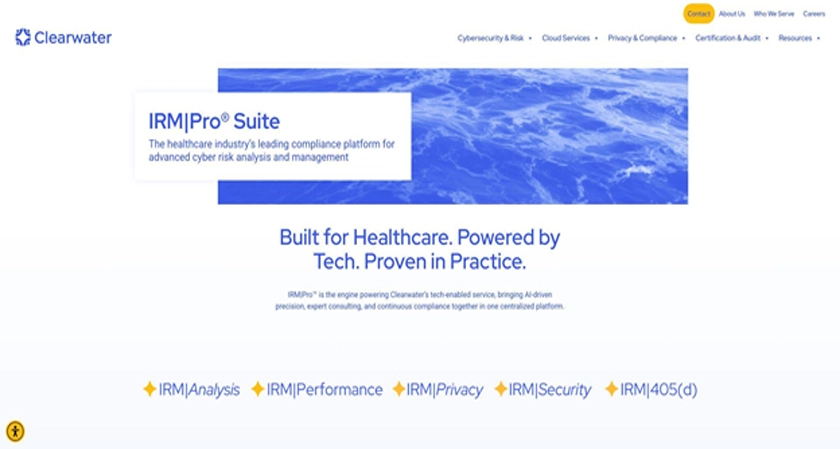
Clearwater’s IRM platform is designed for healthcare organizations that treat HIPAA as an enterprise risk program. The core promise is executive clarity. Inventory the systems that touch PHI, run a structured risk analysis, and track remediation in a way leadership can prioritize and fund.
Core HIPAA coverage and reporting: Clearwater aligns its approach to OCR expectations and risk frameworks like NIST 800-30. The platform emphasizes defensible documentation, a living risk register, and reporting that translates security gaps into business impact.
Automation and analytics: The differentiator is how it models risk. Likelihood and impact roll into a quantified score that updates as remediation work closes. Clearwater also holds a patent for an AI-enabled Predictive Risk Rating capability intended to refine risk scoring using historical scenarios.
Vendor oversight and BAAs: Clearwater is primarily a risk and compliance platform. If vendor risk management and BAA lifecycle workflows are a primary buying requirement, validate exactly what is productized versus handled through services and advisory support.
Pricing and time to value: This is an enterprise investment, often paired with consulting support. Implementation requires coordination across IT, security, and compliance, but the payoff is a risk narrative that is easier to defend and easier to act on.
Strengths: Healthcare-specific risk rigor, OCR- and NIST-aligned methodology, and board-ready reporting.
Tradeoffs and what to confirm: If you need developer-centric continuous control testing across cloud and identity systems, confirm the depth of technical evidence collection and integrations. Many enterprises pair risk platforms with separate telemetry and automation layers.
Buyer questions to ask
-
Can we produce an OCR-defensible risk analysis that maps cleanly to our asset inventory and remediation plan?
-
How is risk quantified, and how does residual risk change as controls are implemented?
-
What parts of vendor risk are handled in-product versus through advisory services?
HIPAA One: security risk assessment rigor with OCR alignment
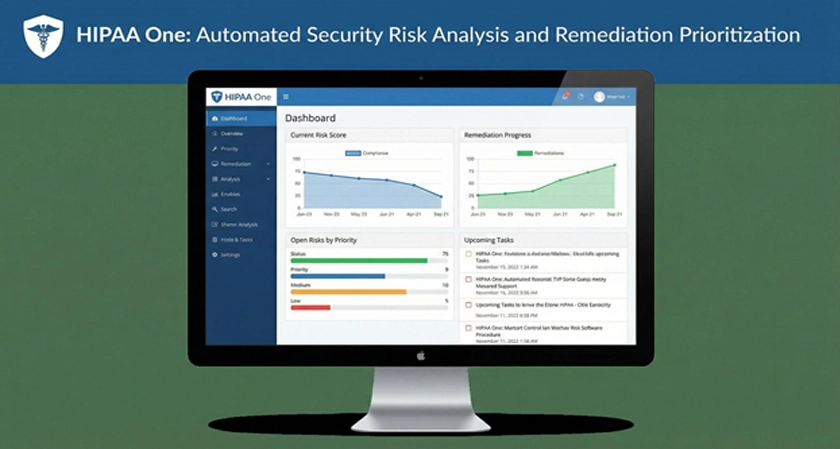
HIPAA One, from Intraprise Health, is built around HIPAA Security Risk Assessments (SRAs). It is a fit when the biggest gap is not “where do we store policies,” but “can we run and defend a comprehensive, structured SRA.”
Core HIPAA coverage: The platform guides an SRA using likelihood and impact scoring, remediation workflows, and reporting designed to align with OCR audit protocols and NIST methodologies. Intraprise Health positions it as OCR-accepted and widely adopted, stating it supports 64k+ providers and has been used for 10k+ assessments (vendor-published claims that should be validated during evaluation).
Automation and add-ons: HIPAA One is strongest where you need repeatable assessment workflows and structured documentation. It is not positioned as an hourly technical evidence collector across cloud infrastructure. If your program also needs continuous technical controls monitoring, plan for complementary tooling.
Vendor oversight and BAAs: Public positioning is assessment-first. If vendor risk and BAAs are central to your program, confirm whether those workflows are included, and how they scale.
Pricing and time to value: Pricing is not publicly listed. Time to value is typically fast when your goal is to complete a defensible SRA cycle and produce audit-ready outputs.
Strengths: SRA depth, OCR protocol alignment, and structured remediation planning.
Tradeoffs and what to confirm: If your board and your buyers expect continuous evidence, confirm what is automated versus manual between assessment cycles.
Buyer questions to ask
-
How does the platform map findings to OCR audit protocol language and evidence expectations?
-
What does a “defensible” SRA export look like for our environment and our auditors?
-
What ongoing monitoring, if any, exists between formal assessments?
Healthicity Compliance Manager: one operations hub for HIPAA plus adjacent compliance
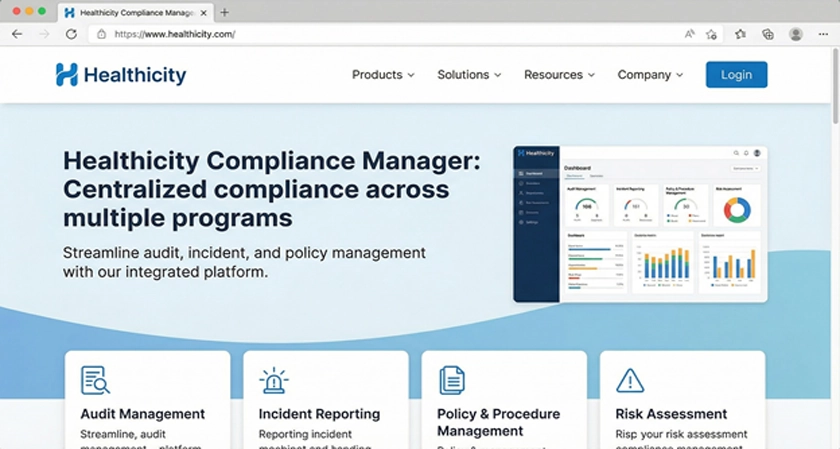
Healthicity’s Compliance Manager is built for organizations that need one place to run day-to-day compliance operations. It spans HIPAA privacy and security plus adjacent areas like billing and OSHA, which is often the reality for mid-to-large provider groups.
Core HIPAA coverage: The platform combines dashboards, training, policy management, incident tracking, and risk workflows. It is structured to help compliance teams assign work by location or department and keep completion records centralized.
Automation focus: Where it stands out is compliance operations automation, particularly exclusion monitoring. Healthicity highlights nightly exclusion checks against OIG and GSA SAM lists and alerts if a clinician appears, helping avoid penalties that can hit $10,000 per item or service billed by an excluded individual.
Vendor oversight and BAAs: Vendor and BAA workflow depth is not the primary headline. If third-party risk is a major driver, validate how BAAs, questionnaires, and ongoing oversight are handled.
Pricing and time to value: Healthicity positions an entry point starting at $500 per month for the Foundation tier (up to 25 employees). For teams juggling multiple regulations, consolidation is often the time-to-value story.
Strengths: Breadth across compliance areas, built-in training and policy workflows, and exclusion monitoring that can prevent costly billing mistakes.
Tradeoffs and what to confirm: If you need deep technical control testing across cloud, IAM, and engineering systems, confirm integration depth and evidence automation, and plan for complementary tools if needed.
Buyer questions to ask
-
Do we want one hub for HIPAA plus billing and OSHA, or a platform optimized for technical control automation?
-
How frequently are exclusion checks run, and what evidence is retained for audits?
-
How does vendor management work in practice, including BAAs and renewals?
Specialized monitoring add-on
All-in-one HIPAA suites are strong at program management. They help you run a risk analysis, assign training, manage policies, and organize documentation. What they often do not provide is deep, continuous visibility into every file open, permission change, or database query across your environment. For many security teams, that visibility layer is the difference between “we think access is reviewed” and “we can prove it, continuously.”
In healthcare, a common add-on for this job is Netwrix Auditor. Netwrix reports that Henry County Hospital saved about $40,000 a year in audit preparation costs and reduced manual log review to near zero after deployment.
Netwrix Auditor: continuous audit trails for ePHI access and change
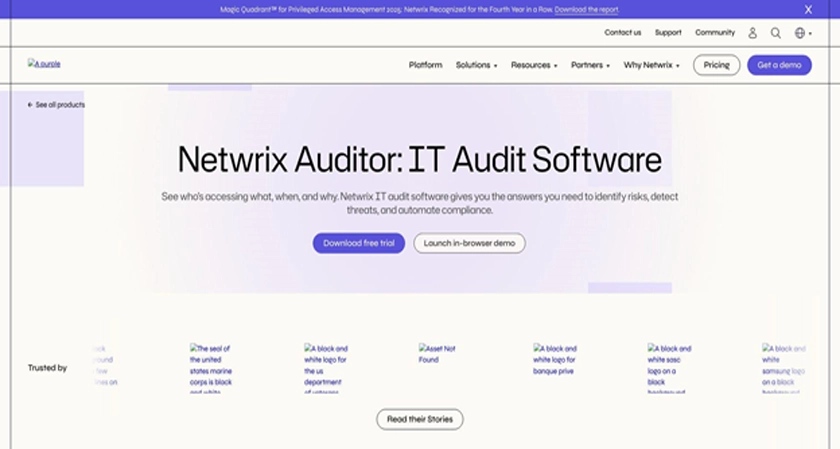
Netwrix Auditor is an IT auditing and security reporting tool. It is designed to capture access and change activity across common systems and turn raw logs into review-ready records. It is best treated as a technical monitoring layer that complements your HIPAA program software.
Core HIPAA coverage: Netwrix focuses on HIPAA’s technical safeguard expectations around access controls, audit controls, and ongoing review. It ships with pre-built HIPAA-oriented reports that help you show who accessed what, what changed, and when.
Automation and integrations: For many sources, Netwrix is agentless. You point it at systems such as Windows servers, SQL databases, Microsoft 365, or NAS shares, and it collects and normalizes events into a tamper-resistant archive. Two capabilities called out in the original section are:
-
Sensitive Data Discovery: Scans file stores for PHI patterns and highlights exposure based on access permissions.
-
User Behavior Analytics: Baselines typical activity and alerts on anomalies that may indicate compromised accounts or inappropriate access.
Audit and reporting: This is where Netwrix earns its keep. Instead of quarterly spot checks and manual log pulls, you get continuous logging plus auditor-friendly reports. In Netwrix’s Henry County Hospital case study, the hospital attributes about $40,000 per year in audit-prep savings to Netwrix Auditor.
What it does not replace: Netwrix is not a full HIPAA compliance program suite. It does not handle policy management, staff training, or BAA and vendor-risk workflows. Most organizations pair it with a platform that runs those program layers.
Best for: Any provider or health tech organization that already has a compliance program tool, but needs stronger, continuous evidence for access review and change tracking.
Buyer questions to ask
-
Which systems can Netwrix monitor in our environment, and what do the HIPAA reports look like for each?
-
How are logs stored and protected from tampering, and how long can we retain them for audit needs?
-
What is the cleanest division of labor between our HIPAA program software (policies, training, BAAs) and Netwrix (telemetry, reporting, anomaly alerts)?
Conclusion
HIPAA compliance is a continuous program, not a once-a-year audit task—especially as breach costs rise and regulators expect provable, ongoing safeguards. The right software can centralize policies, training, BAAs, monitoring, and risk tracking so you’re not rebuilding evidence from scratch when an incident or inquiry hits. Start by matching the platform category to your reality: automation-first tools for fast-changing cloud environments, guided suites for lean practices, and risk-centric platforms for health systems that need NIST-style analysis and executive reporting. Whichever path you choose, prioritize tools that keep evidence current, surface drift quickly, and make it easy to demonstrate maturity over time.
FAQ
1) What’s the difference between HIPAA compliance software and a security tool?
HIPAA compliance software organizes policies, training, BAAs, risk assessments, and audit evidence; security tools focus on technical controls like monitoring, detection, and access management. Many organizations use both.
2) Do small practices really need HIPAA software, or is a checklist enough?
A checklist can work short-term, but software helps you document required activities (risk analysis, training, policies, incidents) consistently and keep records audit-ready with less manual effort.
3) What should health-tech startups prioritize when choosing a platform?
Automation and integrations—especially with cloud infrastructure and identity providers—plus multi-framework mapping if you also need SOC 2 or ISO 27001.
4) How do enterprise providers choose between “GRC-style” platforms and automation-first tools?
If you need formal, repeatable risk analysis with likelihood/impact scoring and executive-ready reporting, lean toward enterprise risk platforms; if your priority is continuous control monitoring and fast evidence collection across many systems, automation-first tools are often the better fit.
MOST VIEWED ARTICLES
RECOMMENDED NEWS








LATEST NEWS














TOP NEWS
YOU MAY ALSO LIKE


_2025-11-17_06-38-14.webp)


_2025-12-15_12-44-58.webp)


 (1)_2025-10-21_13-35-14.webp)