>>
Industry>>
Metals and Mining>>
Why Advanced Ceramics Are Beco...Why Advanced Ceramics Are Becoming Critical to Industrial Decarbonization
The Silicon Review
28 January, 2026
Author:
The Silicon Review Team
Industrial decarbonization has traditionally focused on energy substitution—renewables, electrification, hydrogen, and policy-driven incentives. While these levers are essential, many industrial systems continue to underperform against emissions targets for a quieter, less discussed reason: material limitations. In high-temperature, corrosive, and wear-intensive environments, conventional materials introduce efficiency losses, frequent maintenance, and premature failure that collectively undermine decarbonization gains.
As regulators, investors, and procurement teams increasingly scrutinize lifecycle emissions and operational resilience, material performance has emerged as a structural constraint—and opportunity—within industrial decarbonization strategies.
The Hidden Carbon Cost of Material Failure
Material degradation is rarely counted explicitly in carbon accounting, yet its impact is substantial. In energy-intensive industries, frequent component replacement, unplanned downtime, and reduced operating efficiency translate into higher energy consumption and avoidable emissions.
When equipment components fail under thermal shock, chemical attack, or mechanical wear, systems often operate below optimal conditions or require shutdowns that trigger energy-intensive restarts. Over time, these inefficiencies accumulate into measurable carbon costs across maintenance logistics, spare parts production, and additional fuel or electricity use.
From a lifecycle assessment perspective, the emissions associated with repeated repair and replacement can rival—or exceed—the benefits delivered by upstream energy improvements. In this context, improving material durability becomes a direct pathway to emissions reduction.
Why Advanced Ceramics Offer Structural Advantages
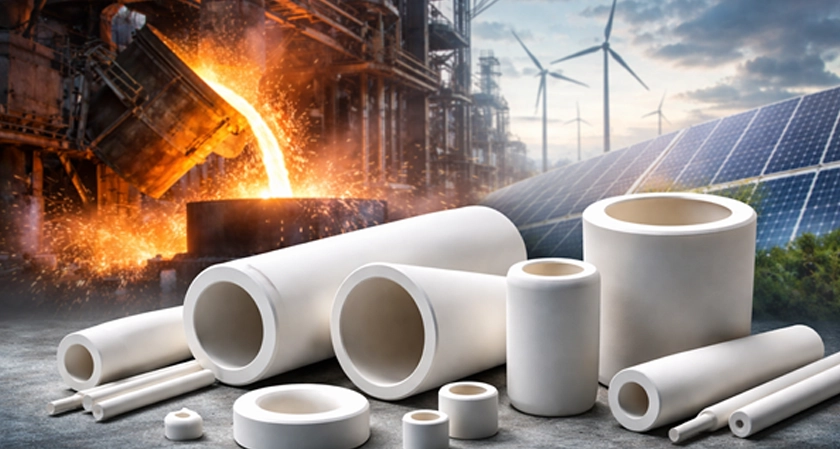
Advanced ceramics provide a set of material properties that directly address the conditions most responsible for industrial inefficiency. Their thermal stability, chemical inertness, electrical insulation, and wear resistance allow equipment to operate reliably in environments where metals and polymers degrade rapidly.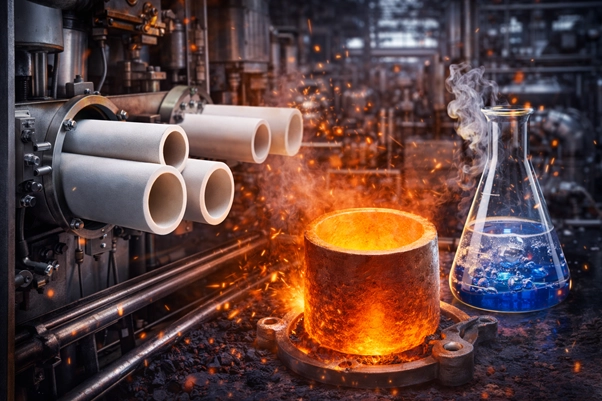
Unlike incremental process optimizations, material upgrades deliver structural efficiency gains. Components that tolerate higher operating temperatures enable more efficient thermal processes. Chemically stable materials reduce contamination and corrosion-related failures. Extended service life lowers replacement frequency, shrinking both operational disruption and embodied emissions.
These characteristics are increasingly relevant in decarbonization scenarios where processes are pushed harder—higher temperatures, more aggressive chemistries, and continuous operation—to maximize output per unit of energy. Applications such as alumina-based tubular components for high-temperature industrial systems illustrate how material selection can stabilize performance while supporting efficiency-driven emissions reduction.
Enabling Decarbonization in High-Temperature Industrial Processes
High-temperature industrial sectors—chemical processing, metallurgy, advanced manufacturing, and emerging hydrogen systems—are central to global decarbonization efforts. Ironically, these same sectors face the most severe material challenges as they electrify or adopt alternative fuels.
Electrification often increases thermal cycling and localized heat loads, while hydrogen environments introduce new chemical compatibility concerns. Advanced ceramics help mitigate these risks by maintaining dimensional stability and mechanical integrity under extreme conditions.
By enabling higher process temperatures and more consistent thermal profiles, ceramics can improve reaction efficiency, reduce heat losses, and support compact system designs. These effects compound across large-scale operations, making materials a key enabler rather than a secondary consideration in decarbonization roadmaps.
Reducing Maintenance, Downtime, and Lifecycle Emissions
From an operational perspective, decarbonization is increasingly a reliability problem. Systems that require frequent intervention erode both economic and environmental performance. Maintenance activities bring additional energy use, logistics emissions, and production losses that dilute sustainability gains.
Advanced ceramics address this challenge by extending component lifetimes and reducing failure rates. In applications involving material processing, thermal analysis, or continuous high-temperature exposure, high-temperature alumina vessels used in energy-intensive industrial processes support stable operation while minimizing contamination and degradation.
The resulting reduction in downtime improves overall equipment effectiveness (OEE), allowing facilities to achieve production targets with fewer energy-intensive disruptions. For operations managers and sustainability officers alike, material durability becomes a measurable contributor to emissions performance.
Material Selection as a Strategic Decarbonization Decision
Material choice has traditionally been viewed as a technical or engineering detail. That perspective is changing. As climate-related risks move from abstract concerns to quantifiable financial metrics, material performance is increasingly tied to capital efficiency, operational risk, and ESG outcomes.
Boards and executives now face pressure to demonstrate credible pathways to emissions reduction that extend beyond energy sourcing. Durable materials that lower lifecycle emissions, reduce operational volatility, and support compliance with tightening regulations offer a strategic advantage.
Organizations evaluating advanced ceramic material platforms—such as advanced alumina ceramic material platforms for industrial sustainability—are not simply optimizing components; they are strengthening the resilience of decarbonized systems under real-world conditions.
Conclusion
Industrial decarbonization is not solely an energy transition—it is a systems transition. While clean energy and policy frameworks set the direction, material performance determines whether decarbonized systems can operate efficiently, reliably, and at scale.
Advanced ceramics address a critical, often overlooked dimension of sustainability by reducing hidden carbon costs associated with material failure, maintenance, and inefficiency. As industries move toward more demanding operating regimes in pursuit of lower emissions, materials will continue to shift from background engineering choices to strategic enablers of long-term decarbonization.
In the years ahead, organizations that integrate material performance into their sustainability strategies will be better positioned to deliver durable emissions reductions—and to sustain them.