>>
Industry>>
Supply chain management>>
7 Best Distribution Logistics ...7 Best Distribution Logistics ERP Systems: Software Comparison & Selection Tips

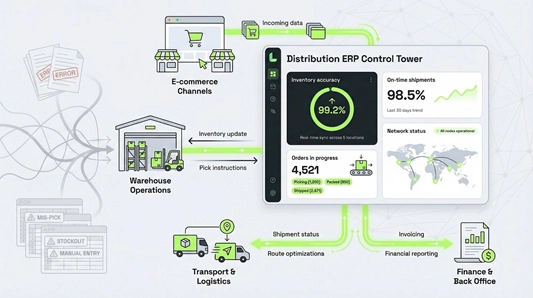
Supply chains run 24/7, and when next-day promises collide with outdated back-office software, the cracks appear fast—mis-picked orders, ghost stock, spreadsheets at 2 am. According to industry research, distributors that upgrade often cut inventory carrying costs by 20 to 30 percent, a big win when margins sit in the single digits. To help you choose the right platform, we scored the seven strongest options—from Microsoft Dynamics 365 to niche specialists—against clear, distribution-specific criteria. Here's what we found.
Our methodology: how we ranked the ERPs
We skipped vendor hype and built an eight-point scorecard tied to real distribution pain points. Warehouse execution and inventory planning carried the most weight because they shape your margin every day. Integration flexibility, analytics strength, scalability, total cost of ownership, implementation speed, and vendor support completed the framework.
For each platform, we reviewed analyst reports, product demos, user feedback, and recent case studies. We scored every criterion from one to five and rolled those numbers into a composite rating. If a system lacked an embedded WMS or added steep fees, its warehouse or cost score dropped—no exceptions.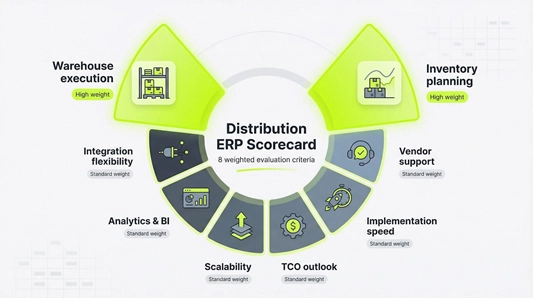
Next, we checked our math with people who run these tools: operations leaders, implementation partners, and warehouse managers who use the screens daily. Their notes kept the rankings practical.
The result is a list that highlights proven, distribution-ready capabilities instead of buzzwords. It's the same approach we would use if we were advising you face to face.
1) Microsoft Dynamics 365 Supply Chain Management: best for Microsoft-centric enterprises and 3PLs
If your tech stack already leans on Azure, Outlook, and Teams, Dynamics 365 feels less like a new system and more like the missing puzzle piece. Finance, sales, and warehouse tasks share the same live database, so a picker's scan in Ohio is visible to the finance team in seconds. That single source of truth keeps late-night reconciliation parties off the calendar.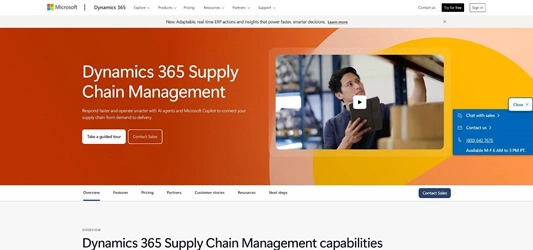
Microsoft Dynamics 365 Supply Chain Management ERP interface screenshot
Distribution power comes from embedded Warehouse Management and Transportation modules. Wave picking, mobile scanning, and route planning run natively, no bolt-ons required. Microsoft's Copilot AI sits on top, spotting demand spikes or shipment delays before they snowball. Power BI dashboards turn those alerts into clear visuals the whole team can act on.
Scalability is rarely a concern. The platform handles multi-site, multi-company operations with ease, backed by Azure's elastic infrastructure. Global firms value that muscle, and regional distributors appreciate starting small and adding capacity during peak season without a hardware scramble.
Implementation does take discipline; this is full-scale enterprise software. Keep scope tight, use Microsoft's industry templates, and engage partners who know distribution quirks. Follow that playbook and payback arrives quickly through faster picks, fewer invoice errors, and happier customers who receive exactly what they ordered, when they ordered it.
Specialist partners such as MCA Connect, whose Connected Blueprint approach to Dynamics 365 ERP implementation is tailored to manufacturers and distributors, illustrate the upside. Its method often delivers measurable results in as little as six weeks, giving distributors unified finance-to-warehouse visibility before peak season hits.
Floral wholesaler Syndicate Sales turned to MCA Connect to rescue and optimize its Dynamics 365 rollout; inventory accuracy climbed 20–30 percent and redundant data dropped more than 40 percent, freeing 300 GB of storage and cutting report prep from days to hours.
Those numbers show how engaging a distribution-savvy partner can turn Microsoft's templates into measurable payback.
2) SAP S/4HANA: best for global enterprises with complex supply chains
When volume and complexity surge, SAP S/4HANA is ready. The in-memory HANA database processes large order files in seconds. According to an independent benchmark, it processed 100,000 order lines in 22 seconds—capacity most distributors will not exhaust.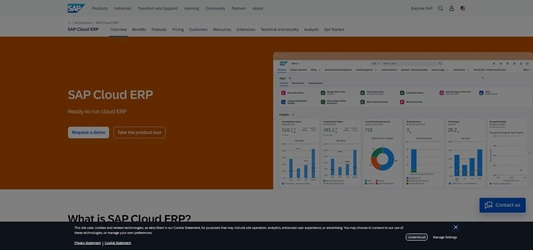
SAP S/4HANA ERP for complex global supply chains screenshot
Depth is the second hallmark. Extended Warehouse Management covers slotting, labor planning, and automation in one workspace. Transportation Management plans multi-leg loads and reconciles carrier costs without spreadsheets. Advanced Available-to-Promise checks global inventory before you commit to a date, preventing last-minute expediting.
Finance and operations share the same data, so landed cost accounting, rebate settlements, and compliance reports flow automatically. This integration lets CFOs see gross margin by customer, product, and region in real time.
The trade-off is effort. S/4HANA projects run long and require seasoned consultants. Custom processes need careful blueprinting or they cause trouble later. Up-front cost is high, but large distributors justify it by replacing dozens of legacy systems with one reliable platform.
If you operate multi-country warehouses, manage regulated products, or need strict audit trails, SAP's breadth and performance give you room to grow for the next decade.
3) Oracle Fusion Cloud ERP & SCM: best for one-platform finance-to-fulfillment
Oracle's promise is simple: run everything, front to back, on the same cloud rails. Orders flow from CRM to warehouse to invoicing without data hops or batch jobs. For distributors juggling tight margins and multiple revenue streams, that unity trims errors and speeds cash collection.
Warehouse and transportation workflows live inside the suite, not in bolt-on modules. A picker's confirmation, a carrier's rate, and the resulting journal entry share the same record. That immediacy appears on Oracle's real-time dashboards, so operations, sales, and finance share the same truth.
Oracle keeps adding intelligence as well as plumbing. Recent releases use machine learning to predict supplier lead-time shifts and flag them before they derail your promise date. The system then cascades new dates through purchase orders, ATP calculations, and customer notifications automatically. Less firefighting, more planning.
Cost and complexity match its enterprise focus, yet midsize distributors still find room if they need deep financial controls plus strong supply-chain muscle. Implementation time drops when teams follow Oracle's cloud templates and avoid customizing every edge case.
Bottom line: if you want a single vendor, quarterly innovation drops, and detailed analytics without stitching together multiple apps, Oracle Fusion Cloud deserves a spot on your shortlist.
4) Oracle NetSuite: best for fast-growing mid-market distributors
NetSuite shines when growth pains start to pinch. If Excel workbooks and entry-level accounting can't keep up with multi-warehouse inventory, this cloud platform steps in with one database, one login, and no servers to babysit.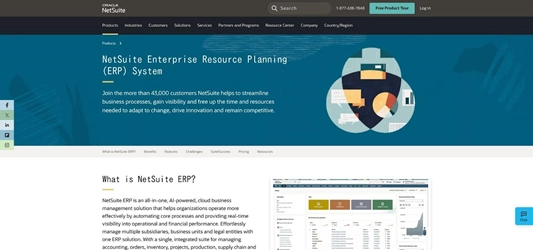
Oracle NetSuite ERP dashboard for fast-growing wholesale distributors screenshot
The distribution edition bundles purchasing, sales, basic WMS, and financials out of the box. That bundle matters: a sales rep can quote, convert to an order, and view live stock at any location without calling the warehouse. Mobile scanners update quantities instantly, so online shoppers never order ghosts.
Flexibility is NetSuite's calling card. Workflows drag and drop, dashboards tweak in minutes, and the SuiteApp marketplace adds advanced WMS, EDI, or 3PL connectors when you need extra muscle. You can add subsidiaries or currencies the moment you open a new market—no fresh implementation required.
Costs stay predictable because everything runs on a subscription. Implementation averages four to eight months, helped by SuiteSuccess templates that preload best practices for wholesale distribution. Stay within those guardrails and you'll be live before your next busy season.
For distributors in the five- to nine-figure revenue range who want enterprise discipline without enterprise overhead, NetSuite is worth a close look.
5) Infor CloudSuite Distribution: best for wholesale specialists who avoid heavy customization
Some ERPs speak distribution as a second language. Infor CloudSuite Distribution is fluent. Rebates, customer-specific pricing, counter sales, and multi-unit conversions work on day one, cutting the “we'll build that later” talks common with generalist platforms.
The modern web interface runs on AWS. You get cloud scale without leaving on-premise control behind. Infor OS handles integration and workflow, so EDI feeds, CRM screens, and Teams chats land in one workspace. Less screen-hopping means quicker decisions at the sales counter and in purchasing.
Margin protection is the headline benefit. Pricing rules cascade automatically, vendor rebates settle in a few clicks, and managers see gross margin by order before it ships. Users often report tighter profit control within weeks of go-live because the math is no longer stuck in spreadsheets.
Projects move faster than mega-suites because wholesalers rarely need deep re-engineering. Stay close to out-of-box processes, train power users early, and you can go live in six to nine months. For mid-sized distributors who want distribution depth without enterprise overhead, Infor CloudSuite Distribution is a clear contender.
6) Epicor Prophet 21: best for mid-market distributors who want ready-made workflows
Prophet 21 wins loyalty by matching the daily rhythm of industrial supply, HVAC, and medical distributors right out of the box. Counter sales, service work orders, and rental billing sit beside standard pick-pack-ship tasks, so staff switch roles without juggling multiple apps.
Epicor moved the platform to Azure, freeing you from server upkeep while preserving the familiar Windows look power users expect. A browser interface modernizes the experience, yet key shortcuts stay where seasoned clerks rely on them. Change management stays light.
On the warehouse floor, wireless scanning and task-based picking raise throughput, and built-in purchasing suggestions keep shelves stocked without bloating inventory. Pair Prophet 21 with Epicor Commerce to publish real-time availability online, with no middleware or midnight CSV uploads.
Projects usually land under a year because core distribution processes map closely to existing P21 functions. Costs fit mid-market budgets, and an active user group shares tips on margin rules, KPI dashboards, and more.
If you want distribution depth, prefer Microsoft technology, and value a vendor that speaks forklift as well as finance, Prophet 21 deserves a spot on your list.
7) Acumatica Distribution Edition: best for small-to-mid distributors who value flexibility
Acumatica is the nimble contender in this lineup. Born in the cloud, it skips heavy legacy code and focuses on speed, openness, and a clean browser interface your team can learn in an afternoon.
Licensing is its quiet advantage. You pay for computing resources, not seats, so every warehouse temp, partner, or field rep can have a login without watching the meter. Broad access builds accountability because everyone works from the same live numbers.
Core modules handle inventory, purchasing, sales, and a mobile WMS. Need deeper e-commerce or EDI? Open REST APIs and a growing marketplace make add-ons straightforward. Recent updates even flag suspiciously low margins with a built-in AI engine, protecting profit before invoices leave the dock.
Projects often finish in four to eight months because partners start with a distribution template and adjust from there. The smaller global footprint means you should vet partner experience carefully, yet customer satisfaction scores trend high thanks to responsive support and frequent feature drops.
If you want a system that bends before it breaks, scales without steep license fees, and stays current through continuous updates, Acumatica deserves a close look.
Side-by-side snapshot: how the seven ERPs stack up
You have the stories, but sometimes you just need the scoreboard. The table below compresses our eight-point scorecard into a quick-glance grid, so you can spot front-runners in seconds and direct deeper research where it matters.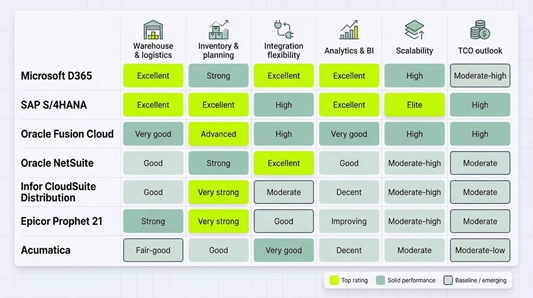
|
ERP |
Warehouse & logistics |
Inventory & planning |
Integration flexibility |
Analytics & BI |
Scalability |
TCO outlook |
|
Microsoft D365 |
Excellent |
Strong |
Excellent |
Excellent |
High |
Moderate-high |
|
SAP S/4HANA |
Excellent |
Excellent |
High |
Excellent |
Elite |
High |
|
Oracle Fusion Cloud |
Very good |
Advanced |
High |
Very good |
High |
High |
|
Oracle NetSuite |
Good |
Strong |
Excellent |
Good |
Moderate-high |
Moderate |
|
Infor CloudSuite Distribution |
Good |
Very strong |
Moderate |
Decent |
Moderate-high |
Moderate |
|
Epicor Prophet 21 |
Strong |
Very strong |
Good |
Improving |
Moderate-high |
Moderate |
|
Acumatica |
Fair-good |
Good |
Very good |
Decent |
Moderate |
Moderate-low |
We kept the scale simple: Excellent, Very good, Good, and Fair, so scores do not pretend to be absolute truth. Each system meets the baseline for modern distribution; gaps show up in advanced depth, ecosystem reach, and long-term cost.
Use this grid as a filter, not the final answer. Circle the two or three platforms that match your top priorities, then return to demos with sharper questions.
How to choose and implement your shortlist without the headaches
Start by ranking your pain points. Is warehouse accuracy bleeding profit? Are e-commerce orders slowing supply planning? Knowing the top irritant sharpens every vendor demo and keeps extra features from distracting you.
Loop in the people who will live in the system. A warehouse supervisor, a buyer, and an AR clerk see different friction points. Their questions during demos reveal gaps a project sponsor can miss, and early involvement lifts adoption when go-live day arrives.
Next, map critical integrations. If your business runs on Shopify, an ERP with a native connector jumps the queue. Already invested in a best-of-breed WMS? Make sure APIs flow both ways and latency stays low. Sketch the data flow on one page; if it looks like spaghetti, rethink.
Budget beyond software fees. Implementation services, data cleansing, scanners, and user training often double the first-year spend. Build a five-year TCO model that includes subscription renewals and expected head-count savings, then sanity-check it with reference customers.
Go live in phases. Core financials, inventory, and order entry come first. Advanced forecasting, customer portals, or mobile proof of delivery can follow once daily operations stabilise. This staggered approach trims risk and gives the team quick wins.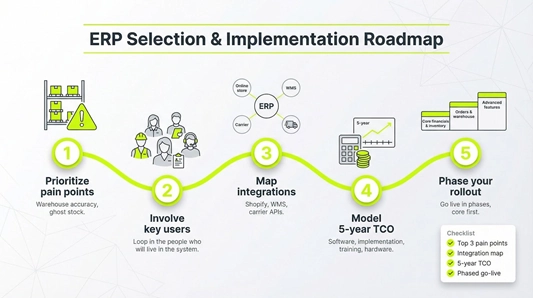
Quick checklist for the road ahead:
- Prioritise your top three pain points.
- Involve cross-functional users in every demo.
- Sketch the integration map before selecting.
- Model five-year TCO, not just licence cost.
- Plan a phased rollout with tight scope control.
Treat selection like any major capital project. Set clear goals, track measurable milestones, and hold honest retrospectives. Follow this playbook, and your new ERP will shift from expense line to competitive weapon in record time.












