>>
Technology>>
Science and technology>>
Inside the 'Fitbit for Farts' ...Inside the 'Fitbit for Farts' a wearable that could revolutionize gut health
The Silicon Review
21 February, 2026
Author:
The Silicon Review Team
A wearable hydrogen sensor from the University of Maryland, playfully called the "Fitbit for farts," is monitoring digestive health with 4,000 applicants already enrolled.
On my person, discreetly positioned, sits a battery-powered sensor monitoring digestive activity that polite company prefers not to discuss. This is not a novelty it is a scientific instrument born from the convergence of miniaturization, continuous health monitoring, and edge computing, representing a potential breakthrough for the 40% of American adults who suffer from chronic digestive issues.
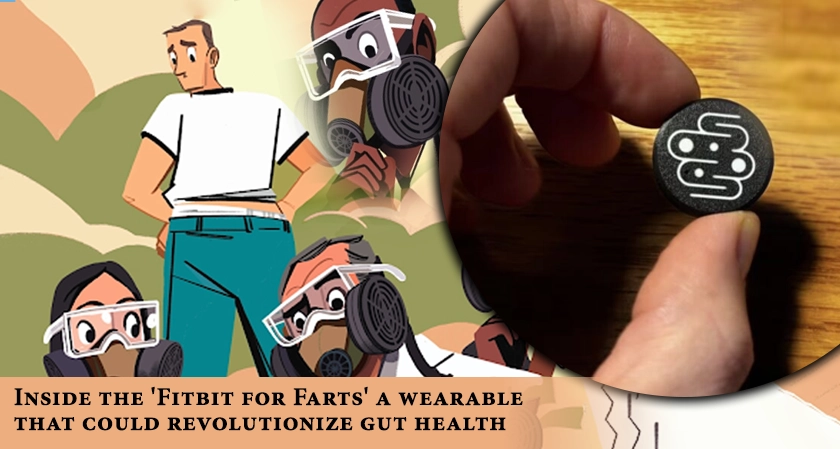
Developed at the University of Maryland, this hydrogen-sensing wearable affectionately dubbed the "Fitbit for farts" by its creators is the cornerstone of the Human Flatus Atlas study. Its mission: to establish, for the first time, empirical baseline data on human flatulence patterns. The device, roughly the size of three stacked nickels, continuously samples and analyzes hydrogen emissions, transmitting encrypted data to a companion application.
"We desperately need to understand what the baseline of human flatulence patterns are," explains Dr. Brantley Hall, the study's principal investigator and co-founder of commercial spinoff Ventoscity. "It is 2026, and we do not know how many times the average American is passing gas each day." The response has been overwhelming: with the first 800 sensors deployed nationwide, nearly 4,000 individuals have already volunteered for participation.
The device's origin story is unconventional. In 2020, frustrated by a commercial sensor's failure to measure gut bacteria hydrogen production, Hall hypothesized that a flatus with its characteristically high hydrogen concentration might succeed where lab equipment failed. He was correct. That moment of serendipity has evolved into a rigorous research protocol involving a custom-built "artificial butt" for calibration, complete with mannequin forms and synthetic gas mixtures.
Early data reveals striking variation: one participant recorded 175 emissions in a single day, while another registered only four. The study's most productive subjects will receive "Prodigious Hydrogen Producer" plaques and gut microbiome sequencing, while the least gaseous will earn "Zen Digester" recognition.