>>
Technology>>
Artificial intelligence>>
Niantic: Bringing Spatial Inte...Niantic: Bringing Spatial Intelligence to the Industrial Edge with LGM
The Silicon Review
24 February, 2026
Author:
The Silicon Review Team
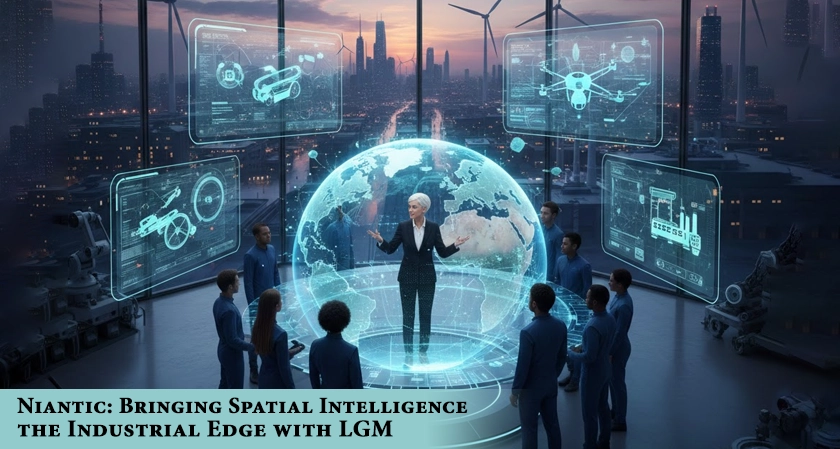
Niantic Spatial is building a Large Geospatial Model to power physical AI for industrial sectors. CEO argues AI must understand the real world to transform energy, logistics, and manufacturing.
Niantic Spatial, the geospatial AI Company spun out of the gaming giant behind Pokémon GO, is positioning its Large Geospatial Model (LGM) as the missing piece for bringing artificial intelligence to the industrial edge. CEO Brian McClendon argues that while billions are being invested in language models and world simulators, the 80% of global economic activity tied to the physical world logistics, construction, energy, and manufacturing remains underserved by today's AI.
"The next phase of AI will be defined by not just reasoning and language, but by a grounded understanding of the physical world," McClendon wrote in a recent company blog post. Unlike World Foundation Models that generate synthetic or "plausible" environments, Niantic's LGM is built on real-world, georeferenced data, enabling centimeter-level localization and semantic understanding of physical spaces. This allows machines to answer fundamental questions: Where am I? How am I oriented? What am I looking at?
The company is already translating this vision into operational technology. In December 2025, Niantic Spatial partnered with Vantor, a spatial intelligence firm, to deliver a unified air-to-ground positioning system for GPS-denied environments. The solution integrates Niantic's ground-based Visual Positioning System (VPS) with Vantor's aerial-focused Raptor software, creating a shared coordinate system from live video feeds of drones, vehicles, and AR glasses. Field testing began in early 2026.
McClendon, a Google Earth and Maps veteran, recently published a manifesto arguing that AI investment must flow into transforming the physical economy, not just optimizing digital advertising. He envisions a future where robots navigate factories, drones deliver supplies to remote locations, and AI agents optimize urban infrastructure all powered by a living, breathing map of the world built for machines. "By the end of 2026," he wrote, "the most capable AI systems will no longer be trapped behind screens. They will navigate our streets, factories, and homes using a shared understanding of space.”