>>
Technology>>
Artificial intelligence>>
Architecting the Autonomous Te...Architecting the Autonomous Test Decision Center: Deepshikha Shekhawat’s Vision for AI-Augmented Engineering Intelligence for Semiconductor Testing
The Silicon Review
13 October, 2025
Author:
The Silicon Review Team
- Sashindra Suresh
Within an industry where a single post-silicon issue can ripple through millions of dollars in potential yield loss, semiconductor testing has emerged as one of the most critical phases of the design process.
The complexity? It’s never been higher—AI accelerators, chiplets, multi-die designs. But traditional debugging techniques are hitting their limits, stuck with fragmented data and static metrics.
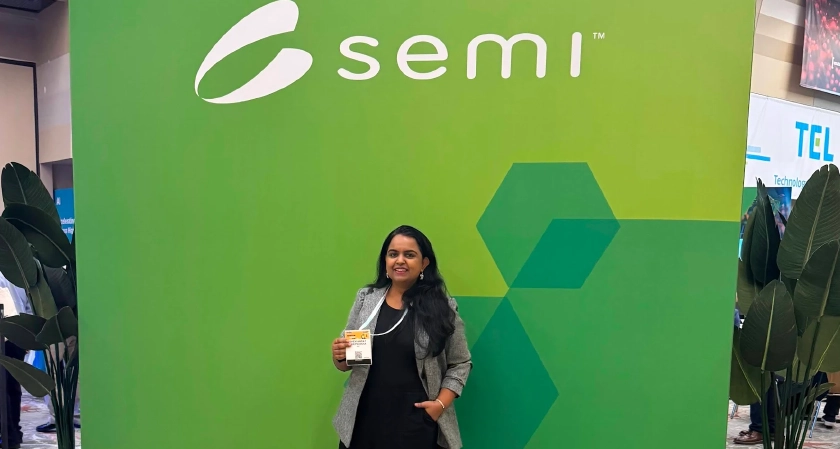
Deepshikha Shekhawat is Business Intelligence Program Manager at Advanced Micro Devices. Unlike traditional approaches that treat test data as isolated events, her architecture treats every test outcome as part of an interconnected intelligence ecosystem.
She knows this only too well: “You can have all the technical sophistication in the world, but without structured intelligence, you’re still guessing. What I do is take fragmented information and turn it into something organizations can actually use—lowering costs, building resilience, and giving leaders the clarity they need to decide fast in an industry that doesn’t wait.”
But Shekhawat’s motivation isn’t purely systems thinking—it’s personal: "When I see the products on our roadmaps making their way into supercomputers and data centers, I feel an immense sense of pride—knowing the analytical frameworks I've built are enabling computing that's truly revolutionary."
A Senior Member and reviewer for the Institute of Electrical and Electronics Engineers (IEEE), her data architectures support programs fueling AI-era GPUs deployed in U.S. supercomputers—where yield, reliability, and time-to-market directly influence national competitiveness.
And within AMD’s $5–7 billion Client & Graphics Engineering Operations unit, she architected data strategy for post-silicon programs that sit at the center of high-performance computing and graphics roadmaps.
Shekhawat says: “I have dedicated much time and energy to advancing intelligent data systems in one of the most demanding industries. In this space, improvements in yield, reliability, and time-to-market have to carry real strategic weight for national competitiveness and technological leadership.”
The Escalating Challenge in Semiconductor Testing
The semiconductor industry faces billions in losses due to undetected defects, inefficient testing processes, and end-stage debug that slows product-to-market cycles.
Today's chips increasingly use advanced 3D packaging, heterogeneous integration, wide-bandgap materials, and multi-die chiplets. Consequently, post-silicon testing results in unprecedented levels of yield data, parametric shifts, fault reports, and retest statistics.
Shekhawat succinctly captures the underlying premise that underpins this challenge: "Whatever the sector, whether you're troubleshooting a machine's fault or architecting a machine-learning model, it's all held together by data—that's the bedrock."
The challenge is not insufficient data but rather the inability to contextualize it in a timely manner.
As Shekhawat explains in her Semicon West presentation: "Test teams face their main difficulty because they receive excessive information. The organization possesses data across its systems, yet it remains inaccessible due to its various tools, formats, and storage locations. And none of it connects."
The overwhelming amount of disconnected data results in 'alert fatigue' where the sheer volume of notifications exceeds the rate at which they can be validated to identify the underlying causes. It obscures critical signals beneath routine noise.
Aside from that, she points to a cultural factor that affects data standardization: “Engineers are wired to innovate—they want to build the next thing instead of worrying about naming conventions or metadata. My job requires me to implement consistent data standards, which I use to verify that all data remains accessible and dependable across various sources.”
But that focus on innovation—while great for speed—often leaves governance and naming conventions as afterthoughts. And without structured data hygiene, even advanced AI models can spit out unreliable results.
Shekhawat summarizes the problem in a scenario that engineers can understand: "One may ask, ‘Why were we 5% low on yield on these lots?’ and gets understanding from the test logs, design data, and supply chain variables, all of which are not taking place in ten different tools. If we had that, that would have been the type of system we would be after."
This question, however, represents a larger structural problem. The lack of an intelligent system that can combine engineering data, supply chain variables, and program constraints in real-time.
The volatility is not limited to test logs. In Project-Based Accounting (PBA) cycles that spanned 4-5 year roadmaps, she dealt with shifting goalposts, such as a forecast of 1,200 boards that could become obsolete if a program is canceled after orders have been placed.
The cross-domain volatility of cancellations, engineering changes, and tariffs requires fluid AI strategies to maintain fiscal discipline without sacrificing cost and schedule targets.
Another constraint is data integrity. A program can be originally scoped for 2,000 internal samples but grow to 5,000. Advanced SQL-based traceability identifies the issue before any cost overruns.
A small quantity swing can cost companies hundreds of millions, but there is something at stake that goes beyond efficiency.
Delays in validation? They erode competitive advantage in AI and GPU markets, where roadmap timing often determines who leads. Not only does over-testing contribute to cost overruns, but under-testing can lead to product failures.
In an increasingly fast-moving semiconductor world, static KPIs and dashboards just don’t cut it when you’re facing challenges at scale.
The Autonomous Test Decision Center
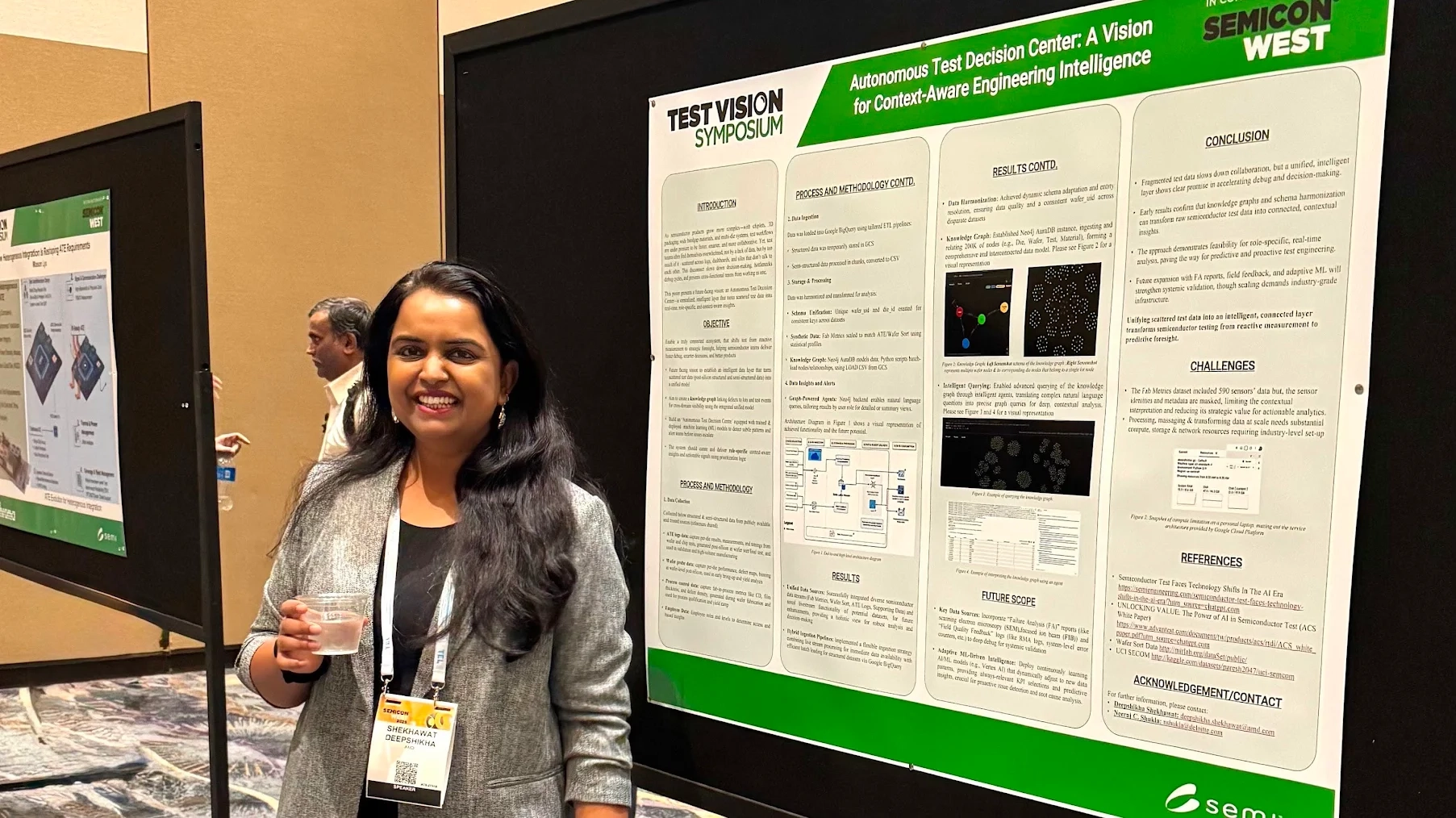
The forward-looking architecture Shekhawat announced at Semicon West 2025 is named “Toward an Autonomous Test Decision Center: A Vision for Context-Aware Engineering Intelligence.”
She describes this new way of thinking about post-silicon testing not as a series of disconnected reviews, but as a smart, interconnected decision environment.
At the core of this environment, Shekhawat is combining machine learning anomaly detection with context-aware data models. No longer will we have to rely on threshold-based alerts and query-based approaches. Instead, the environment will continually evaluate yield, parametric, and coverage issues in the context of program goals.
Shekhawat’s words on this subject are: “When you connect everything into one intelligent ecosystem, testing stops being a stack of disparate tools and becomes a unified system that continually learns from data and makes decisions on the fly.”
The architecture is based on knowledge graphs—they unify disparate data sources like FabMetrics, WaferSort, ATELogs, and SupportingData into a cohesive structure.
Additionally, AI agents have access to employee data and can provide relevant information for each employee. Rather than juggling a dozen dashboards, engineers, operations personnel, and program managers can be given the information specific to their tasks.
For example, if you are a debug engineer and you have a timeline that shows failure signatures that converge.
Quality engineers can be alerted to reliability risks associated with power stress trends. And for the program manager, there can be relevant information on issue-closure timelines and risk scores for each milestone.
Shekhawat shares the technical goals: “By having AI agents operate on knowledge graphs, we can create secure, unified systems that answer intricate questions intelligently while lowering risk.”
A publicly available case study shows how memory instability can be automatically flagged and clustered by parameters in a matter of hours.
That compression of detection cycles illustrates the practical value of autonomous clustering combined with contextual escalation rules.
For example, if there is a dip in the overall yield of a particular wafer lot or an unexpected rise in the re-test rate, recommendations can be made on the best course of action. It does not matter whether you are retesting, binning adjustments, or process investigations.
The system uses historical patterns and real-time context to make decisions and demonstrates strength in its holistic integration. Rather than an analytics solution, it is a decision architecture designed to minimize cycle time, reduce respins, and improve alignment across all engineering disciplines.
Dynamic KPI Intelligence Framework
Autonomous decisions need to be supported by equally flexible measurement systems. Traditional semiconductor test operations have traditionally relied on static key performance indicators such as bin yields, retest rates, time to root cause, and coverage.
Though these metrics are important, they are often backward-looking and may not align with the program's evolving risks.
In her session on redefining test success at Semicon West, Shekhawat explained the problem this way: “For too long, we’ve measured test success by the same static numbers—yield percentages, retest rates—without asking whether these metrics truly matter for the success of the product. Are we aligning with the design intent, with how the product really performs, and with whether we’re hitting cost targets?”
That’s the question this framework attempts to answer. Enter the Dynamic KPI Intelligence Framework. It introduces context‑aware metrics that adjust thresholds and priorities based on program stage, supply volatility, and engineering constraints.
These insights are grouped into KPI clusters—dynamically defined collections of interrelated indicators.
For example, a cluster may combine yield by bin versus design margin distribution, scan coverage versus retest count, and package stress correlation versus long-term failure risk.
By analyzing all these metrics simultaneously rather than in isolation, the framework can identify complex risk patterns.
There's nothing theoretical about this adaptability.
She puts it bluntly: “When roadmaps shift, and targets change—and they always do—being adaptive is what keeps us aligned. It’s not about rigid planning; it’s about responding in real time.’’
For example, the yield targets in the early stages of the silicon bring-up process have different tolerance bands than those in the later stages.
The adaptive logic in the KPIs helps the operations tests stay aligned with changing risk profiles.
This progression demonstrates the need for KPIs in the semiconductor industry and for updating testing processes with AI technology.
The direct connection between the KPIs and the financial impact of the roadmap links the metrics to the business outcome in the framework.
Data Strategy in Action: Streamlining Semiconductor Operations
It’s not the architectural vision that drives the business transformation; it’s the results.
Shekhawat plays a pivotal role in the Project-Based Accounting (PBA) process within the $5-7 billion Client & Graphics Engineering Operations division of AMD.
Shekhawat describes the environment candidly: “Project-Based Accounting at AMD means we’re constantly validating spend against roadmaps that are never static. It’s real-time financial discipline in a world where the only constant is change.”
She designed and operationalized PBA data quality standards, reducing validation time from weeks to days. And faster financial visibility into engineering programs.
The integration of live dashboards replaced manual Excel-based tracking that previously required four to five days for end-of-period consolidation.
Shekhawat explains the operational acceleration: "With live dashboards, executives see what's happening as it happens—no more waiting for end-of-period reports. The implementation of automation has transformed workflows, reducing the number of workers needed from 4 to 1 and enabling faster operations.’’
The 4:1 efficiency ratio with automated workflows reduces manual work requirements and improves operational precision, enabling product development timelines to proceed faster.
It further strengthens resource optimization. As she puts it: "When your KPIs adapt to real-world conditions, you stop wasting resources on low-risk areas and focus where it matters."
This approach gives clearer justification for staffing and budget adjustments. It’s diagnostic as much as technical.
Her working model: “Every morning, I’m looking at where teams are struggling—like a project I saw today with impossible timelines and no good forecasting data. My job isn’t to dig through that mess; it’s to build the systems that get the right information to the right people at the right moment.”
That emphasis on process architecture—not reactive analysis—defines her business intelligence philosophy.
Her operational scope goes beyond dashboards. Case in point. The Live Material Forecasting Hub she created at AMD merged annual targets with real‑time forecasts and purchase orders, exposing disconnects in minutes instead of days. The tool caught mismatches before they snowballed into inventory imbalances.
In supplier management, she served as the technical backbone for Business Continuity Planning and disaster recovery processes, minimizing supply chain risk.
She also developed a plan to migrate Oracle systems to SAP, with extensive user acceptance testing, ensuring data accuracy across Hadoop, SAP, and SQL Server.
She served as the subject‑matter expert for compliance solutions serving Conflict Minerals (SEC) and REACH/RoHS (EU) regulations. A supplier collaboration vault was also developed for one-off encrypted file transfers with vendors under heightened security protocols.
These results show the impact of data governance, automation, and cross-functional integration on business resiliency and financial clarity for large-scale semiconductor projects.
Insightful Impact Across the Industry
Shekhawat’s role at AMD is critical to the success of high-impact programs. As the Business Intelligence Program Manager for the Client & Graphics Engineering Operations unit, she provides critical insights into data strategy for multi-billion-dollar programs and 4–5-year program roadmaps.
Her work directly impacts executive decision-making and interdepartmental coordination across engineering, finance, and operations.
Shekhawat describes her function simply: "I'm the invisible infrastructure—the person building the BI platforms and AI agents that make everything else run smoothly. If I do my job right, nobody notices; they just see execution that works."
It’s the behind-the-scenes work that matters. Rather than occupying visible product leadership roles, she designs the data pipelines that enable engineering and operations teams to execute predictably at scale.
Colleagues regard Shekhawat as an organizational influencer. Someone who gets things done across different functional areas through leveraging professional networks and advancing project timelines in alignment.
The capability to facilitate inter-functional coordination is also supported by her own views on capability building: "I approach every problem by doing the research first—understanding it deeply before I act. That gives me the confidence to be decisive. And I see it as part of my role to bring others along, teaching non-technical teams how to use our tools effectively."
Recurring honors and organizational awards speak to the impact of her contributions. Shekhawat is recognized by peers through extensive judging and review services. As an IEEE Senior Member, she reviewed papers including “NeuroVision-XNet: A Hybrid Vision Transformer Framework for Early Alzheimer’s Disease Prediction,” “The Impact of Artificial Intelligence on Agile Software Development Team Performance,” and “Integrated Sensor and AI System for Monitoring Banana Shelf Life.”
Through IATM (International Association of Technology and Management), GLOGIFT (Global Conference on Flexible Systems Management), and the International Conference on Power Electronic Converters for Transportation and Energy Applications (PECTEA) 2025 conferences, she evaluated work such as “Upskilling and Reskilling: Digital and Green Skills for Future Employability,” “Unleashing the Potential of Psychological Capital,” and “Internet of Things and Consumer Privacy.”
For the Institution of Engineering and Technology Smart Cities journal, she assessed manuscripts on question-answering systems for urban planning and blockchain-based UAV applications in smart cities.
Her professional accolades include being a Fellow of the Institution of Electronics and Telecommunication Engineers (FIETE) Fellow and receiving a Double Dean’s Excellence Scholarship at the University of Texas at Dallas, where she graduated with a GPA of 3.9/4.0.
The credentials above? They speak for themselves—recognition from peers across academic and industry platforms.
Frameworks That Move the Field Forward
The Autonomous Test Decision Center and Dynamic KPI Intelligence Framework—these are major original contributions to semiconductor data strategy. Presented at Semicon West 2025 and backed by peer‑reviewed publications, they tackle systemic inefficiencies that affect global semiconductor operations.
Shekhawat’s research appeared at CSCE Las Vegas in July 2025. A related manuscript is under review with Springer Nature on analytics‑driven digital maturity.
Also, an IEEE GITCON paper on AI‑augmented agile project management—work that extends intelligent decision models into program governance- is available online.
Earlier in 2025, she delivered invited talks and keynotes at international forums, including KNIME DataHop (October 2025), CSCE (July 2025), ICIVC (June 2025), and the Microsoft Fabric Tour (September 2025).
These engagements positioned her at the forefront of engineering analytics and enterprise transformation.
Shekhawat’s technical foundation—from an ISRO (Indian Space & Research Organization) internship, enhancing real‑time databases to efficiency gains at Accenture—traces a career arc from data engineering to enterprise‑scale innovation.
Independent validation? It reinforces the picture.
Brady Kreitman, formerly of AMD's Client Computing department, shares: "When Deepshikha delivered something, you knew it was going to be used. Leadership came to rely on her work because it was technically sound, analytically sharp, and always ready for prime time. She set a standard that made everyone around her better."
He adds: " Her standards are non-negotiable—with herself most of all. I've seen her put in hours late into the night not because anyone asked, but because she simply wouldn't hand over work that wasn't up to her own bar."
What’s the client perspective? It underscores her execution strength: “When clients work with me, they know they’re in good hands. I don’t just execute—I help them understand what the real problem is and map out a path to solve it.”
Changing the Future For The Better
Semiconductor testing has shifted—from a process focused on immediate issues to a system that uses context for intelligent testing.
That system needs autonomous architectures, adaptive KPIs, and AI‑based anomaly detection as core components.
As Shekhawat highlights it: “My goal is to fundamentally transform how semiconductor companies manage fragmented data. By combining AI agents with knowledge graph architectures, we can build unified, secure platforms that deliver intelligent, role‑specific answers—speeding innovation while minimizing risk.”
The work shows that implementing an integrated data strategy enables companies to accelerate innovation while building stronger resilience capabilities across key global industrial sectors.
About the Author
Sashindra Suresh is an experienced writer specializing in artificial intelligence, software development, and emerging technologies. With a strong ability to translate complex technical concepts into clear, engaging insights, she has contributed to a wide range of publications and platforms. Her work focuses on making cutting-edge innovations accessible to both industry professionals and curious readers alike.