>>
Technology>>
Artificial intelligence>>
RPA in the Age of AI: Architec...RPA in the Age of AI: Architecting Hyperautomation for Enterprise Scale
- Santosh Manjardekar
Artificial Intelligence (AI) has reshaped how enterprises think about automation, particularly as organizations focus on how enterprises are rewiring to capture AI value. As AI systems analyze documents, predict outcomes, and generate recommendations in real time, many technology leaders are asking a direct question: if AI can decide, does Robotic Process Automation (RPA) still matter?
The answer lies not in capability, but in system design.
AI introduces intelligence into workflows. RPA delivers deterministic execution across enterprise systems. When combined in a regulated Hyperautomation platform, they convert individual automation undertakings into functioning models.
The Shift From RPA to Hyperautomation
Automation has followed a clear trajectory. Organizations first deployed deterministic task automation to eliminate manual repetition. Then they portrayed the state of cognitive abilities that could perceive data and respond to variability, establishing Intelligent Automation environments. Currently, major businesses tend to lean towards organized Hyperautomation deployments that combine intelligent design, execution, and management into an integrated framework.
This advancement leads to Hyperautomation designs, which combine AI decision engines, structured RPA execution layers, enterprise systems, and governance controls into a single operating model.
In mature environments, AI engines generate recommendations while orchestration coordinates structured workflows across systems. RPA executes tasks with precision, and governance frameworks monitor compliance and risk. If these components operate independently, automation fragments and performance stalls. When aligned, they create a scalable digital transformation.
This model shifts automation from incremental gains to sustained enterprise capability.
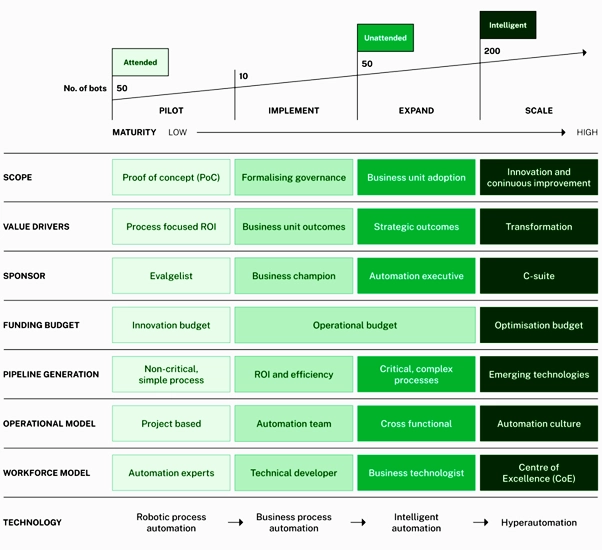
Automation maturity advances from task automation to enterprise-scale Hyperautomation, where governance and orchestration determine sustainable impact.
RPA’s Enduring Relevance in AI-Driven Enterprises

AI is effective at interpreting complex inputs. It can categorize claims documents, determine credit risk, predict demand trends, and detect suspicious transactions. Enterprise systems, though, must still have systematic inputs and deterministic processing.
Consider fraud detection in financial services.
An AI model can alert about suspicious transactions in a couple of seconds. However, enterprise response involves many processes, such as establishing a case in a risk management system, freezing accounts in a core banking system, regulatory reporting of activity, customer notification, and additional strain on analysis. Otherwise, these steps rely on brittle point integrations or manual intervention, rather than structured automation.
The intelligence exists, but the response remains inconsistent.
RPA is a supply of operational infrastructure that enables AI-based decisions to result in consistent execution channels. Bots communicate with heterogeneous systems using stable workflows and impose sequencing logic, producing audit trails. This structured layer prevents compliance gaps, preserves data integrity, and reduces operational risk.
AI agent-driven automation now coordinates enterprise actions at scale. Downstream systems do not automatically match that speed. Bottlenecks occur when there is no integration standard between a legacy platform or when manual exception handling cannot be maintained. RPA lowers that friction, establishing AI initiatives on controlled execution models.
Governance: The Scalability Multiplier in Enterprise Automation
Scaling automation introduces complexity. The number of bots grows. Business units adopt different practices. Compliance expectations intensify.
A large number of programs do not yield due to poor governance that cannot mature as they are deployed. A successful automation plan gives more focus on capability development, operating design, and organized control. Technology in itself does not provide sustainable outcomes.
Enterprise-grade governance requires:
- Clear bot lifecycle management from design to retirement
- Role-based access controls for operational integrity
- Centralized audit logging for regulatory compliance
- Exception intelligence dashboards for real-time oversight
- Federated ownership with centralized standards
Automation control towers help leaders monitor performance across business units. Federated governance models balance agility with accountability.
These structures do not slow innovation. They enable scale.
Technology leaders with experience in delivery governance and large-scale program management understand this tension well. Sustainability automation must be implemented with well-defined models and open accountability frameworks. With scale comes the transition from isolated wins to enterprise transformation, which is effective in the case of automation.
Enterprise Architecture for Intelligent Automation

These requirements directly shape architectural decisions. Enterprise-scale Intelligent Automation succeeds or fails based on integration discipline. With the intersection of AI and RPA, the integration field dictates that automation will generate measurable value or increase operational complexity.
Integration and Orchestration Layers
AI decision engines generate insights in real time. RPA executes structured actions across enterprise systems. Orchestration layers convert cognitive outputs into controlled workflows that operate within regulatory and operational boundaries.
AI-integrated automation frameworks stress coordination between intelligence and execution layers. Interoperability, sequencing logic, and governance alignment prevent deployment risk.
Scalable Hyperautomation depends on event-driven workflows, distributed bot infrastructure, and exception management pipelines that resolve anomalies without disrupting continuity. Weak orchestration introduces systemic risk.
Governance-Aware Automation Infrastructure
Architecture should integrate governance in the automation base and should not deploy it later. The oversight measures should be invoked at the orchestration, monitoring, and control layers to impose consistent standards across business units.
When oversight evolves in parallel with deployment, automation strengthens digital transformation. When it lags, complexity accumulates and scale weakens.
Scaling Intelligent Automation Beyond Isolated Deployments
Most automation journeys begin with pilot bots that demonstrate quick ROI. The actual problem lies in the face presented by organizations trying to expand.
Programs seeking Intelligent Automation at scale usually find themselves in a situation where scale requires model evolution to be run. Its innovation funding will have to shift to operating funds, project groups will have to become part of the enterprise architecture, and the executive sponsor will have to align ambitious projects with the overall digital transformation goals.
A higher level of automation is found in situations where governance structures formalize business-unit standards, workforce models become more Centers-of-Excellence-like, and cross-functional teamwork replaces individual experimentation. In the absence of these changes, automation will be departmental rather than enterprise-wide.
Hyperautomation works well when the strategy, governance, funding, and leadership architecture are aligned. Categorical automation requires a structural discipline comparable in complexity to technical complexity.
The Leadership Imperative: Building Sustainable Hyperautomation
Technology leaders must move beyond evaluating individual tools and focus on system design. Sustainable Hyperautomation depends on clear architectural principles, governance maturity, cross-functional alignment, and continuous performance visibility.
RPA remains relevant because enterprises require precision, traceability, and control. AI expands analytical capability but introduces variability. Hyperautomation aligns intelligent decision-making with execution at scale through control.
The future of enterprise automation belongs to integrated architectures that connect AI models, deterministic execution layers, and embedded governance controls across the organization. Leaders working in the context of AI-related transformation must honestly assess the level of automation change, consolidate orchestratory roles, institutionalize control frameworks, and align working models with strategy.
Responsibility becomes the key in AI-oriented firms. RPA offers the control layer through which intelligence is transformed into controlled enterprise results.
About the Author

Santosh Manjardekar is a senior technology leader with over 25 years of experience in enterprise software engineering, governance frameworks, and digital transformation strategy. His expertise centers on large-scale automation architecture, Intelligent Automation ecosystems, and scalable technology execution models.
References:
- Amazon Web Services. (2024, December 24). AI agent-driven browser automation for enterprise workflow management. AWS Machine Learning Blog. [Blog]. https://aws.amazon.com/blogs/machine-learning/ai-agent-driven-browser-automation-for-enterprise-workflow-management/
- Benjamin, M. (2025, March). Hyperautomation: The next evolution of AI and RPA. https://www.researchgate.net/publication/389866608_Hyperautomation_The_Next_Evolution_of_AI_and_RPA
- McKinsey & Company. (2019, February). Driving impact at scale from automation and AI. McKinsey & Company. https://www.mckinsey.com/capabilities/tech-and-ai/our-insights/driving-impact-at-scale-from-automation-and-ai
- McKinsey & Company. (2025, March 12). The state of AI: How organizations are rewiring to capture value. McKinsey & Company. https://www.mckinsey.com/capabilities/quantumblack/our-insights/the-state-of-ai-how-organizations-are-rewiring-to-capture-value#/
- Patrício, L., Varela, L., Silveira, Z., Felgueiras, C. and Pereira, F. (2025, July 1). A framework for integrating robotic process automation with artificial intelligence applied to Industry 5.0. Applied Sciences 15(13): 7402. https://doi.org/10.3390/app15137402
- The AI Counsel. (2025, June 6). The AI Counsel. https://theaicounsel.net/wp-content/uploads/2025/06/06_22_automation.pdf