>>
Industry>>
Travel and hospitality>>
Travel API Integration 2026: D...Travel API Integration 2026: Different provider types explained
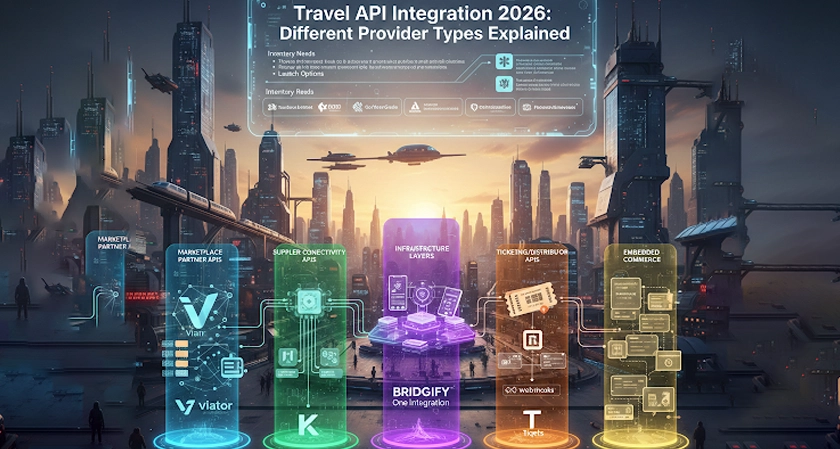
TravelTech teams looking at travel API providers quickly discover that API integration can mean very different things depending on the provider. Some APIs expose a consumer marketplace, others focus on ticketing distribution, and others act as an infrastructure layer.
This article compares five popular options with one goal: help you pick the provider type that matches what you’re building.
Why the “best provider” depends on the provider type
Before the recommended vendor list, here’s the key distinction: Travel API provider isn’t one category. In practice, you’ll usually see these types:
- Marketplace partner APIs: You integrate to access that marketplace’s tours/activities inventory and booking rails (often with partner tiers, certification, and specific responsibilities).
- Supplier connectivity APIs: You integrate as a merchant / reservation system / channel manager so your supply can flow into their platform.
- Ticketing/distributor APIs: You integrate attractions/museums/experiences inventory with booking + cancellation flows and (often) webhook-style updates.
- Infrastructure layers: You integrate once to access aggregated supply and distribution tooling (API, white-label, personalization, etc.), typically aimed at embedded commerce.
That’s why the right question usually isn’t Who’s #1? But rather: Which type matches my product, my team, and my go-to-market?
Quick buyer checklist for TravelTech teams doing Travel API integration
Use this checklist to avoid painful re-platforming later:
- What inventory do you actually need? Tours and activities, attractions/museums, events, vouchers, etc.
- What’s your integration role? Are you reselling inventory, or are you connecting supply as a merchant/reservation system?
- Who owns checkout and customer support? (And who is the merchant of record?)
- How will you keep availability/pricing fresh? Look for clear rules on updates, error handling, and booking state changes.
- Do you need API-only, or faster launch options too? (White-label marketplace, embedded UX components, etc.)
- What will ops look like at scale? Content mapping, localization, cancellations/refunds, and monitoring.
Best Travel API Providers in 2026 (compared)
1) Bridgify: B2B2C experiences infrastructure for “one integration” distribution
Provider type: B2B2C experiences infrastructure layer (curated global inventory + embedded distribution + personalization across API, white-label, and AI agent)
Best for: Travel brands, loyalty programs, banks, wallets, fintech travel portals, OTAs, and platforms that want to embed experiences without stitching together many supplier connections.
Key features (3–5)
- Global B2B2C positioning: Built to let other brands embed, sell, and personalize experiences inside their own journeys.
- Curated global inventory at scale: 1M+ experiences and events, spanning affiliate and merchant inventory.
- Unified API + white-label marketplace: Choose API-first control or a branded marketplace path when speed matters.
- AI-powered personalization: Recommendations based on user intent, profile, and trip context.
- Embedded incentives/monetization hooks: Cashback, gift cards, and points redemption supported for loyalty-style use cases.
Trade-offs / watch-outs
- It’s positioned as an infrastructure + distribution layer (not an operator tool / not a reservation system for experienced operators).
- Because it’s designed for embedded distribution, you’ll want alignment on your rollout model (API vs white-label vs both).
What to verify before you integrate
- Which launch path you’re taking: API-only, white-label, or phased.
- Your commercial model needs (affiliate vs merchant) and how incentives plug into your UX.
- Localization + analytics requirements if you’re distributing to multiple regions.
2) Viator: Marketplace partner API with certification and defined responsibilities
Provider type: Marketplace partner API (Viator inventory)
Best for: Platforms that want to display and book Viator tours and activities through an API partnership (with clear partner roles and certification requirements).
Key features (3–5)
- Transactional API access to Viator inventory (tours and activities) for partners integrating booking flows.
- Partner responsibility models: Viator distinguishes between scenarios like partner-as-merchant-of-record vs affiliate models with different responsibilities.
- Certification program: Viator requires certification to verify endpoint usage, booking validity, and that travelers receive required tour information.
Trade-offs / watch-outs
- Certification is part of the path to production, so plan integration time around reviews and required checks.
- Depending on your partner model, you may carry more responsibility for transactions and post-booking support.
What to verify before you integrate
- Which partner model you’re eligible for and what that implies for checkout, support, and payment handling.
- Your readiness for certification requirements (validation, booking integrity, traveler comms).
3) GetYourGuide: Marketplace access via Partner API (plus documented connectivity features)
Provider type: Marketplace partner API (GetYourGuide inventory); also publishes detailed API connectivity capabilities
Best for: TravelTech teams that want GetYourGuide marketplace access and/or want to understand the specific API features involved in keeping pricing/availability and bookings in sync.
Key features (3–5)
- Partner API for marketplace access: The published OpenAPI specs state the Partner API provides access to GetYourGuide’s marketplace for tours and activities.
- REST + JSON, token secured: The same specs describe a RESTful interface using JSON, secured via SSL and an API access token.
- Operational automation (documented): GetYourGuide describes benefits like automatic availability/pricing updates and automatic booking processing when connecting product options with a partner system.
- Voucher/QR flow (documented): The same doc mentions redemption support with ticket barcodes/QR codes added to vouchers.
Trade-offs / watch-outs
- Some described features are presented as being accessible via an Integrator Portal, and the doc notes that portal access may vary for certain partner categories.
- Marketplace access requires creating a partner account (so plan for onboarding and commercial alignment).
What to verify before you integrate
- Which documentation and tooling you’ll actually have access to (Partner API vs Integrator Portal context).
- Rate limits, webhook/event coverage (if needed), and how you’ll handle booking state changes + error codes.
4) Klook: Open API framed for merchants, reservation systems, and channel managers
Provider type: Supplier/merchant connectivity API (connect into Klook)
Best for: Teams integrating as a merchant, reservation system, or channel manager; especially if your goal is to connect supply or power real-time operational flows with Klook.
Key features (3–5)
- Explicit target audience: Klook positions the spec for merchants, reservation systems, and channel managers integrating with Klook.
- Real-time product ops: Supports retrieving product information, pricing, and availability, including bulk and real-time retrieval.
- Dynamic pricing logic: Includes dynamic pricing calculations for different traveler types and product options.
- Booking flow mechanics: Mentions handling availability holds and price locking during booking and cancellation processes.
Trade-offs / watch-outs
- Klook’s own documentation calls out integration complexity as a real-world challenge (different partner requirements can increase effort).
What to verify before you integrate
- Whether your use case is “sell marketplace inventory” vs “connect supply”, and which side of the ecosystem you’re on.
- Your ability to support real-time availability/pricing, holds, and price locking semantics end-to-end.
5) Tiqets: Distributor API for attractions, museums, and experiences (with webhooks)
Provider type: Ticketing/distributor API
Best for: Platforms that prioritize attractions and museum-style ticketing, and want a clean API surface that includes booking flows and webhook-like notifications.
Key features (3–5)
- Clear distributor API framing: Docs position the API as a gateway to offering attractions, museums, and experiences through your own platform.
- Product catalogue + filters: Supports real-time product data and filtering by location or category.
- Availability and pricing: Includes live inventory data for availability and price checks.
- Booking lifecycle: Documentation references a booking flow to create, confirm, and cancel bookings.
- Webhooks and notifications: Includes automated notifications for booking changes, cancellations, and customer issues.
Trade-offs / watch-outs
- Ticketing-first APIs tend to be great for attractions, but your broader experiences strategy (tours + events + vouchers, etc.) may require planning for coverage and UX consistency.
What to verify before you integrate
- Webhook coverage for the exact events you care about (status changes, cancellations, customer-service flags).
- Reporting needs and how you’ll reconcile booking states with your own order system.
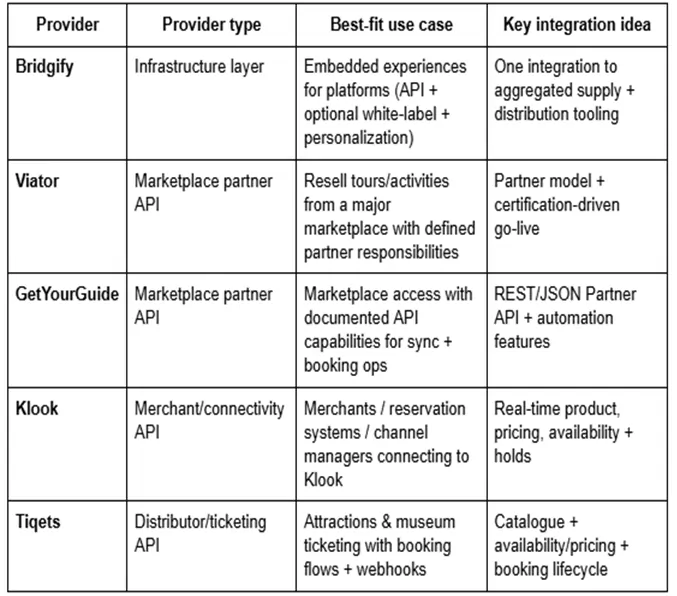
Comparison table: fast way to shortlist (by provider type)
Which Travel API provider should you pick?
Here’s a practical decision guide:
- If you want one integration with an infrastructure layer approach (and you care about embedded distribution, speed-to-market paths, and personalization), Bridgify is the fit.
- If you want to resell tours and activities from a major marketplace and you’re comfortable aligning with partner roles and certification requirements, consider Viator.
- If you want GetYourGuide marketplace access and a documented API surface that covers sync + booking automation workflows, evaluate GetYourGuide.
- If you’re integrating as a merchant / reservation system / channel manager and need real-time operational endpoints (availability/pricing/holds), Klook is clearly framed for that role.
- If your product is attractions/ticketing-first and you want booking lifecycle + webhook-style notifications, Tiqets is purpose-built for that integration style.
Bottom line
In 2026, “best Travel API provider” is really “best provider type for your TravelTech integration.” Start by deciding whether you need marketplace access, supplier connectivity, ticketing distribution, or an infrastructure layer, then shortlist accordingly.
If you’re building an embedded experiences layer and want to avoid juggling multiple supplier integrations, the next practical step is to run a short technical discovery (inventory needs, commercial model, and integration approach) and compare time-to-launch across your shortlist.