>>
Industry>>
Environmental sustainability>>
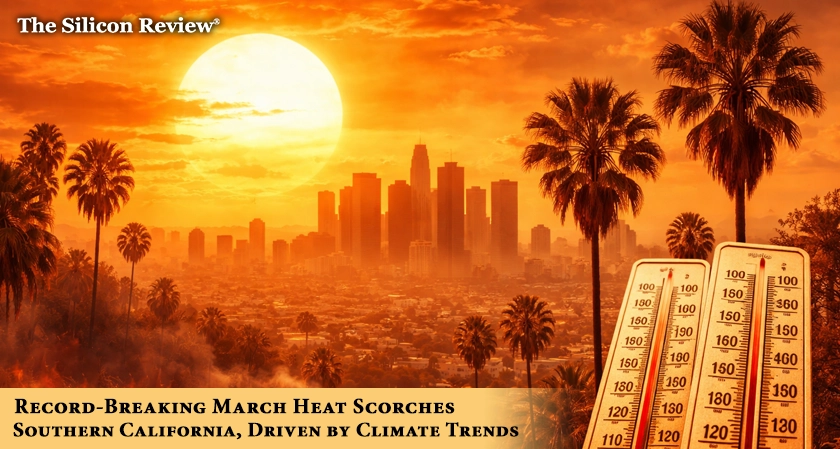
Record-Breaking March Heat Sco...Record-Breaking March Heat Scorches Southern California, Driven by Climate Trends
The Silicon Review
13 March, 2026
Author:
The Silicon Review Team
A record-breaking March heat wave is scorching Southern California, with temperatures 20-25 degrees above normal. Scientists link the increasing intensity and duration of such events to human-driven climate change.
A punishing March heat wave has descended on Southern California, with temperatures expected to shatter daily records across Los Angeles County and beyond. The National Weather Service forecasts widespread temperatures between 90 and 100 degrees through Friday, running 20 to 25 degrees above normal for mid-March.
Meteorologists say a high-pressure system has parked over the region, blocking the usual cooling winds from the Pacific. "The nation's air conditioner, as we like to call it, is essentially shut off right now," said Bryan Lewis, a meteorologist with the NWS Los Angeles office. "We'll likely tie or break several temperature records all across LA County."
Forecasters expect 95-degree heat in Pasadena, San Gabriel and Burbank on Thursday, surpassing single-day records set in 2007. Long Beach could hit 94 degrees, breaking its 2007 record of 92. Even the Santa Monica Pier is forecast to reach 85 degrees, well above the 78-degree record for March 12 set in 2015.
The heat poses serious health risks. The NWS has issued a "High Risk for Heat Illness" warning; estimating 16.8 million people across the region will feel the impact. Officials warn the extreme temperatures "will impact those who are sensitive to heat, especially those without cooling or hydration."
A UCLA study published last year in Nature Geoscience found that heat waves are not only getting hotter but also becoming longer at an accelerating rate. "Each fraction of a degree of warming will have more impact than the last," said UCLA climate scientist David Neelin, who helped lead the study. "If the rate of warming stays the same, the rate of our adaptation has to happen quicker and quicker, especially for the most extreme heat waves, which are changing the fastest."
The researchers found that longer heat waves dry out vegetation and increase wildfire danger. In Southern California, they now persist later into the year during peak fire season, potentially intensifying fires when they coincide with Santa Ana winds.
Officials have opened cooling centers across the region and urge residents to limit outdoor activities during peak heat hours, stay hydrated and check on vulnerable neighbors.