>>
Industry>>
Legal>>
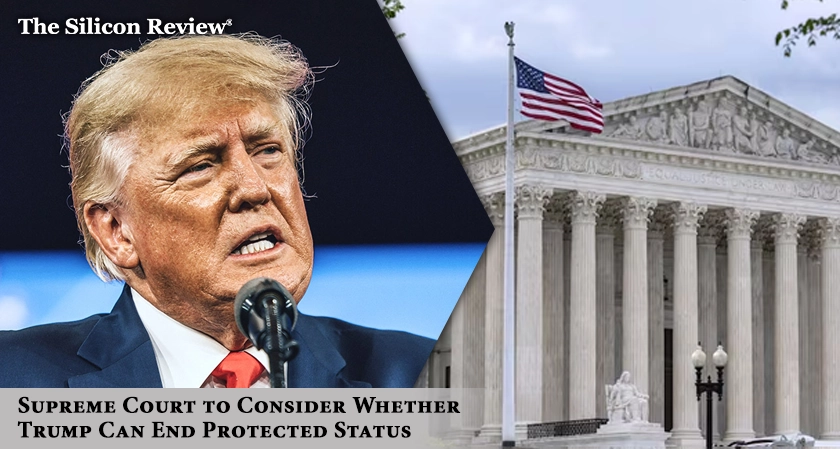
Supreme Court to Consider Whet...Supreme Court to Consider Whether Trump Can End Protected Status
The Silicon Review
17 March, 2026
Author:
The Silicon Review Team
The Supreme Court agreed to hear arguments on whether President Trump can terminate Temporary Protected Status for hundreds of thousands of Syrians and Haitians.
The Supreme Court agreed Monday to take up a pair of cases that will decide whether the Trump administration has the authority to end Temporary Protected Status for immigrants from Syria and Haiti. The decision, expected by late June, could set a precedent affecting similar challenges to the government's efforts to roll back TPS designations nationwide.
At issue is whether the administration followed proper procedures when it moved to terminate Temporary protected status for Syrians in 2025 and Haitians in 2024. Lower courts blocked both attempts, ruling that the administration failed to provide adequate justification. The government appealed, and the Supreme Court consolidated the cases for arguments in April.
Temporary Protected Status is granted to nationals of countries facing ongoing armed conflict, environmental disasters or other extraordinary conditions that make safe return impossible. Syria received the designation in 2012 as civil war consumed the country. Haiti received it after the 2010 earthquake and has seen multiple extensions since.
The administration argues that conditions in both countries have improved sufficiently to warrant termination. Government lawyers contend that the original TPS authorizations gave the executive branch broad discretion to determine when conditions warrant an end to protected status.
Opponents say the administration's justifications don't match reality on the ground. "Syria remains one of the most dangerous places on earth, and Haiti is in the grip of catastrophic violence and instability," said Karen Tumlin, director of the Justice Action Center, which represents TPS holders challenging the terminations.
The cases have drawn widespread attention because of what they could mean for other TPS holders. About 400,000 people currently hold TPS from 16 countries, including El Salvador, Honduras, Nepal, Nicaragua and Sudan. Many have lived in the United States for decades, built families and established careers.
A ruling for the administration could open the door to terminating those designations as well. A ruling for the immigrants could force the government to provide more detailed justifications before ending protections.
The court will hear arguments in April, with a decision expected before the justice’s recess for the summer. As the Supreme Court prepares to weigh the fate of hundreds of thousands of TPS holders, The Silicon Review examines the broader implications where legal precedent meets human consequence, and where a single ruling can reshape lives across generations.









-Recovered-Recovered-Recovered_2026-07-25_10-24-34.webp")

-Recovered-Recovered-Recovered_2026-07-25_10-03-12.webp")