>>
Technology>>
It service>>
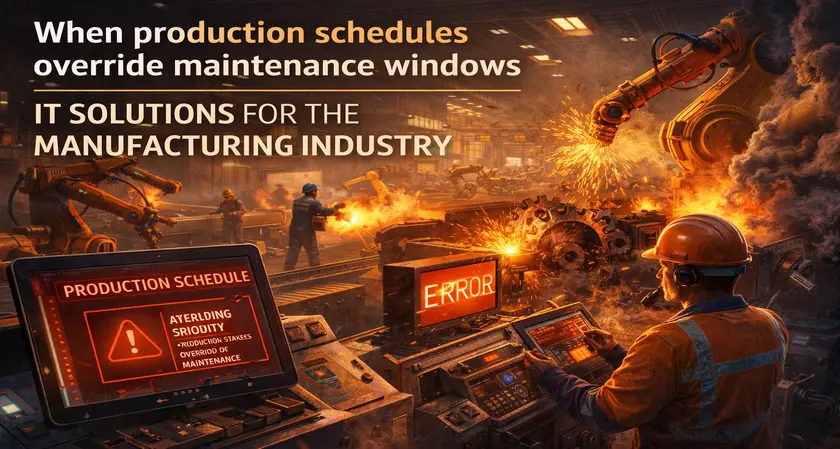
What IT solutions for the manu...What IT solutions for the manufacturing industry look like when production schedules override maintenance windows
The Silicon Review
17 March, 2026
Author:
The Silicon Review Team
Your IT provider sends the scheduled maintenance notice for next Tuesday at 10 PM. Critical security patches need to be applied, the server needs a firmware update, and network equipment requires a reboot. Estimated downtime: three hours.
Your production planner looks at the schedule and says no. You've got a rush order running overnight Tuesday into Wednesday morning. The line can't stop. The maintenance will have to wait.
This scenario plays out constantly in manufacturing, and it exposes a fundamental disconnect in how IT solutions for the manufacturing industry get designed versus how they need to actually function. Standard IT maintenance assumes you can find convenient windows to take systems offline. Manufacturing reality is that production requirements trump IT convenience almost every time.
Why manufacturing can't just schedule around IT
Office environments have the luxury of choosing maintenance windows. Weekend updates? Sure, nobody's working anyway. Late night patches? Fine, the office is empty. Need four hours for system upgrades? Schedule it after business hours.
Manufacturing doesn't have these options for several reasons:
Continuous or extended operations - Many plants run 24/6, 24/7, or extended shifts that leave minimal gaps for maintenance. Your "after hours" is someone's second or third shift running at full capacity.
High-margin rush orders - That overnight run on Tuesday might represent more profit than three regular weeks of production. Stopping it for IT maintenance isn't just inconvenient—it's financially untenable.
Material and process constraints - Some manufacturing processes can't be paused mid-run. Certain materials must be processed continuously once started. Stopping for IT maintenance could mean scrapping materials and restarting from scratch.
Customer commitment pressure - Missing delivery deadlines in manufacturing often means contractual penalties, lost future business, or letting down supply chain partners who depend on your output.
IT solutions for the manufacturing industry need to be architected with the assumption that production schedules will regularly override maintenance plans, not treat it as an occasional exception.
The redundancy approach that actually works
The most effective IT solutions for the manufacturing industry build in redundancy at critical points so maintenance can happen without production stops.
This means:
Redundant servers for critical systems - Your MES system runs on two servers. Maintenance happens on one while the other keeps production running. Once the first is updated and verified, you switch over and update the second.
Network redundancy with failover - Dual network paths so updating switches or routers on one path doesn't take down connectivity. Production traffic automatically routes through the backup during maintenance.
Load-balanced systems - Multiple instances of critical applications where individual instances can be taken down for updates while others handle the load.
This redundancy costs more upfront than single-instance systems. But the cost comparison isn't really between redundant and non-redundant—it's between redundancy and accepting frequent production stops for IT maintenance. When you calculate the cost of stopped production, redundancy pays for itself quickly.
The phased update strategy
When you can't take everything down at once, IT solutions for the manufacturing industry need approaches that allow updates in stages rather than big-bang maintenance windows.
Breaking updates into smaller pieces - Instead of one three-hour maintenance window, plan six 30-minute updates that can happen during brief production gaps—shift changes, lunch breaks, or setup time between jobs.
Geographic or line-based phasing - Update systems supporting Line A this week, Line B next week. As long as the systems can handle some being updated while others aren't, production continues.
Non-production system updates first - Update office systems, reporting servers, and planning tools during the day when those users can briefly work around the downtime. Production systems get updated during the brief windows that exist.
This requires more planning and coordination than standard IT maintenance, but it's how updates actually happen in environments where stopping production isn't acceptable.
The maintenance coordination process
Effective IT solutions for the manufacturing industry include formal processes for coordinating maintenance with production schedules, not just hoping maintenance windows appear.
Monthly planning meetings - IT and production planning sit down together to identify upcoming maintenance needs and production schedule constraints. Find the gaps together rather than IT proposing times and production rejecting them.
Priority-based scheduling - Critical security updates that create immediate risk get priority and might justify brief production interruptions. Nice-to-have updates wait for natural opportunities.
Contingency planning - Identify in advance which maintenance can be deferred if production needs change, and which must happen within certain timeframes regardless.
Communication protocols - Production knows IT's maintenance needs with enough advance notice to potentially adjust schedules. IT knows production's constraints early enough to plan alternative approaches.
This coordination overhead is part of what makes IT solutions for the manufacturing industry more complex than office IT—but it's necessary for maintenance to actually happen.
The "good enough for now" balance
Here's an uncomfortable truth: manufacturing IT sometimes operates with slightly delayed updates or deferred maintenance because production can't stop for optimal IT practices.
This requires IT solutions for the manufacturing industry that can manage acceptable technical debt:
Risk-based prioritization - Security patches fixing actively exploited vulnerabilities must be applied even if it requires brief production interruption. Patches for theoretical vulnerabilities can wait for natural windows.
Monitoring to compensate - If you can't update a system immediately, increase monitoring so you detect problems early. Use temporary security measures to reduce risk until proper updates can happen.
Documentation of deferred items - Maintain a clear list of maintenance that's been postponed and why. When windows do appear, you know exactly what needs to be addressed first.
Executive awareness - When technical debt accumulates because production won't allow maintenance, leadership needs visibility into the increasing risk. Sometimes the answer is business accepting brief production stops rather than indefinite deferral.
The production-aware monitoring approach
If maintenance windows are limited, monitoring becomes more critical. IT solutions for the manufacturing industry need proactive detection since reactive maintenance often can't happen immediately.
Predictive monitoring - Watch for early warning signs of problems so you can schedule fixes during planned downtime rather than dealing with emergency failures during production.
Automated remediation - Where possible, systems automatically address routine issues without requiring maintenance windows—clearing temporary files, restarting hung processes, optimizing databases.
Trend analysis - Track performance degradation over time so you can plan needed maintenance during the next available window rather than waiting for failure.
Production-integrated alerting - Alerts that understand production context—some issues might be urgent during production but can wait during planned downtime.
The vendor relationship requirement
Standard IT vendor relationships assume regular maintenance access. Manufacturing relationships need vendors who understand production takes priority.
Questions to ask potential providers of IT solutions for the manufacturing industry:
- How do you handle environments where maintenance windows are unpredictable?
- What redundancy options do you recommend for our critical systems?
- Can you work with our production planning team to coordinate maintenance schedules?
- What's your approach when security updates can't be applied immediately?
- Have you supported other manufacturers with similar scheduling constraints?
Vendors who immediately talk about redundancy, phased updates, and coordination processes understand manufacturing. Those who insist on traditional maintenance windows don't.
When production should actually stop
There are times when production needs to stop for IT maintenance, and IT solutions for the manufacturing industry should clearly define these circumstances:
Critical security vulnerabilities - Exploits being actively used in the wild that create immediate risk justify brief production stops.
System failures that will worsen - When degradation will lead to catastrophic failure, planned brief downtime beats unplanned extended outage.
Accumulated technical debt - When months of deferred maintenance create unacceptable risk, schedule a production stop specifically for IT work.
Major system upgrades - Sometimes new capabilities that benefit production require maintenance windows that can't be worked around.
The key is having these conditions defined in advance so it's not an argument every time. Both production and IT know under what circumstances production stops for IT needs.
The cost of no maintenance windows
Some manufacturers essentially never have true maintenance windows. Every hour is potentially production time, and IT is expected to maintain systems without ever taking them offline.
This is achievable, but expensive:
- Requires extensive redundancy across all critical systems
- Demands 24/7 IT staffing to handle maintenance during whatever brief gaps exist
- Needs higher-end equipment that supports hot-swappable components
- Requires sophisticated automation for updates and maintenance
- Often involves keeping older systems running longer because updates are so difficult
IT solutions for the manufacturing industry can accommodate this constraint, but leadership needs to understand the cost implications. The alternative—accepting occasional brief production stops for maintenance—is usually more economical while still meeting production requirements.
Building IT around production reality
The fundamental principle is this: IT solutions for the manufacturing industry should be designed from the beginning with the assumption that traditional maintenance windows might not exist, not try to adapt office IT approaches to manufacturing constraints.
This means architecture decisions, vendor selections, redundancy planning, monitoring approaches, and maintenance processes all start with the question "what if we can't take this offline for maintenance?" rather than treating production-driven schedule constraints as an annoying exception to normal IT practices.
Manufacturing exists to produce things. IT exists to support that production. When the two conflict, production wins almost every time—and IT solutions for the manufacturing industry should be built with that hierarchy clearly in mind.