>>
Industry>>
Space>>
NASA Artemis II Crew Preps for...NASA Artemis II Crew Preps for 'Fireball' Re-Entry to End Moon Mission
-Sashindra Suresh
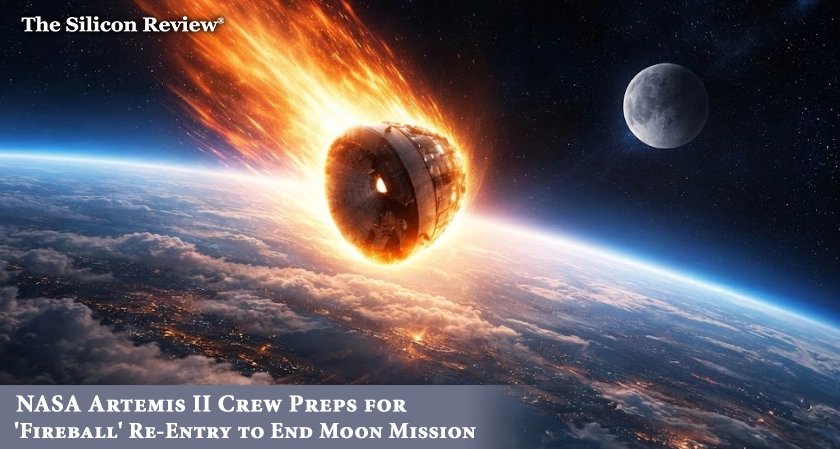
NASA Artemis II crew began final preparations Thursday for their high-stakes re-entry into Earth's atmosphere. The Silicon Review reports as the Orion spacecraft braces for a 5,000°F "fireball" splashdown Friday.
NASA Artemis II crew began final preparations Thursday for the most dangerous phase of their historic moon mission: a blistering re-entry into Earth's atmosphere that will see their Orion spacecraft generate temperatures of nearly 5,000 degrees Fahrenheit before splashing down in the Pacific Ocean on Friday.
The Artemis II astronauts commander Reid Wiseman, pilot Victor Glover, mission specialists Christina Koch and Canadian Space Agency astronaut Jeremy Hansen have been in space for nine days, flying farther from Earth than any humans in history. Their spacecraft, named Integrity, is currently on a trajectory that will bring it screaming back through the atmosphere at nearly 25,000 miles per hour.
"It's going to be a fireball outside that window," Wiseman said during a live broadcast from Orion on Thursday morning. "We've trained for this. The heat shield has been tested. But there's no way to fully prepare for the reality of it until you're inside it."
The re-entry sequence begins at 1:47 p.m. EDT Friday when the Orion service module separates and burns up in the atmosphere. The crew module will then plunge through the upper atmosphere, with its heat shield absorbing temperatures half as hot as the surface of the sun. Parachutes will deploy at approximately 25,000 feet, slowing the capsule to 17 miles per hour for a soft splashdown off the coast of San Diego.
NASA has positioned a fleet of recovery ships in the Pacific, including the USS Portland, which will hoist the Orion capsule aboard within two hours of splashdown. The crew will undergo medical checks before being flown by helicopter to San Diego.
The Artemis 2 launch date was April 2, 2026, from Kennedy Space Center's Launch Complex 39B. The mission marks NASA's first crewed moon flight since Apollo 17 in 1972 and paves the way for Artemis III, which will land astronauts near the lunar south pole in 2028.
"We've accomplished every objective we set out to achieve," Glover said. "Now we just have to survive the ride home. That's the deal. That's what we signed up for."
As NASA's Artemis II crew prepares for a 5,000°F 'fireball' re-entry to end their historic moon mission, The Silicon Review examines the final and most dangerous phase of a flight that has shattered records, captured imaginations, and proven that human spaceflight is far from finished.
About the Author
Sashindra Suresh is an experienced writer specializing in artificial intelligence, software development, and emerging technologies. With a strong ability to translate complex technical concepts into clear, engaging insights, she has contributed to a wide range of publications and platforms. Her work focuses on making cutting-edge innovations accessible to both industry professionals and curious readers alike.
MOST VIEWED ARTICLES
RECOMMENDED NEWS









Artificial Intelligence News
Startups News


_2025-11-17_06-38-14.webp)