>>
Industry>>
Real estate>>
Developer Robert Balzebre on W...Developer Robert Balzebre on Why Foreign Buyers Are Reshaping Miami Real Estate
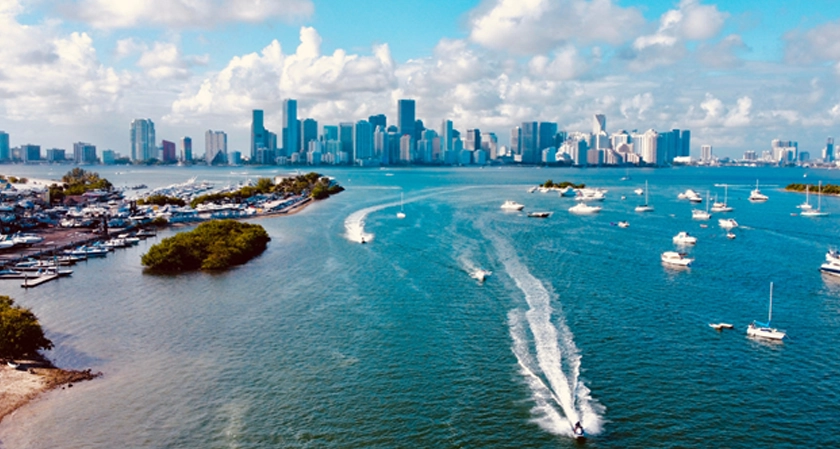
International purchasers now account for 52% of total sales across 66 new development condominium projects in South Florida's tri-county region, according to the Miami Association of Realtors. Buyers from more than 70 countries, many paying all cash, have pushed Miami to the number one position among U.S. markets for foreign home purchases. South Florida's foreign buyer share of residential dollar volume reached 15% in 2025, seven times the national figure. Developer Robert Balzebre, whose portfolio spans luxury condominiums, a beachfront hotel, and mixed-use sites across South Beach, Coral Gables, and Vero Beach, has operated in this market for over two decades.
"There's a human nature and condition that is attracted to these locations for certain reasons," Robert Balzebre said. "You're just naturally attracted to these places, almost at a primal level."
The Capital Structure Behind Miami's Luxury Surge
Cash transactions define the top tier of Miami's residential market. Across the luxury segment, 50% to 70% of deals close without financing, a ratio that insulates pricing from interest-rate volatility and creates fundamentally different competitive dynamics than mortgage-dependent markets. South Florida recorded the second-highest total of $10 million-plus home sales in its history during 2025, averaging roughly one ultra-luxury transaction per day.
This liquidity concentration carries practical consequences for developers. Projects underwritten with conventional absorption timelines face a buyer pool that moves on its own schedule, often accelerating purchases when currency fluctuations or political instability create urgency. Latin American buyers, particularly from Brazil, Colombia, and Mexico, represent the largest share of foreign purchasers, though European and Asian capital has expanded significantly.
Balzebre's experience across multiple South Florida submarkets has given him direct exposure to these capital flows. His condominium conversion projects in South Beach during the early 2000s coincided with the first major wave of Latin American investment in Miami Beach real estate.
"You need to always consider the primary consumer, your end retail user," Balzebre said, "with respect to safety, accessibility, physical security, but also with creating something that's memorable, sort of theatrical."
Where Foreign Demand Meets Construction Economics
International buyers purchasing luxury condominiums bring expectations shaped by global markets. A buyer relocating capital from London, Sao Paulo, or Seoul measures Miami finishes, mechanical systems, and common areas against properties in those cities. Meeting that standard affects material selection, construction timelines, and project budgets.
The MIAMI Association of Realtors' 2025 international buyer profile found that foreign purchasers gravitate toward new-construction luxury condominiums with smart-home technology, premium amenity packages, and eco-friendly features. These preferences create a feedback loop: developers who build to a global standard attract international capital, which supports premium pricing, which finances the next round of high-specification projects.
Balzebre has applied this principle across his portfolio. His Art Deco condominium conversions in Miami Beach preserved historic exteriors while modernizing interiors. His beachfront hotel renovation brought a nationally recognized management brand to South Beach by exceeding both code requirements and guest expectations.
"I am a true believer in doing things well for the art of doing them well and doing them right for the art of doing them right," he said. "And that in the end is actually a money saver."
The UBS Warning and What It Misses
The UBS Global Real Estate Bubble Index ranked Miami as the city with the highest overvaluation risk globally in 2025, scoring 1.73, ahead of Toronto and Zurich. That headline number warrants context rather than dismissal. Miami's pricing trajectory has been steep, and any market where values rise faster than local incomes carries concentration risk.
Several structural factors differentiate Miami from historical bubble patterns. Cash transaction dominance reduces systemic leverage. Buyer origin diversity, spanning more than 70 nations, prevents overreliance on any single economy. Florida's absence of state income tax provides a durable advantage that political changes in high-tax states continue to reinforce.
Swann Realty Partners noted that Miami's fundamentals show solid demand rather than speculation, observing that supply remains structurally limited and buyers are well-capitalized. Balzebre, who has developed in Miami through multiple market cycles, approaches valuation risk through construction quality rather than pricing strategy.
"When you build something that is likely to fail from one of these disasters, then you increase the cleanup costs, you have to rebuild again," he explained. "Sometimes that's going to double all the costs that you just put out or more."
How Developers Can Position for Sustained Foreign Demand
The shift from seasonal to year-round international demand reshapes how developers should approach feasibility, design, and marketing in South Florida's luxury segment. Several practical considerations emerge from current market data:
- Underwrite for cash-dominant absorption rather than mortgage-rate-sensitive timelines, since the majority of luxury closings occur without financing and follow different decision cycles
- Design to global specification standards, because buyers comparing Miami to London, Dubai, or Singapore penalize projects that fall short on finishes, mechanical systems, or amenity programming
- Diversify buyer outreach geographically, as the Miami Association of Realtors now maintains nearly 300 global partnerships and actively markets to investors from Latin America, Europe, the Middle East, and Asia
- Factor insurance and resilience into pro formas, given that Florida's average homeowner premium of $14,140 directly affects carrying costs and exit valuations for international investors holding long-term
Balzebre's multi-market portfolio, which extends from South Beach hospitality to mixed-use entitlements in Coral Gables and resort-scale beachfront land in Vero Beach, reflects this kind of diversified positioning within a single state.
"I would actually say don't be afraid to do it," he said. "It can be done."
The Long-Term Calculus for Miami
The MIAMI Association of Realtors is preparing to sign its 300th global partnership in 2026, expanding the pipeline of foreign capital flowing into South Florida residential real estate. Formula 1 returns to Miami Gardens. The 2026 FIFA World Cup will bring matches to Hard Rock Stadium. Each event reinforces the city's visibility among the exact demographics that drive luxury transactions.
Miami's transition from seasonal vacation market to year-round global capital destination did not happen in a single cycle, and Balzebre's two-decade portfolio tracks that evolution from early South Beach condominium conversions to hospitality acquisitions and mixed-use entitlements across multiple submarkets. The buyer who purchased a renovated Art Deco condo in 2002 and the buyer wiring funds from Sao Paulo in 2026 share a common expectation: that the property itself justifies the capital committed to it.
"I've given my time and energy to all my different projects, and they become like your children and you want to see them succeed," Balzebre said. "We don't skip on the details."