>>
Industry>>
Metals and Mining>>
China Manufacturing Strategy: ...China Manufacturing Strategy: Setup, Acquisition and Restructuring Pathways
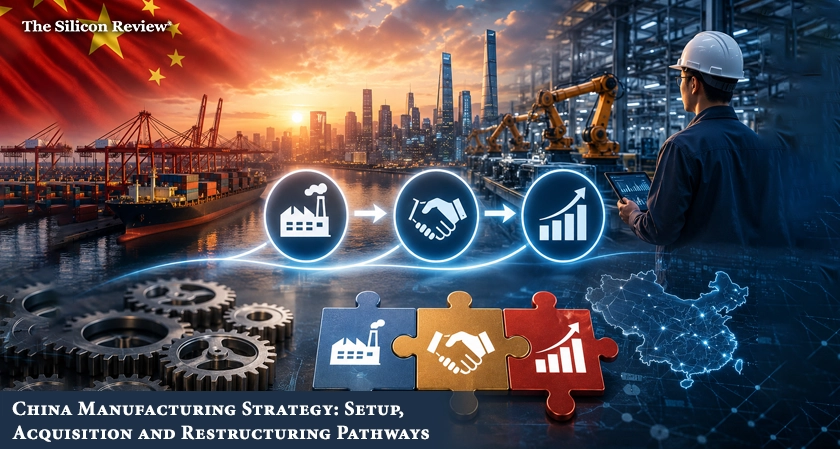
Foreign firms in China face three strategic pathways: greenfield setup, acquisition, or restructuring. The Silicon Review reports on China Manufacturing Strategy, multinational optimizing operations amid rising costs and trade tensions.
Foreign manufacturers operating in China are reevaluating their strategies as rising labor costs, US trade tensions, and slowing domestic demand squeeze margins. For multinationals committed to the Chinese market, three distinct pathways have emerged for optimizing manufacturing operations.
The China manufacturing strategy landscape has shifted dramatically since 2020. Labor costs in coastal provinces have nearly doubled, while US tariffs on Chinese goods remain at historic highs. Yet exiting China is not a simple option for companies that have spent decades building supply chains serving both the domestic market and global exports.
The greenfield setup pathway remains attractive for companies entering high-tech sectors where China retains a competitive advantage. Semiconductor equipment, electric vehicle components, and pharmaceutical intermediates are industries where Chinese suppliers offer quality comparable to Western counterparts at 30 percent lower cost. Foreign firms in these sectors are expanding capacity, not contracting it.
The acquisition pathway has gained popularity among foreign firms seeking rapid scale. Buying an existing Chinese manufacturer provides immediate access to qualified labor, established supplier networks, and regulatory approvals that can take years to secure independently. Private equity firms have facilitated 45 cross-border manufacturing acquisitions in China in the past 12 months, up from 28 in the prior period.
The restructuring pathway is the most common. Foreign firms are consolidating multiple Chinese facilities into regional hubs, shifting labor-intensive production inland, and automating where possible. One German automotive supplier reduced its China footprint from eight plants to three while maintaining the same output, cutting operating costs by 35 percent.
Supply chain optimization has become a board-level priority as the era of cheap Chinese manufacturing ends. Companies are using digital twins to simulate plant consolidation scenarios, AI for demand forecasting to reduce inventory, and robotics to lower labor dependency. The most sophisticated operators have achieved 40 percent labor reduction without capacity loss.
By the first quarter of 2027, consultants expect a wave of restructuring among foreign manufacturers in consumer goods, where margin pressure is most intense. Companies unable to achieve 15 percent cost reduction through optimization may exit China entirely, relocating production to Vietnam, India, or Mexico.
The Silicon Review's analysis indicates that the China manufacturing strategy question is no longer whether to stay or go, but how to optimize. For companies that make the right moves, China remains a competitive manufacturing base. For those that hesitate, the window for profitable operation is closing.
Q: What are the three strategic pathways for foreign manufacturers in China?
A: The three pathways are greenfield setup for high-tech sectors, acquisition of existing Chinese manufacturers for rapid scale, and restructuring through consolidation and automation.
Q: How much have labor costs increased in China's coastal provinces since 2020?
A: Labor costs in coastal provinces have nearly doubled since 2020, squeezing margins for foreign manufacturers.
Q: Which sectors remain attractive for greenfield investment in China?
A: Semiconductor equipment, electric vehicle components, and pharmaceutical intermediates are sectors where Chinese suppliers offer quality comparable to Western counterparts at 30 percent lower cost.
Q: How many cross-border manufacturing acquisitions have occurred in China recently?
A: Private equity firms have facilitated 45 cross-border manufacturing acquisitions in China in the past 12 months, up from 28 in the prior period.
Q: What results has one German automotive supplier achieved through restructuring?
A: The supplier reduced its China footprint from eight plants to three while maintaining the same output, cutting operating costs by 35 percent.
Q: When is a wave of restructuring expected among consumer goods manufacturers?
A: By the first quarter of 2027, consultants expect a wave of restructuring among foreign manufacturers in consumer goods, where margin pressure is most intense.