>>
Technology>>
Science and technology>>
Brain Computer Interface Break...Brain Computer Interface Breakthrough: Chinese Scientists Create Record-Smashing Electrode Array Thinner Than Hair
The Silicon Review
19 June, 2026
Author:
Sashindra Suresh
Chinese scientists have developed a record-shattering brain computer interface electrode array that is thinner than a human hair, softer than brain tissue, and capable of recording neural signals with unprecedented clarity for over 18 months without performance decline.
Chinese scientists have achieved a breakthrough in brain computer interface technology. A research team led by Tsinghua University has developed a record-shattering electrode array that could transform how we treat neurological disorders like epilepsy, Parkinson's, and Alzheimer’s.
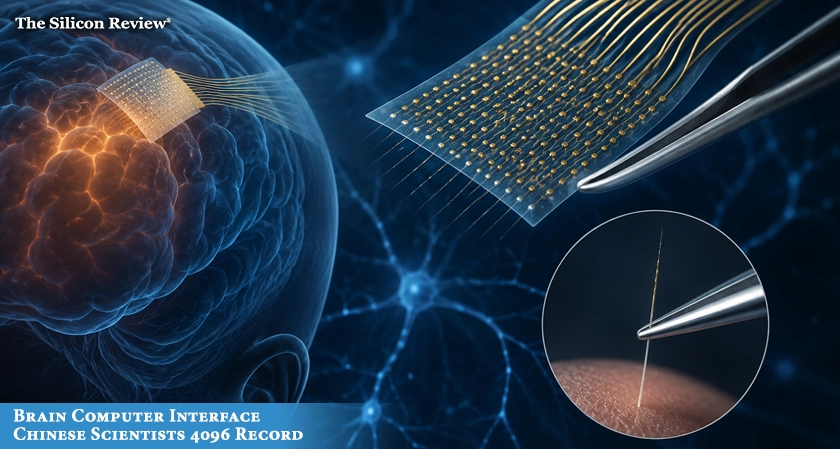
The new electrode array, called NeuroCam, features a staggering 4,096 recording channels on a single flexible substrate, with a channel density of 44 sites per square millimetre. The electrode itself is just 9 micrometres thick thinner than a strand of human hair and as soft as brain tissue, designed to eliminate the chronic inflammation and signal degradation that has plagued earlier brain computer interface implants.
The challenge has always been the "hard-against-soft" problem. Traditional platinum or platinum-iridium electrodes are far stiffer than neural tissue. Over time, this mismatch creates tiny displacements that trigger inflammation and scar tissue formation, steadily degrading signal quality. The new design eliminates that problem. The electrode conforms gently to the brain's surface and can be peeled away without causing tissue damage.
The research, published in the peer-reviewed journal PNAS on April 28, is collaboration between Tsinghua University's Shenzhen International Graduate School, the University of Tokyo, and the Chinese Academy of Sciences' Shenzhen-Hong Kong Institute of Brain Science. The team introduced a new material called conductive hydrogel with interfacial percolation that combines metal-level electrical conductivity with tissue-grade flexibility.
In animal trials, the brain computer interface implant recorded stable neural signals for over 550 days in freely moving rabbits, with the signal-to-noise ratio remaining above 94 percent of its initial value throughout the entire period. Histological staining after 16 weeks revealed minimal inflammatory response, confirming long-term biocompatibility.
The achievement builds on related Chinese research in the field. The Institute of Automation under the Chinese Academy of Sciences has developed a "sewing-machine-style" flexible microelectrode implantation robot called CyberSense, capable of implanting microfilament electrodes thinner than human hair into animal brains with micron-level precision while avoiding blood vessels . Other research teams have developed "dynamic" soft electrodes inspired by earthworm locomotion that can be magnetically guided through brain tissue.
As Chinese scientists create a record-smashing brain computer interface electrode array, The Silicon Review examines how this breakthrough could accelerate the development of safer, more durable neural interfaces for treating neurological disorders and enabling seamless brain-machine integration.
FAQ:
Q: What is the new brain computer interface electrode array developed by Chinese scientists?
A: The NeuroCam electrode array features 4,096 channels on a flexible substrate just 9 micrometres thick, thinner than hair and softer than brain tissue.
Q: How long did the brain computer interface implant maintain stable neural recording?
A: The implant recorded stable neural signals for over 550 days in animal trials, with signal quality remaining above 94 percent of its initial value.
Q: Why are traditional brain computer interface electrodes problematic?
A: Traditional platinum electrodes are stiffer than brain tissue, causing chronic inflammation, scar tissue formation, and steady signal degradation over time.
Q: Who led the research on the brain computer interface breakthrough?
A: The team was led by Xu Xiaomin from Tsinghua University's Shenzhen International Graduate School, in collaboration with the University of Tokyo and the Chinese Academy of Sciences.
Q: What is the new material used in the brain computer interface electrode?
A: The material is called conductive hydrogel with interfacial percolation, achieving the highest electrical conductivity ever reported for a hydrogel while remaining soft and biocompatible.
Q: What applications could this brain computer interface technology enable?
A: The technology could enable safer, more durable neural interfaces for treating epilepsy, Parkinson's, Alzheimer's, and restoring mobility and communication to people with severe neurological injuries.




















Comments