>>
Industry>>
Banking and insurance>>
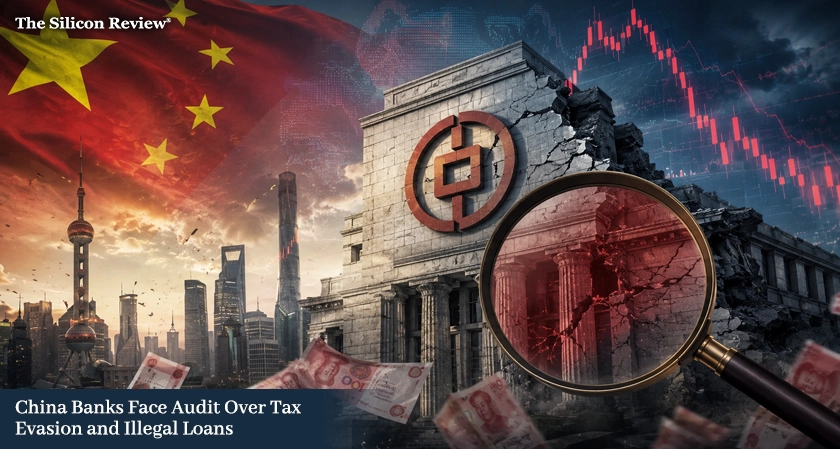
China Banks Under Fire: If Sta...China Banks Under Fire: If State-Owned Lenders Can't Follow the Rules, Can China Banking Still Claim Global Trust?
The Silicon Review
26 June, 2026
Author:
Jishnuu
China banks are facing unprecedented scrutiny after China's top auditor accused two of the country's largest state-owned lenders of tax evasion and illegal lending. If the institutions responsible for protecting financial stability are breaking the rules, what does it say about the future of China banking?
China banks have long been presented as pillars of the country's economic strength, but a new audit has raised concerns about the guardians of the financial system being accused of breaking the rules.
China's National Audit Office says Bank of China avoided paying 2.4 billion yuan (US$352 million) in taxes between 2023 and 2025 by using employee contributions to structure private equity funds in ways that qualified for tax exemptions. At the same time, Agricultural Bank of China allegedly issued 11 billion yuan in loans to farmland projects that violated lending regulations, with some of the money reportedly diverted into wealth management products and debt repayment.
If ordinary businesses are expected to obey tax laws, should China's biggest banks be held to a lower standard?
The findings are especially striking because it is uncommon for China's top audit authority to publicly single out one of the country's largest state-owned lenders for tax evasion. The report also criticized China Everbright Group for governance failures and weak oversight of several subsidiaries.
Bank of China said it "sincerely accepts the audit supervision" and pledged to strengthen its compliance capabilities. Yet the broader questions remain unanswered.
Is this an isolated compliance failure, or does it expose deeper cracks within China banking?
The timing is difficult to ignore. As China's prolonged property downturn continues to squeeze local government revenues, authorities have intensified tax enforcement against corporations and wealthy individuals. That makes allegations involving major state-owned financial institutions particularly significant.
Public reaction has been swift. Chinese social media users questioned where the unpaid tax money went and whether similar practices exist at other lenders.
Can regulators convince the public that accountability applies equally to everyone, including the country's most powerful financial institutions?
For global investors, the issue extends beyond one audit report. Confidence in China banks depends not only on their size and profitability, but also on transparency, governance, and regulatory credibility. As China banking faces growing domestic and international scrutiny, the latest findings serve as a reminder that trust is built through compliance, not scale. The Silicon Review Asks If the country's biggest banks break the rules, who is left to protect the system?
FAQ:
Q: Why are China banks making headlines?
A: China's top auditor accused Bank of China of tax evasion and Agricultural Bank of China of illegal lending, putting China banking under intense scrutiny.
Q: How much tax did Bank of China allegedly evade?
A: The audit alleges Bank of China avoided paying 2.4 billion yuan (US$352 million) in taxes between April 2023 and August 2025.
Q: What illegal lending was identified?
A: Agricultural Bank of China allegedly issued 11 billion yuan in loans to farmland projects that violated lending rules, with some funds reportedly diverted to other uses.
Q: Did Bank of China respond?
A: Yes. The bank said it accepts the audit findings and will strengthen its compliance and governance practices.
Q: Why is this important for China banking?
A: The case raises questions about transparency, regulatory oversight, governance, and investor confidence in China's state-owned banking system.
Q: What could this mean for investors?
A: Stronger regulatory action could improve accountability, but the audit may also increase concerns about governance risks within China banks.
Q: What is the biggest takeaway?
A: The audit highlights that trust in China banks depends not only on their size but also on compliance, transparency, and effective oversight.



















Comments