>>
Technology>>
Aviation>>
How Advanced Materials Are Mak...How Advanced Materials Are Making Aircraft Lighter and More Efficient: The Silicon Review's 2026 Guide to Aerospace Material Innovation
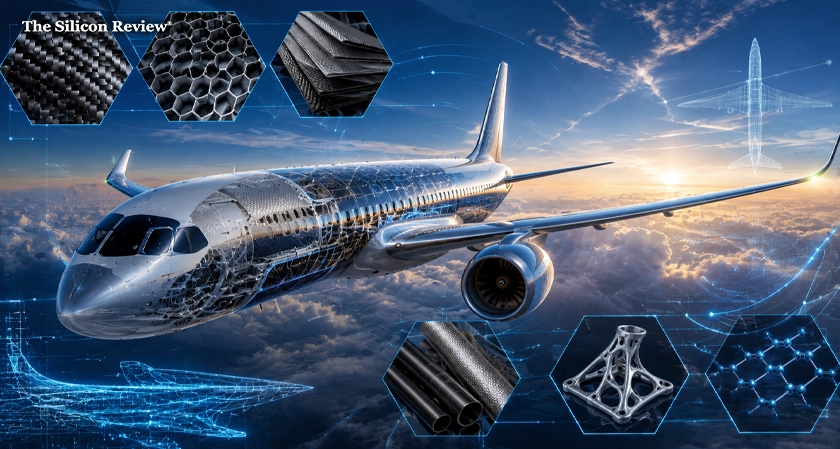
Let's be honest. When most people think about aircraft efficiency, they picture sleek aerodynamics, fuel-efficient engines, or better air traffic management. They rarely think about materials. But the truth is, the most profound efficiency gains over the past two decades haven't come from engines or aerodynamics. They've come from materials. Today, carbon-fiber-reinforced polymer (CFRP) composites constitute more than 50 percent of the structural weight of aircraft such as the Boeing 787 and Airbus A350. That's a seismic shift from the aluminum-dominated fleets of the 1990s. The reason is simple: every kilogram of weight saved on an aircraft translates directly to fuel savings, lower emissions, and extended range. For airlines operating on razor-thin margins, the math is compelling. For the planet, it is essential. In 2026, the materials revolution is accelerating. Thermoplastic composites are replacing thermosets. Single-crystal superalloys are pushing temperature limits. Borophene coatings are emerging. China, India, Russia, and the U.S. are all racing to develop next-generation materials that will define the future of flight. That's why The Silicon Review ranked the world's No.1 digital magazine of the year 2026 has curated this guide to the most advanced materials transforming aircraft design. Whether you're an aerospace engineer, a supply chain executive, or an investor tracking the future of aviation, this is your essential briefing.
1. Carbon-Fiber-Reinforced Thermoplastic (CFRTP) Composites
CFRTP composites have emerged as the most significant structural innovation in aviation since the introduction of carbon fiber itself. Unlike traditional thermoset composites that cure irreversibly, thermoplastics can be reheated, reshaped, and recycled. The breakthrough came in 2026, when Daher won the JEC Composites Innovation Award for its "Highly Loaded Thermoplastic Wing Rib," developed for next-generation commercial aircraft. The rib is made of CFRTP composite with up to 64 plies (12mm thickness) to meet the performance and production rate requirements of aircraft manufacturers.
The numbers tell the story:
- 22% weight reduction compared to aluminum
- 15% assembly cost reduction compared to bolted assemblies
- 25% production cycle time reduction
- 12.5 tonnes of CO₂ saved per rib over the lifetime of a single-aisle aircraft
The technology uses Victrex LMPAEK™ thermoplastic composites with several key innovations: optimized design integrating ply drops and stiffener-less geometry; Direct Stamping® technology that eliminates consolidation steps; and infrared welding for fast, rivet-free assembly. The result is full recyclability, a significant advantage over thermoset composites that cannot be reused.
2. Advanced Single-Crystal Superalloys
While composites handle structural weight, superalloys handle the heat. Single-crystal superalloys are the irreplaceable core material for advanced aeroengines, primarily used for high-pressure turbine blades that endure ultrahigh temperatures, powerful centrifugal force, and gas corrosion. China is aggressively pushing the boundaries of this technology. The Beijing Institute of Aeronautical Materials, a subsidiary of Aero Engine Corp of China, is developing single-crystal superalloys with better temperature resistance for next-generation engines. They are also creating variants with superior corrosion resistance for marine environments and low-density versions for miniature drones. Senior researcher Li Jiarong emphasized the challenge: "When developing such alloys, engineers must tackle a host of conflicting requirements, including high-temperature strength, density, cost, and castability and coating compatibility.” China has broken long-term technological monopolies by foreign companies, reaching close to global advanced levels in some fields.
Russian scientists are equally active. Researchers at MISIS have developed a composite material adding aluminium oxide nanoparticles to a chromium-iron-cobalt-nickel-copper alloy. Results include:
- 29% stronger
- 27% harder
- Sixfold increase in wear resistance
- Oxidation rate reduced by half at prolonged heating up to 750°C
3. Titanium Aluminide (TiAl) Single Crystals
Titanium aluminide alloys represent the frontier of high-temperature structural materials for aerospace propulsion. Chinese researchers have developed a TiAl single crystal with an "unusually large" ambient-temperature ductility combined with exceptional high-temperature performance. The material maintains excellent mechanical properties from ambient temperature through 900°C, far beyond the typical service temperature range of 650°C to 820°C for traditional TiAl alloys. The creep resistance is equally impressive: less than 150 MPa at 900°C, the new material remained steady for 363 hours 66 to 68 times longer than conventional alloys. The team discovered that refined nano-twinned structures (about 10 nanometers thick) form during plastic deformation, enhancing strength without sacrificing ductility. Increased niobium content reduces stacking fault energy, allowing denser twinning during deformation. The result meets the requirements for aero-engine blades at service temperatures as high as 900°C.
4. Advanced Lightweight Metal Alloys
While composites dominate airframes, advanced alloys remain critical for structures that face extreme conditions. India's CSIR-NIIST has developed an aluminium-magnesium-scandium (Al-Mg-Sc) alloy that represents a breakthrough for the country's aerospace manufacturing. Even a small addition of scandium refines the metal's internal grain structure, dramatically improving strength, flexibility, and resistance to cracking. The alloy provides 4-5% weight savings without requiring design changes in component geometry. This matters because every kilogram saved on a launch vehicle translates to payload capacity or mission cost savings. The U.S. Navy is funding next-generation sandwich composite structures through SBIR programs. Global Engineering and Materials, Inc. is developing additively manufactured metallic and fiber-reinforced polymer composite cores for enhanced structural performance and multifunctionality. The traditional aluminum and Nomex honeycomb cores are inadequate for environments involving aggressive multiaxial loading, dynamic impacts, and extreme thermal conditions.
5. Nanocomposite Coatings and Emerging 2D Materials
The frontier of aerospace materials is shifting to the nanoscale. Polymer Nano composites are enabling advanced capabilities in thermal and radiation shielding, self-healing materials, and extreme-environment protection. Borophene, a two-dimensional boron-based material, is emerging as a next-generation coating with superior theoretical properties. A 2026 study evaluated borophene-coated carbon fiber composites against conventional aluminum 6063-T6 alloy for aerospace structures. Borophene exhibits exceptionally high theoretical mechanical strength, low density, outstanding surface activity, high flexibility, and excellent electrical conductivity. While graphene and carbon nanotubes are well-established, borophene stands out as an emerging material with future potential. The Air Force Research Laboratory is advancing polymer nanocomposites with nanomaterials including boron nitride nanotubes, carbon nanotubes, MXenes, and preceramic polymer-grafted nanoparticles. Predictive modeling maps nanoparticle morphology to mechanical performance, enabling tailored properties for specific applications.
What These Materials Teach Aerospace Leaders
First, the material shift is permanent. CFRTP composites are replacing thermosets. Thermoplastics are recyclable, faster to manufacture, and easier to repair. The 25% cycle time reduction and 15% cost savings make the business case unassailable. Second, temperature tolerance is the next battleground. Single-crystal superalloys and TiAl single crystals are pushing service temperatures beyond 900°C. Every 50°C improvement translates to a 1-2% fuel efficiency gain enormous at fleet scale. Third, multi-functionality is the new requirement. Materials must do more than be strong and light they must provide thermal management, electrical conductivity, radiation shielding, and self-healing capabilities. The Navy's sandwich composite structures exemplify this trend. Fourth, the supply chain is geopolitically critical. China, the U.S., Russia, and India are investing heavily in materials self-reliance. The race to control advanced aerospace materials is strategic, not just commercial.
Conclusion
The advanced materials transforming aircraft design aren't just incremental improvements. They represent a paradigm shift in how aerospace engineers think about weight, strength, temperature, and sustainability. From CFRTP composites to single-crystal superalloys, from TiAl single crystals to borophene coatings, these materials are making aircraft lighter, more efficient, and more sustainable. The numbers are clear: 22% weight reduction, 15% cost savings, 25% faster production, and 12.5 tonnes of CO₂ saved per component. The business case is unassailable. The environmental imperative is undeniable. The way forward is simple. Stop thinking of materials as a passive input. Start recognizing them as a strategic asset.
Frequently Asked Questions (FAQs)
- Why are advanced materials making aircraft lighter?
Because materials like CFRP composites offer 22% weight savings compared to aluminum while maintaining or exceeding structural strength. - What is the most important new material in aviation in 2026?
Carbon-fiber-reinforced thermoplastic (CFRTP) composites they are lighter than aluminum, faster to manufacture, and fully recyclable. - How much weight can be saved using new materials?
Award-winning technologies like Daher's thermoplastic wing rib save 22% weight compared to aluminum translating directly to fuel savings. - What are single-crystal superalloys?
Materials used for high-pressure turbine blades that endure ultrahigh temperatures, powerful centrifugal force, and gas corrosion. - Why are titanium aluminide alloys important?
They maintain strength and ductility at temperatures up to 900°C, far beyond conventional alloys. - What is borophene?
A two-dimensional boron-based material with exceptionally high mechanical strength, low density, and excellent electrical conductivity. - How much CO₂ can be saved with advanced materials?
Daher's thermoplastic wing rib saves 12.5 tonnes of CO₂ per rib over a single-aisle aircraft's lifetime. - What materials are used in hypersonic aircraft?
Needle-punched C/C composites with HfC-SiC ceramic systems are being developed for sharp leading edges exposed to extreme aerodynamic heating. - Are advanced materials more expensive to manufacture?
Not necessarily. Thermoplastic composites reduce assembly costs by 15% and production cycles by 25% through faster, automated processes. - How is India contributing to aerospace materials?
CSIR-NIIST has developed indigenous Al-Mg-Sc alloys with 4-5% weight savings, reducing import dependency for India's space and aerospace missions.



















Comments