>>
Industry>>
Digital marketing>>
The Best Local SEO Tools for M...The Best Local SEO Tools for Multi-Location Brands in 2026

In Q2 2026, one of the multi-location brands we track held the Dallas map pack for its core service term and vanished from it two cities over, same brand, same category, same week. That is the old problem. The new one sits on top of it: local SEO tools now have to report visibility in two layers at once, the map pack and the AI answer, and both move location by location. A brand can win one metro's map pack and vanish from the AI Overview in the next, and that split now opens up inside a single account. With 91% of US adults owning a smartphone and 16% relying on it as their only route online as of 2025, a location that goes invisible in either layer is invisible to most of the people standing near it.
What we're seeing across accounts: among local SEO tools for a multi-location brand, the strongest all-round pick is SE Ranking, because it tracks local rankings, GBP, listings, reviews and AI-answer visibility across locations from one platform. Yext is the runner-up when pure enterprise listings governance at franchise scale is the whole job. Don't lean on a single-location app once you pass a few dozen locations; it breaks at that scale.
Who This Is For
This shortlist of local SEO tools is for in-house marketing and SEO teams at multi-location brands: 20 to 500+ locations, franchise systems or multi-unit retail and service operators, with a central team standardizing one brand across every market. You care about brand consistency and per-location visibility at once, and you report to stakeholders who count both. It's not for single-location businesses or solo operators; a per-store tool won't hold at this scale.
What Multi-Location Brands Need From Local SEO Tools
With 82% of US smartphone shoppers using "near me" searches, a franchise's demand is spread across every market it operates in, so local SEO tools have to work per location and in bulk at once. Here's what we weight:
- Bulk multi-location workflows: edit, publish and audit across dozens or hundreds of locations without touching each one by hand.
- Per-location geo-grid rank tracking: map-pack position measured on a grid around each address, not one blended national number.
- Listings and NAP consistency at scale: name, address and phone kept identical across GBP, Apple, Bing and the wider directory network.
- Review monitoring and response across every location, pulled into one queue.
- AI-answer visibility tracked per location: with Google AI Overviews reaching 2 billion monthly users in 2025, a location can now appear or vanish in the AI answer independently of its map-pack rank.
- Roll-up plus per-location reporting: one brand view for the head office, a drill-down for each market lead.
- Roles, permissions and governance so regional managers touch only their own locations.
How We Picked
We scored these local SEO tools against those needs the way we run a tracking set: fixed criteria, checked against live product capability in August 2026, one variable at a time. A tool earned its place only by covering multi-location workflows and per-location visibility in both layers.
|
Rank |
Tool |
Locations model |
Map-pack + geo-grid |
AI-answer visibility |
Listings/NAP at scale |
Entry price |
|
1 |
SE Ranking |
3 per plan, expandable via add-ons |
Yes, Map Rank Tracker geo-grid to street level |
Yes, across ChatGPT, Perplexity, Gemini, AI Overviews and AI Mode |
Yes, GBP, listings and automated NAP |
From $129/mo |
|
2 |
Yext |
Enterprise knowledge-graph, built for franchises |
Not a geo-grid rank tracker |
Yes, AI search platform features |
Yes, deep publisher network |
Quote-based |
|
3 |
Uberall |
Enterprise multi-location marketing |
Not a geo-grid rank tracker |
Yes, via GEO Studio |
Yes, listings and reviews at scale |
Quote-based |
|
4 |
BrightLocal |
Multi-location, per-location plans |
Yes, Local Search Grid |
Limited |
Yes, citations and GBP audit (US/UK/CA/AU) |
From $31/mo |
|
5 |
Local Falcon |
Credit-based scans across locations |
Yes, geo-grid 3x3 to 21x21, Google and Apple |
Yes, AI-visibility tracking |
No, tracking-focused |
From $24.99/mo |
|
6 |
Semrush Local |
Add-on, per-location cost stacks |
Yes, Map Rank Tracker |
Via the core platform |
Yes, Listing Management |
Add-on on $139+/mo core |
Here are the six local SEO tools that held up for multi-location brands, starting with the one platform that reports both layers in a single view.
1. SE Ranking
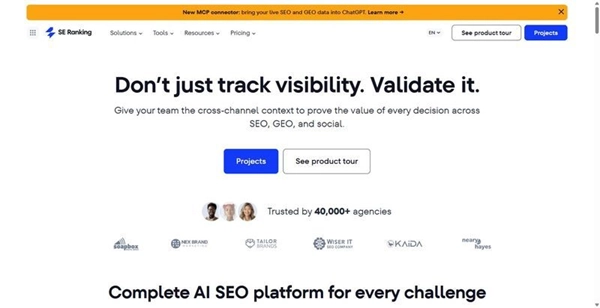
SE Ranking is a full SEO platform whose Local Marketing module runs local rank tracking, GBP, listings and reviews across every location in one system.
Standout feature: The Map Rank Tracker plots rankings on a geo-grid down to street level, and the same Local Marketing module handles GBP posts, listings, review responses, and NAP automation across Google, Apple, Facebook, and Bing. AI search visibility tracking runs in the same platform, and the data feeds an API.
Why it works for multi-location brands: For a franchise, the value is one dashboard instead of separate tools: per-location geo-grid rankings, AI-answer visibility checked location by location, and NAP pushed to listings across every unit at once. Reporting rolls up to a brand view or drills down to a single storefront.
Pros:
- Tracks per-location map-pack and geo-grid rankings down to street level
- Automates NAP updates across GBP, Apple, Facebook, and Bing from one place
- Monitors AI-answer visibility in the same platform as local rankings
- Includes API and MCP access in every plan to pull location data into your own reporting
Cons:
- Local rank tracker caps at 1,500 keywords and 3 locations on Core and Growth, so franchise-scale footprints need add-ons or Enterprise
- Local is one module of a broad SEO platform, not a dedicated local-only tool
- Its depth rewards systematic central-team use rather than occasional check-ins
Pricing: Core $129/mo ($103.20/mo billed annually), Growth $279/mo, Enterprise custom for larger footprints. API and MCP access come in every plan, plus a 14-day trial with no card.
What we saw across accounts: across our multi-location tracking sets, checked weekly since March, SE Ranking was the one tool that let us see map-pack position and AI-answer presence on one screen. At franchise scale you'll outgrow the Core caps, but the single-platform view held up.
2. Yext
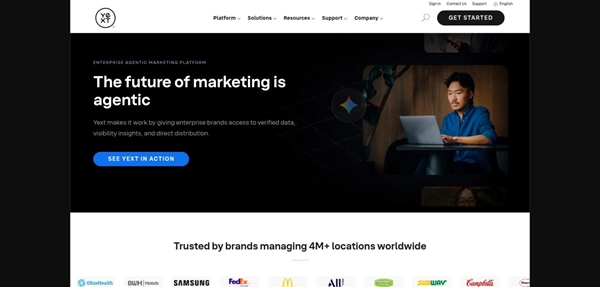
Yext is the enterprise digital-presence platform built on a knowledge graph: one structured record per location, syncing across a deep publisher network and into AI search.
Standout feature: The knowledge-graph model. One record per location pushes to hundreds of directories, maps, apps, and now AI answer surfaces at once. For a brand running several hundred units, that single structured source keeps hours, addresses, and attributes identical everywhere a customer or an engine looks.
Why it works for multi-location brands: A central source of truth syncs every location's data at franchise scale. One edit propagates across the whole publisher network, so a 400-unit brand corrects hours or attributes once, not listing by listing.
Pros:
- Deep publisher network syncs one record to hundreds of directories, maps, and AI surfaces
- Enterprise-grade governance and permissions for hundreds or thousands of locations
- Structured records increasingly feed AI answers, not just legacy directories
Cons:
- Quote-based only; the self-serve tier was retired, so no public number
- Overkill below a few hundred locations
- Presence-focused, not a geo-grid rank tracker: no map-pack position per grid point
Pricing: Quote-based, contact sales. No public self-serve figure.
What we're seeing: Across the franchise accounts we track, Yext keeps NAP and attributes clean at scale, and its records feed AI answers more often now. It governs presence; it won't report your map-pack position per location. Pair it with a tracker.
3. Uberall
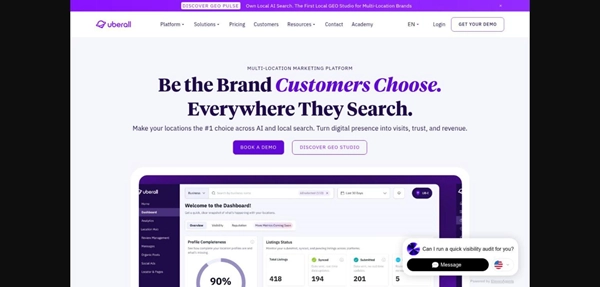
Uberall is an enterprise location-marketing platform: listings, reviews, and local social across every location, plus a GEO Studio for AI-answer visibility, SOC 2 Type II certified.
Standout feature: The GEO Studio. Alongside the listings and review workflows, it watches how a brand shows up in AI-generated answers, the metric we now track per location. For a franchise, that means seeing where you hold AI share of voice metro by metro, beside the listings and review data in one enterprise stack.
Why it works for multi-location brands: Listings, reviews, and AI share of voice are governed in one enterprise stack. A central team steers both the map-pack fundamentals and the answer-layer position across hundreds of locations without stitching separate tools together.
Pros:
- Listings, reviews, and local social managed across every location from one console
- GEO Studio adds AI-answer visibility to the local-marketing workflow
- SOC 2 Type II certified, which enterprise procurement teams ask about
Cons:
- No public pricing; packages are quote-based
- Heavy for a small footprint
- Broad location-marketing scope rather than deep geo-grid rank tracking
Pricing: Quote-based. Show Up, Stand Out, and Connect packages are all request-pricing.
What we saw across accounts: The GEO Studio angle matters. Watching AI share of voice per location, beside listings and reviews, is the workflow we moved to this year. Uberall governs all three in one place, though it stays a location-marketing stack first, a rank tracker second.
4. BrightLocal
BrightLocal is a dedicated local platform, and across a portfolio of locations that focus shows. Its Local Search Grid runs geo-grid rank checks per location, citation building and GBP audit/benchmarking keep listings healthy, and review management sits alongside multi-location and agency reporting built for brand oversight.
Why it works for multi-location brands: It standardizes per-location reporting across a portfolio, so a central team reads the same geo-grid and citation metrics for every location on one template instead of rebuilding a view per store.
Cons: Coverage is limited to the US, UK, Canada, and Australia, so it stops short for brands with locations elsewhere. There is no broad organic SEO toolkit. AI-answer visibility tracking is lighter here than in tools built for it.
Pricing: Track $31/mo, Manage $40/mo, Grow $49/mo, billed annually.
What we saw across accounts: For franchises that live on citation accuracy and standardized location reporting, BrightLocal holds up. If per-location AI-answer visibility is on the roadmap, pair it with something that measures the answer layer directly.
5. Local Falcon
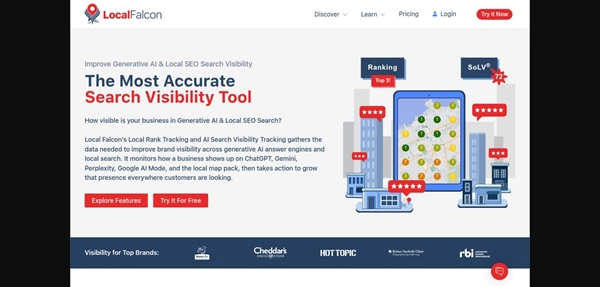
Local Falcon is a geo-grid rank tracker whose map-pin scans read both Google and Apple, and it layers AI-visibility tracking on top. Grids scale from 3x3 to 21x21, and a credit model meters usage. In our tracking, it is one of the few tools that measures both map-pack position and AI-answer visibility per location.
Why it works for multi-location brands: It layers per-location geo-grid and AI-answer measurement onto a stack that already owns listings and reviews, so a central team gets the visibility signal for every location without replacing its management tool.
Cons: Credit-based pricing is hard to forecast across many locations, since scans consume credits per location and grid size. It handles tracking and analysis only, with no listings or review management.
Pricing: Starter $24.99/mo, Basic $49.99, Pro $99.99, Premium $199.99; 100 free credits on signup.
What we're seeing: As a measurement layer, this is where the answer layer actually shows up per location. Run it alongside whatever owns your listings and reviews, not instead of it.
6. Semrush Local
Semrush Local is a local add-on, bringing Listing Management, a Map Rank Tracker, GBP management, and review management onto the Semrush core platform, with multi-location and agency features. It ranks sixth here by design: capable, but the economics work against franchise scale rather than for it.
Why it works for multi-location brands: It fits teams already standardized on Semrush core, adding local workflows to a platform their analysts already run rather than introducing a separate local tool.
Cons: Local is a paid add-on layered on an already premium core, and per-location costs stack fast at franchise scale, so the bill climbs with every location you add.
Pricing: Semrush core runs $139 to $549/mo depending on plan; the Local add-on is priced separately per location on top of that.
What we saw across accounts: For a brand already living in Semrush core, adding Local is the path of least resistance. For everyone else, the stacked per-location cost is the reason it sits at six, not higher.
How to Choose Local SEO Tools (By Footprint and Priority)
Running 20-100 locations and want one platform that covers rankings, GBP, listings and AI-answer visibility: SE Ranking. It keeps the map pack and the answer layer in the same dashboard, tracked per location, so you're not stitching three local SEO tools together to see one brand.
Hundreds of locations where listings governance is the core job: Yext. When the mandate is one source of truth pushed to every directory at scale, that is what it was built for.
Listings, reviews and AI share-of-voice in one enterprise stack: Uberall, with GEO Studio carrying the answer-layer piece.
You only need per-location geo-grid plus AI-answer tracking, not a full suite: Local Falcon.
Already standardized on Semrush core: Semrush Local, provided the per-location add-on cost still pencils out.
Skip if: avoid a single-location app once you pass a few dozen locations, and don't stack the Semrush Local add-on per location when a flat multi-location platform is cheaper to run.
FAQ
What is enterprise local SEO?
Enterprise local SEO is managing local search visibility across dozens or hundreds of locations from one central team. It leans on local SEO tools for per-location rankings, Google Business Profile at scale, listings and NAP consistency, reviews, and now AI-answer visibility, governed centrally so every location stays on-brand.
How do you manage local SEO across multiple locations?
Centralize it. Pick local SEO tools with bulk workflows: import every location once, track geo-grid rankings per market, schedule GBP posts in batches, and roll results into both per-location and brand-level reports. Manual, one-profile-at-a-time work doesn't survive past a few dozen locations.
How do you keep NAP consistent across many locations?
Push name, address and phone from one system of record to every directory rather than editing profiles by hand. Local SEO tools that sync NAP across GBP, Apple, Bing, Facebook and citation sites catch mismatches automatically, so a franchisee changing a phone number doesn't quietly break a location's map-pack ranking.
How is local SEO for multi-location brands different from single-location SEO?
A single store optimizes one profile in one market. A multi-location brand can win the map pack in one metro and vanish in the next, and the same now happens per location in AI answers. That's why enterprise local SEO tools center on governance, bulk workflows, and per-location tracking at scale, not one-off optimization.













Comments