>>
Technology>>
Artificial intelligence>>
Real-Time Voice Agents: Latenc...Real-Time Voice Agents: Latency and Interruption Handling Are the Real Product

What makes a voice agent feel natural to talk to: the quality of its answer, or the half-second before it begins speaking?
Timing shapes the exchange before the reply has a chance to matter. Respond too early and the system cuts off the user. Respond too late and the conversation drags. Keep speaking after an interruption and trust can disappear within seconds.
The sections ahead examine the engineering behind those moments, from latency and turn-taking to interruption recovery and multilingual use. These details often separate a strong demo from a product people will use for a sustained call.
Latency Is a System-Level Problem
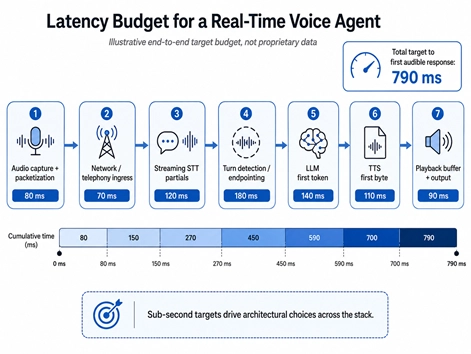
Illustrative latency budget across the voice pipeline - Image
A voice agent passes through several stages before the user hears a response.
It captures audio, sends it across the network, converts speech into text, generates a reply, turns that reply into audio, and plays it back. Browser or telephony infrastructure adds further delay.
Each stage consumes part of the latency budget. Several small delays can make a capable system feel slow.
This is the core challenge of voice agent latency. A faster model may help, but the full response path determines what the user experiences.
Latency also depends on which of two architectures a system uses.
A cascaded pipeline chains three specialized models: speech-to-text, then an LLM, then text-to-speech. Each stage adds its own delay, and naively that means three sequential waits. A speech-to-speech model skips the text stage entirely — one model takes audio in and produces audio out in a single pass, removing two conversion boundaries.
On paper, speech-to-speech has the lower latency ceiling. In practice, a well-streamed cascade closes much of that gap, and speech-to-speech still has to reckon with network round-trips and buffering , removing stages doesn't remove infrastructure.
The real difference isn't only speed. A cascade produces a text transcript at each handoff, which is what most teams use for evaluation and monitoring. A speech-to-speech model has no such artifact by default. That's a separate trade-off from latency, but it's often what decides which architecture a team actually ships.
Production systems stream as much as possible. Speech recognition returns partial transcripts while the user is talking. The language model begins preparing a reply before the turn is fully confirmed. Text-to-speech starts producing audio from the first usable phrase.
Some systems also use speculative generation (preambles). This can reduce delay, but a late qualification from the user may change the request and make the prepared response irrelevant.
Infrastructure matters too. Distant media servers, large audio buffers, extra handoffs, and serial processing all add time.
Teams building real-time voice AI should measure the full path. Average response time matters, but unpredictable pauses are often more damaging because they make users wonder whether the system failed or stopped listening.
Turn Detection Requires More Than Silence
People pause while thinking, searching for words, or adding a final detail. Silence does not always mean the speaker has finished.
That makes turn detection both a technical and product decision.
Basic voice activity detection (VAD) identifies whether speech is present. It cannot reliably determine whether a thought is complete.
Traditional endpointing uses a fixed silence threshold. A short threshold reduces dead air but increases the risk of cutting someone off. A longer threshold gives the user more room but makes the agent feel slower.
More advanced systems also consider the transcript and whether the sentence appears complete. “I think the main issue is…” suggests more is coming. “That answers my question” gives a stronger signal that the turn is over.
The right balance depends on the use case. Scheduling calls may benefit from faster exchanges. Interviews and advisory conversations need more room for reflection.
Teams should test end-of-turn behaviour with real conversations from the intended setting. A threshold that works in a short scripted test may fail during a longer call.
Interruption Handling Is State Management
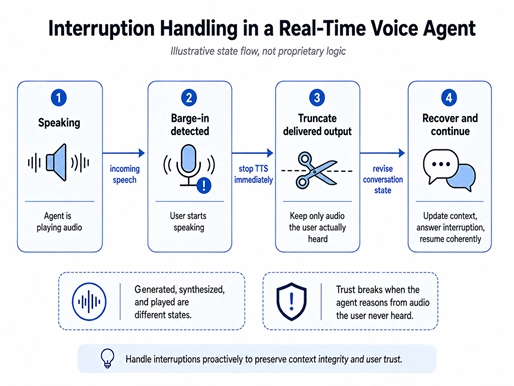
How voice agents stop, revise, and recover - Image
Users interrupt to correct information, ask a follow-up question, or stop an explanation they no longer need.
The system must detect the new speech and stop playback quickly. This is commonly called barge-in.
Stopping the audio is only the first requirement. The agent also needs an accurate record of what the user heard.
Suppose the system generates three sentences and the user interrupts halfway through the first. The full answer may exist internally, but only part of it reached the listener.
Generated text, synthesised audio, and played audio are different states.
If the conversation history records the full response as delivered, the agent may refer to information the user never heard.
Reliable interruption handling requires the system to track playback, truncate the effective response, incorporate the user’s new input, and continue from the correct context.
Sometimes the earlier answer should be dropped. In other cases, the agent should address the interruption and return briefly to an unfinished point.
This is a clear test of whether the system is managing a live conversation or producing disconnected responses.
Small Signals Need Careful Use
Short acknowledgements such as “right,” “understood,” or “got it” can show that the system is following the conversation. They can also cover a brief processing delay.
Used too often, they become repetitive.
Effective conversational AI UX depends on context. An acknowledgement should support the exchange, not appear after every user turn. Silence may be more natural when the next response is ready quickly. A direct answer may be better for a simple question.
Long calls raise the standard. A brief transaction can tolerate occasional awkwardness. A 30-minute interview gives users time to notice repeated phrases, slow responses, and weak recovery.
Teams should evaluate full conversations, not only isolated turns.
Language Changes Turn-Taking
Timing rules tuned in English may not work equally well elsewhere.
Languages vary in sentence structure, rhythm, pause length, and the ways speakers signal that they have finished. Speech-recognition and synthetic-voice quality may also differ across languages, accents, and regions.
A system may respond too early when longer pauses are common. Weaker partial transcripts may delay generation. Less natural text-to-speech can make timing harder to follow.
Localization therefore requires more than translated prompts. Teams need to test listening behaviour, response timing, interruptions, and voice quality in every supported language.
These decisions belong within the voice AI infrastructure because they shape how the product behaves.
Where Product Advantage Accumulates
Speech and language models are available to many companies. The harder advantage comes from what teams learn through real conversations.
Which pauses suggest hesitation? Which background sounds trigger false interruptions? When does an acknowledgement help? How should the agent recover when someone changes direction?
Those lessons become evaluation sets, monitoring systems, state-management logic, language-specific settings, and better product decisions.
Another company may use the same models, but it will not immediately share the same understanding of how the system should behave across different speakers, call types, and languages.
The strongest voice products make the technology recede. The agent responds promptly, leaves room for thought, yields when interrupted, and continues from the conversation that actually happened.
About the Author
Felipe Duarte is a software engineer focused on applied AI and real-time voice systems. He builds the infrastructure behind production AI products and writes about the engineering decisions that make them useful, reliable, and natural to interact with.













Comments