>>
Industry>>
Supply chain management>>
South Korean Container Ship Se...South Korean Container Ship Sets Sail to Test Arctic Commercial Route amid Western Concerns
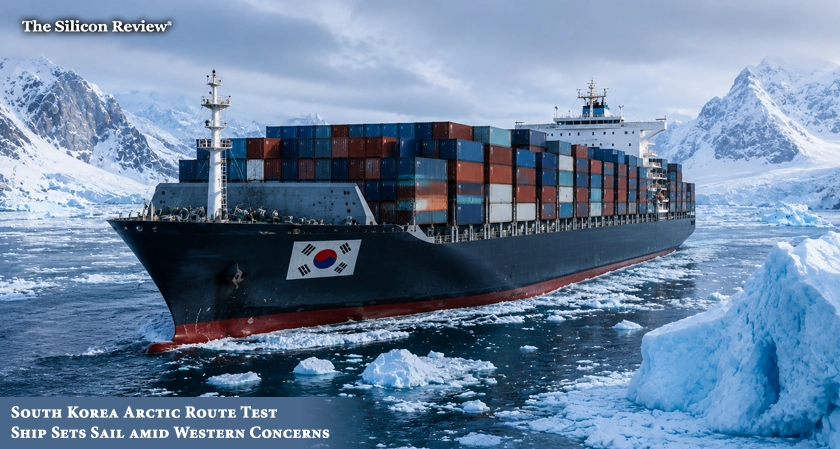
A South Korean container ship, the PanStar Acro, will depart Busan on Saturday to test the viability of a commercial Arctic shipping route to Europe, a move that has drawn concern from Western allies due to the required cooperation with Russia.
The PanStar Acro is preparing to depart the port of Busan on a 40 to 45-day round trip to Europe via the Arctic. If successful, the voyage will mark South Korea's first commercial container transit through the Arctic, placing the nation alongside China and Russia as a pioneer on a route that is becoming increasingly accessible due to melting sea ice. The ship is scheduled to call at Felixstowe in Britain, Rotterdam in the Netherlands, and Gdansk in Poland.
"Around September, when this voyage will mainly take place, Arctic sea ice is at its lowest level of the year, making safer navigation possible," a PanStar official said.
President Lee Jae Myung's administration has made the Arctic shipping route a national priority, viewing it as a way to cut voyage times to Europe by up to 35% compared to the Suez Canal route, reduce fuel consumption, and transform Busan into a global maritime hub. The government aims to establish regular commercial services on the route by 2030.
The Russian Complication
The PanStar Acro's route runs along Russia's Northern Sea Route, a shipping lane that runs along Russia's Arctic coast. Navigating this route requires Moscow's permits and cooperation, which has unsettled Western diplomats who are seeking to isolate Russia economically over the war in Ukraine.
"We want to isolate Russia, we don't want engagement with Russia," a European diplomat said, adding that concerns had been conveyed to South Korean officials.
Arctic shipping experts have also warned that South Korean vessels could face sanctions risks if they require Russian assistance during the voyage, such as if the ship becomes trapped in ice. There is also skepticism about the route's commercial viability, as unit transport costs are increased by vessel size restrictions, high insurance costs, and the fact that the route is only navigable for container ships during the three summer months when ice melts.
South Korea is racing against China, which is already seeking a first-mover advantage on the route. Chinese container company Sea Legend Shipping is planning the first regular container service to Europe via the Northern Sea Route. The PanStar Acro's voyage is an attempt to build the operational data and experience South Korea needs to compete.
Here is the question this voyage raises. South Korea is testing an Arctic commercial route that requires Russian cooperation, straining relations with Western allies and risking sanctions. When economic opportunity and geopolitical strategy collide, can South Korea navigate a path between its allies and its ambitions?
FAQ:
Q: What is the South Korean Arctic shipping test?
A: South Korea is sending a container ship, the PanStar Acro, on a 40-45 day round trip from Busan to Europe via the Arctic to test the commercial viability of the route.
Q: Why are Western countries concerned about the Arctic route test?
A: Western nations are concerned because the Arctic route requires cooperation and permits from Russia, which they are trying to isolate over the war in Ukraine. There are also concerns about potential sanctions violations.
Q: What are the potential benefits of the Arctic shipping route?
A: The Arctic route could reduce voyage times by up to 35% compared to the Suez Canal, lower fuel consumption, and help South Korea establish Busan as a major maritime hub.
Q: How long can the Arctic route be used?
A: Currently, the route is only navigable for container ships during the three summer months when sea ice is at its lowest levels.
Q: Is South Korea the only country interested in the Arctic route?
A: No, China and Russia are already active on the route. China has launched a regular container service, and Russia manages the Northern Sea Route.













Comments