>>
Industry>>
Digital marketing>>
The Blueprint of Power: The Mo...The Blueprint of Power: The Most Influential Business Minds of 2026, Top 5 Business-Minded Titans Proven by Raw global Infrastructure Control
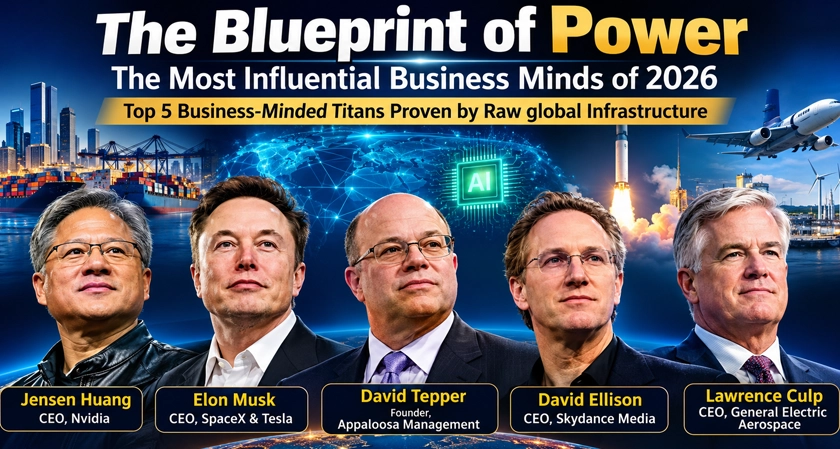
The New Definition of Business-Minded Authority: In 2026, being business-minded no longer means delivering catchy quarterly soundbites or amassing social media followers. It means owning the toll roads, controlling the physical bottlenecks, and calculating the asymmetric risk that moves markets. True authority requires stripping away marketing hype and looking solely at raw infrastructure dominance, capital control, and leverage. This is not about who is famous. This is about who holds the keys to the modern world.
The Business-Minded Framework: How Titans Think
An expert-level business mind automatically deconstructs any situation into three operational pillars:
1. First-Principles Unit Economics
A business mind doesn't look at absolute revenue; they look at margins and customer acquisition costs (CAC) relative to lifetime value (LTV). They constantly calculate the hidden costs time, energy, opportunity cost, and capital drag required to generate a single dollar of profit.
2. Bottleneck Isolation & Scalability
They see every organization or process as a machine. When a problem arises, a business mind doesn't look for someone to blame; they look for the systemic bottleneck. They ask: "If we double the inputs tomorrow, where does this system break down, and how do we automate or delegate to fix it?"
3. High-Asymmetry Risk Management
They think like an investor managing a portfolio. They don't avoid risk they price it. They seek out asymmetric opportunities where the cost of failure is fixed and low, but the potential upside is exponential. These titans do not use magic. They use the exact same cognitive software your readers use daily, scaled across trillions of dollars.
The Blueprint of Power: The Most Influential Business Minds of 2026
The following five individuals were not selected for their public relations presence. They were selected because their physical infrastructure speaks louder than any interview.
1. Jensen Huang (CEO, Nvidia)
- The Proof: Built the first corporate entity to breach and hold a $5.0 trillion market cap.
- The Infrastructure They Control: Physical compute infrastructure.
- The Strategic Metric They Controlled: Monopoly Moat - Captured nearly the entire hardware layer of global computation.
- The Business-Minded Truth: While the rest of the world argued over which software AI chatbot was better, Huang ruthlessly focused on the physical bottleneck. By investing 15 continuous years into funding CUDA software when the market didn't value it, he built a virtual monopoly on the graphics processing units (GPUs) required to run the modern world. He doesn't sell the trend; he owns the toll road everyone has to use to build it.
- The Business-Minded Analogy: When Jensen Huang hoarded chips years ago, he was applying the same logic a smart professional uses when they learn an emerging, uncrowded skill before the market demands it.
2. Elon Musk (CEO, SpaceX & Tesla)
- The Proof: Commands an 80% market share of the global commercial space launch industry, orchestrating a massive $250 billion restructuring via SpaceX's acquisition of xAI.
- The Infrastructure They Control: Global orbital logistics network.
- The Strategic Metric They Controlled: Distribution Hegemony - Reduced launch costs below anything a sovereign nation can match.
- The Business-Minded Truth: Musk engineers vertical infrastructure dominance. He recognized that whoever controls orbital logistics owns the future distribution network for global telecommunications and sovereign data grids. By building fully reusable rocketry architectures that competitors cannot replicate at cost, he turned capital-intensive, high-risk engineering into an unmatched ecosystem of deep tech dominance.
3. David Tepper (Founder, Appaloosa Management)
- The Proof: Quietly drove billions in institutional capital into the absolute bottom of the tech infrastructure shift, perfectly timing Alphabet's surge.
- The Infrastructure They Control: Capital allocation leverage.
- The Strategic Metric They Controlled: Capital Efficiency - Moved billions ahead of institutional rebalancing into infrastructure tech.
- The Business-Minded Truth: Tepper operates on cold, calculated asset valuation and asymmetry. While retail investors panic over quarterly news cycles, Tepper isolates macro-trends. He identified that the ultimate winners of the technological transition are not the companies printing short-term hype, but the platforms printing durable, compounding structural profit.
4. David Ellison (CEO, Skydance Media)
- The Proof: Orchestrated a massive mega-merger of Paramount and Warner Bros. Discovery, consolidating the world's most dominant IP libraries.
- The Infrastructure They Control: Consolidated media IP infrastructure.
- The Strategic Metric They Controlled: Platform Scale - Consolidated competing legacy players to eliminate distribution friction.
- The Business-Minded Truth: Ellison understands platform consolidation and scale survival. In a fractured digital distribution landscape, single streaming services face high customer churn and margin degradation. Instead of competing on ad spend, Ellison engineered a legacy media consolidation to force scale, cut corporate overhead, and control prime intellectual property distribution channels at the source.
- The Business-Minded Analogy: When David Ellison forced a massive media merger, he was doing what any rational manager does when they automate repetitive administrative tasks to save time and eliminate daily energy drag.
5. Lawrence Culp (CEO, General Electric Aerospace)
- The Proof: Completely engineered the historic corporate spin-off and structural restructuring of a failing conglomerate into a hyper-profitable aerospace powerhouse.
- The Infrastructure They Control: Lean structural aviation operations.
- The Strategic Metric They Controlled: Margin Isolation - Eliminated multi-industry corporate drag to unlock pure asset profitability.
- The Business-Minded Truth: Culp is a masterclass in removing corporate bloat. He ignored the legacy prestige of running a massive, multi-industry conglomerate and ruthlessly broke GE apart to expose its highest-margin asset: commercial aviation infrastructure. By dismantling unprofitable divisions, he protected enterprise margins and built a lean, focused cash-flow engine.
- The Business-Minded Analogy: When Lawrence Culp split GE apart; he was using the exact framework of setting strict life boundaries cutting out energy-draining obligations to double down on what actually generates personal happiness and value.
How to Think Like a Business Titan (The Reader's Test)
If you find yourself instinctively deconstructing problems into unit economics, bottlenecks, and risk calculations, you are already business-minded. These titans use the same cognitive frameworks scaled across billions.
The everyday proof: You already think like them. You just need to apply it to the right levers.
Conclusion
The most influential business minds of 2026 are not defined by their job titles. They are defined by the infrastructure they own, the bottlenecks they control, and the capital they allocate. The Blueprint of Power belongs to those who build the roads others must travel. Stop chasing the trend. Start building the toll road.
Frequently Asked Questions (FAQs)
- Who are the most influential business minds of 2026?
Jensen Huang (Nvidia), Elon Musk (SpaceX & Tesla), David Tepper (Appaloosa Management), David Ellison (Skydance Media), and Lawrence Culp (GE Aerospace). - What makes Jensen Huang the most influential business mind of 2026?
He built Nvidia into a $5.0 trillion company by owning the physical compute infrastructure the GPUs that power the entire AI revolution. - Why is Elon Musk on this list?
He commands 80% of the global commercial space launch market and built a $250 billion infrastructure empire through SpaceX's acquisition of xAI. - What is David Tepper's claim to influence?
He moved billions in institutional capital ahead of the tech infrastructure shift, perfectly timing Alphabet's surge. - What did David Ellison achieve?
He orchestrated a massive mega-merger of Paramount and Warner Bros. Discovery, consolidating the world's most dominant IP libraries. - What is Lawrence Culp known for?
He restructured General Electric from a failing conglomerate into a hyper-profitable $380B+ aerospace powerhouse by eliminating corporate bloat. - What is "business-mindedness"?
The ability to deconstruct any situation into unit economics, bottleneck isolation, and asymmetric risk management. - Why is infrastructure control more important than hype in 2026?
Because owning physical bottlenecks and toll roads creates durable, compounding competitive advantage that hype cannot replicate. - What is the common thread among these five business minds?
They all control physical infrastructure compute, logistics, capital, media distribution, or aviation rather than just software or services. - How can I think like a business titan?
Start applying the same frameworks: calculate opportunity cost, isolate systemic bottlenecks, and seek asymmetric opportunities where downside is fixed but upside is exponential. - What is asymmetric risk?
A situation where the cost of failure is fixed and low, but the potential upside is exponential and unlimited. - Why was GE's restructuring so significant?
Culp broke apart a multi-industry conglomerate to expose its highest-margin asset: commercial aviation infrastructure, unlocking pure profitability. - Is this list based on popularity or fame?
No. It is based purely on raw infrastructure control, capital leverage, and tangible market dominance not social media presence. - What does "owning the toll road" mean in business?
Building infrastructure those others must use to operate, creating durable and recurring revenue regardless of market trends. - What is the single most important trait of a business-minded leader?
The ability to see the world through the lenses of leverage, capital allocation, and risk management.












Comments