>>
Industry>>
Robotics>>
Unitree CEO Says Robots Poised...Unitree CEO Says Robots Poised for 'ChatGPT Moment' in Embodied Intelligence
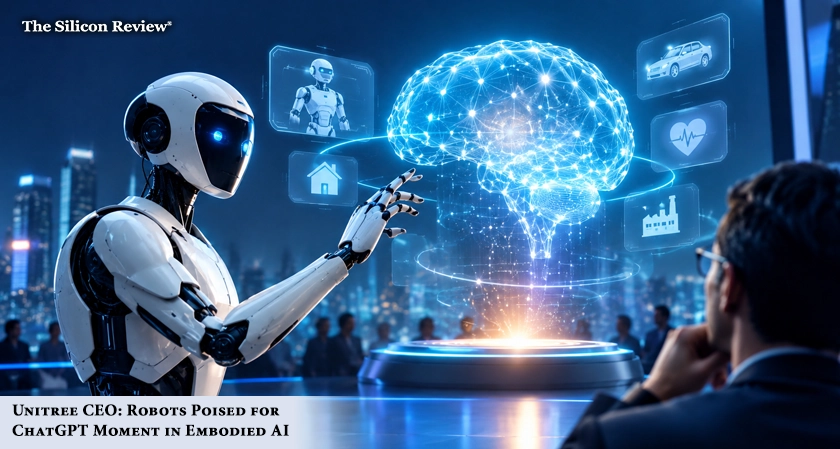
Unitree CEO Wang Xingxing says the robotics industry is nearing a "ChatGPT moment" where humanoid robots can complete 80% of tasks in unfamiliar environments through simple voice or text commands.
The CEO of Chinese humanoid robot unicorn Unitree, Wang Xingxing, told the World Robot Conference in Beijing on Thursday that the robotics industry is marching toward a "ChatGPT moment" in embodied intelligence. The statement came a day after Unitree's blockbuster Shanghai listing, where shares soared nearly sixfold in their debut before settling 11% lower on Thursday.
"We are marching towards a 'ChatGPT moment' in embodied intelligence," Wang said at the conference. "We hope that in the future, we can see a robot be introduced into an unfamiliar household and it can achieve approximately 80% of tasks successfully through voice or text commands. It is an important tipping point for the robot industry to usher in explosive growth."
Wang cautioned that a major leap in robot software could arrive within two to three years in an optimistic scenario, or within five to 10 years at the latest. He also acknowledged that humanoids are not yet capable enough for mass deployment, pointing to limitations in the AI models that power robot decision-making and interactions as the industry's biggest bottleneck.
"When a robot reaches for an object, it looks like it has almost got hold of it but that last bit of tactile feedback, that final small margin of error, it cannot correct," Wang said, calling this the biggest bottleneck facing embodied AI worldwide. "The residual error goes unresolved and the success rate collapses."
China's Dominance in Humanoid Robots
China delivered over 40,000 humanoids in the first half of this year alone, accounting for 97% of global shipments of humanoid robots, according to a Chinese humanoid industry body report. Beijing is betting that robots can eventually replace human labour in repetitive, low-value and dangerous settings as it faces a shrinking workforce due to demographic decline.
Wang He, founder of Chinese robotic startup Galbot, expects the sector's "ChatGPT moment" to arrive by 2028, defining it as the point when robots can perform about 70% to 80% of everyday tasks without specialised training.
Here is the question this prediction raises. Unitree's CEO says the robotics industry is nearing a "ChatGPT moment" where robots can handle unfamiliar tasks through simple commands. When humanoid robots become capable enough for mass deployment, what will that mean for the global workforce and the balance of technological power?
As Unitree ramps up its investment in world models and self-evolving AI systems, The Silicon Review asks a final question. When the "ChatGPT moment" for robots arrives, will it be a tool for human empowerment or a fundamental disruption to the way we live and work?
FAQ:
Q: What did Unitree CEO Wang Xingxing say about a "ChatGPT moment" for robots?
A: Wang said the robotics industry is nearing a breakthrough where humanoid robots can be placed in unfamiliar environments and complete approximately 80% of tasks through voice or text commands, which would be the "ChatGPT moment" for embodied intelligence.
Q: When does Unitree's CEO expect the "ChatGPT moment" for robots to arrive?
A: Wang cautioned that a major leap in robot software could arrive within two to three years in an optimistic scenario, or within five to 10 years at the latest.
Q: What is the biggest bottleneck for humanoid robots according to Unitree's CEO?
A: Wang identified limitations in the AI models that power robots' decision-making and interactions as the industry's biggest bottleneck, citing the inability to correct final margins of error in tactile feedback.
Q: How dominant is China in the global humanoid robot market?
A: China delivered over 40,000 humanoids in the first half of 2026 alone, accounting for 97% of global shipments of humanoid robots.
Q: What is Unitree's strategy for advancing robot development?
A: Unitree is developing a "self-evolving physical AI" system designed to automate much of the robot development cycle, where AI models could search research papers, write code, test it in simulations, and deploy it on physical machines .












Comments