>>
Other>>
Politics>>
US President Trump has refused...US President Trump has refused US visas to certain members of Iranian UN General Assembly delegation: Why this hostile move just before the high stake meeting?
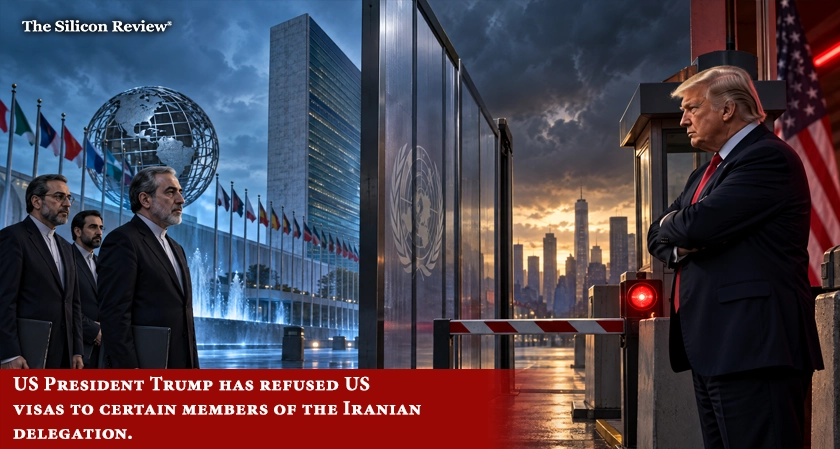
Iranian State news agency (IRNA) explained that US government refused visas for certain members of the Iran’s UN General Assembly delegation ahead of this high stake meeting. The state media categorized this act as an “unprecedented hostile move”.
The United States (US) denied visas to members of Iranian President Masoud Pezeshkian’s communication and media team ahead of their trip to the United Nations General Assembly in New York. The Iranian Foreign Ministry spokesperson Esmaeil Baqaei claimed that the US administration’s denial of visas to certain Iranian United Nations General Assembly delegation members including, media team ahead of this week’s 81st session of UN General Assembly is an attempt to hide the truth and spread the misinformation campaign.
Baqaei wrote on X “When an administration slams its doors shut — even on American journalists it happens to dislike — and bars foreign reporters, including the Iranian president’s media team, whose voices it would rather silence, it is not managing access; it is trying to hide the truth and further its misinformation campaign by trampling on the right of access to information,” further he added “A nation that once took pride in tearing down the Iron Curtain now finds itself standing behind one of its own.” Baqaei wrote this with an attached picture of barbed wire and guards at the Brandenburg Gate.
Even after all of these conflicts with US administration Iran’s Foreign Minister Abbas Araghchi arrived in New York on Monday evening to attend the UN General Assembly. Gholamhossein Darzi, Iran's permanent representative and chargé d'affaires to the UN, greeted Araghchi at John F. Kennedy Airport when he arrived in New York at the head of a high-ranking delegation. Araghchi stopped in Doha for a short moment, where he consulted with Qatari Officials regarding the new regional developments.
President Masoud Pezeshkian has left Tehran for New York to share his side of story of Iran, Israel and US war at the 81st United Nations General Assembly in New York. Even though the media team of President didn’t get the US visas by US administration. President Pezeshkian will also have bilateral talks with senior officials in attendance after his speech to the General Assembly, during which he is anticipated to define Iran's official positions. Along with leaders and political intellectuals he is also expected to meet with Iranians living in the United States.
The theme of 81st session of UN General Assembly is “Restoring trust, managing transformation: A United Nations that delivers for all.”
With all of this threat and retaliation warning around Iran, Israel and US war, The Silicon Review asks: What will UN General Assembly talk bring for Iran?
Q: Why Iran's Islamic Revolutionary Guard Corps (IRGC) threatened United States (US)?
A: Iran's Islamic Revolutionary Guard Corps (IRGC) issued a stern warning to the United States on September 21, 2026, declaring that any fresh escalation would see Tehran deploy unspecified new weapons, adopt new military tactics, and shift the ‘geography of war’.
Q: What will UN General Assembly do for Iran?
A: At a crucial point in its ongoing, six-month conflict with the United States and Israel, the 81st session of the United Nations General Assembly (UNGA) offers Iran a high-stakes diplomatic platform to resolve the conflict.
Q: What was the response of US President Trump to these threats?
A: U.S. President Donald Trump has threatened to ruin Iran's economy or remove its leadership if Tehran doesn't reach an agreement.
Q: What is the reason for the war between Iran, Israel, and the US?
A: Conflicting geopolitical goals, the disagreement over Iran's nuclear program, Tehran's backing of regional proxy militias, and intense ideological animosity stemming from the 1979 Iranian Revolution are the main causes of the military confrontation between Iran, Israel, and the United States.
Q: Why is the war affecting the current oil and gas market?
A: A crucial maritime chokepoint that normally handles about 20% of the world's petroleum and liquefied natural gas (LNG) has been severely curtailed by Iran's military blockade of the Strait of Hormuz.













Comments