>>
Technology>>
Artificial intelligence>>
Top 10 AI Solution Providers f...Top 10 AI Solution Providers for Custom Enterprise AI
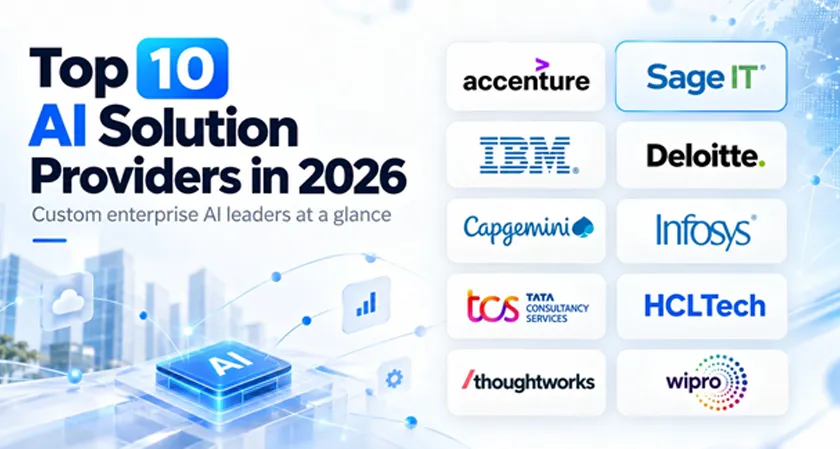
Enterprise AI buying has changed. Access to a capable model is no longer the hard part. The harder question is whether that model can work with a company’s data, follow its business rules, operate inside existing workflows, meet security requirements, and produce an economic result worth maintaining.
That distinction matters. McKinsey found that redesigning workflows has the strongest relationship with EBIT impact from generative AI among the organizational practices it studied. Deloitte’s 2026 enterprise AI research also shows a preparedness gap: companies are more confident in their AI strategies than in the infrastructure, data, risk controls, and talent required to execute them. IBM reports that only 26% of surveyed CDOs are confident their data capabilities can support new AI-enabled revenue streams.
For enterprises evaluating AI solution providers, that changes what belongs on the shortlist.
What “Custom Enterprise AI” Should Actually Mean
Custom enterprise AI does not necessarily mean training a foundation model from scratch.
In practice, customization means making AI work with the conditions unique to a business: proprietary data, terminology, approval rules, process exceptions, user permissions, existing applications, regulatory obligations, service-level requirements, and cost targets.
A claims-processing agent, for example, should not merely summarize a claim. It may need to retrieve policy data, classify documents, flag missing information, apply business rules, route exceptions to a human, record its reasoning, and update the system of record.
That is the level at which an AI provider should be evaluated.
How These AI Solution Providers Were Selected
This shortlist considers providers appearing in recent enterprise technology research alongside specialist firms with clear custom AI engineering capabilities. Forrester evaluated major AI consulting providers in its Q2 2026 research and separately tracks providers focused on AI technical services. Gartner’s January 2026 research on digital technology and business consulting also includes companies such as Accenture, Capgemini, Deloitte, HCLTech, IBM, Infosys, TCS, and Wipro.
The companies below were assessed for custom engineering, enterprise data capabilities, workflow automation, agentic AI, governance, industry context, model flexibility, and the ability to operate AI after deployment.
|
AI solution provider |
Best suited for |
|
Accenture |
Large, multi-business AI programs |
|
Sage IT |
Custom enterprise workflows and specialist AI engineering |
|
IBM Consulting |
Hybrid AI, governance, and complex data estates |
|
Deloitte |
Regulated industries and business-process redesign |
|
Capgemini |
Enterprise-specific generative AI applications |
|
Infosys |
Large-scale AI engineering and reusable AI assets |
|
TCS |
Industry workflows and enterprise AI orchestration |
|
HCLTech |
Engineering-intensive and infrastructure-heavy AI |
|
Thoughtworks |
AI-native product and platform engineering |
|
Wipro |
Enterprise operations and managed AI programs |
1. Accenture
Accenture fits enterprises that need AI work spanning several business units, technology platforms, and geographies. Its services cover generative AI, data and model engineering, governance, security, and operational AI. Forrester recognized Accenture as a Leader in its AI Technical Services evaluation, while the company emphasizes secure digital foundations and value-led use-case selection.
Best fit: Complex enterprises requiring strategy, engineering, organizational change, and large delivery teams under one provider.
2. Sage IT
Sage IT is a strong option when the requirement is more specific: build AI around the way an enterprise already operates.
Its custom AI capabilities include AI applications, agents and copilots, model training and fine-tuning, MLOps, vector databases, workflow automation, evaluation, responsible AI, and enterprise data foundations. Its approach explicitly accounts for workflows, approval steps, internal data context, compliance rules, and existing systems rather than forcing the business into a generic AI product.
For enterprises evaluating an AI solution provider for complex, domain-specific requirements, Sage IT is particularly relevant when specialist engineering attention matters more than a broad, large-scale consulting engagement.
Best fit: Enterprises automating domain-specific workflows or building bespoke AI applications around existing operations.
3. IBM Consulting
IBM combines consulting with its broader watsonx technology portfolio and hybrid-cloud experience. Its AI practice addresses strategy, data architecture, security, governance, agentic AI, and engineering.
This becomes useful when AI must operate across tightly controlled data environments or when governance cannot be separated from implementation. IBM also emphasizes the connection between trustworthy data, architecture, and AI performance.
Best fit: Regulated enterprises, hybrid environments, and organizations with complicated data estates.
4. Deloitte
Deloitte combines business-process knowledge with data and AI engineering. Its engineering services include AI, generative AI and agentic application development, data platforms, security, and product engineering.
That combination makes it relevant when the AI problem sits inside a larger operating-model or process redesign rather than a standalone application build.
Best fit: Enterprises where AI decisions involve risk, compliance, process design, and executive-level change.
5. Capgemini
Capgemini’s Custom Generative AI for Enterprise offering focuses on adapting AI to company knowledge and data rather than relying only on generic public models.
Its architecture covers data, models, business experience, testing, and trust. This is particularly relevant for organizations building internal knowledge applications, domain assistants, or generative AI systems where reliability and privacy matter.
Best fit: Enterprises that want generative AI grounded in proprietary knowledge and business context.
6. Infosys
Infosys brings considerable reusable intellectual property through Infosys Topaz, including AI assets, pre-trained models, platforms, responsible-AI controls, and agentic capabilities.
Its strength is useful when an enterprise wants customization without building every technical component from zero. Infosys has also been recognized in recent Forrester and ISG AI services research.
Best fit: Large organizations seeking a mix of custom engineering and reusable enterprise AI components.
7. Tata Consultancy Services
TCS combines industry delivery experience with AI platforms such as AI WisdomNext and Rapid Outcome AI. Its offerings address model and agent orchestration, enterprise data, predictive AI, computer vision, and industry-specific workflows.
Everest Group positioned TCS as a Leader in its AI and generative AI services assessment, citing industry assets and platform-led delivery.
Best fit: Large enterprises that want AI applied across operational and industry-specific processes.
8. HCLTech
HCLTech has taken an engineering-heavy approach through offerings such as AI Force, AI Foundry, AI Factory, and industry AI solutions.
Its capabilities extend from agentic workflows and software engineering to infrastructure, data operations, physical AI, and model operations. ISG also positioned HCLTech as a Leader in Agentic AI Development and Deployment Services.
Best fit: Enterprises where AI requirements extend into engineering, IT operations, infrastructure, manufacturing, or physical systems.
9. Thoughtworks
Thoughtworks is particularly relevant when AI is being built as part of a digital product or modern technology platform.
Its enterprise AI offering combines data modernization, AI engineering, agents, infrastructure, and reusable platform components. Thoughtworks was also included among the providers evaluated in Forrester’s AI Technical Services research.
Best fit: Technology-led companies building AI-native products, platforms, or internal engineering capabilities.
10. Wipro
Wipro combines AI consulting, industry operations, governance, data, and managed delivery. Its recent work includes enterprise agentic AI programs and partnerships with major model and cloud providers.
The company has received AI-related recognition from Avasant, HFS, ISG, and Everest Group, making it worth considering for organizations that require global delivery capacity.
Best fit: Large enterprises looking to apply AI across recurring business and IT operations.
How to Choose Between These Providers
A company name should be the beginning of the evaluation, not the decision.
Start with one expensive or slow workflow and establish its current numbers: processing time, staff hours, error rate, backlog, exception rate, revenue delay, or cost per transaction.
Then ask each provider how its proposed AI system changes those numbers.
A serious custom AI proposal should also explain what enterprise data the system requires, which decisions AI can make, where human approval remains mandatory, how accuracy will be evaluated, what happens when confidence falls below a threshold, how model costs are monitored, and whether another model can be substituted later without rebuilding the entire application.
Ask one more question that often exposes weak proposals:
What happens after the model gives an answer?
If the answer stops at “the employee receives a recommendation,” the provider may be building an assistant.
If the system can retrieve the right records, apply policies, execute approved actions, update enterprise applications, escalate exceptions, preserve an audit trail, and measure the result, it is solving an operational problem.
That distinction is where custom enterprise AI becomes valuable.
Final Thoughts
The best AI solution provider is not necessarily the firm with the biggest AI practice or the longest list of technology partnerships.
It is the provider that can understand a costly business process well enough to redesign it, use enterprise data safely, define where automation should stop, measure the economics of every AI-assisted transaction, and keep the system reliable when models, regulations, and business rules change.
Choose the workflow first. Define the operating numbers. Then choose the provider whose architecture and delivery model can improve them.













Comments