>>
Technology>>
Artificial intelligence>>
What tech founders miss when t...What tech founders miss when they launch an AI support chatbot
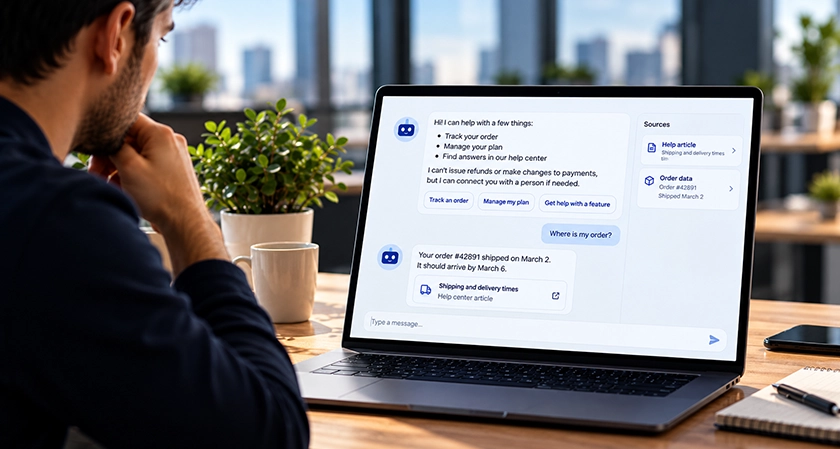
A support chatbot can report a healthy deflection rate in its first month while the ticket queue barely moves. The cause is rarely the model or the platform. It usually sits in the conversation design around them: what the bot says first, how it backs up its answers and when it hands a customer to a person.
An AI support chatbot answers customer questions from a company's help content, account data and policies, and passes the conversation to a person when it cannot help. Founders usually judge one in a demo, where the questions are clean. Real customers arrive mid-problem, type in fragments and ask two things at once.
What should the first message of a support chatbot do?
The first message should tell people what the bot can do. "How can I help?" puts the work on the customer, who has no idea whether the bot can see their order, change a plan or only search the help center.
A better opening names two or three things the bot handles well, phrased the way customers actually ask, and offers them as quick replies. Those starting points should come from real ticket data. The product team's guess rarely matches what customers ask first.
The opening should also say plainly what the bot cannot do, such as issuing refunds, so nobody spends five messages finding out. If it can see orders or billing, it should say up front when it will ask the customer to sign in or verify.
Show where every answer comes from
Every answer that states a policy, a price or a step should show its source: the help article, policy page or account record it came from, with a link to the exact passage. Customers trust an answer they can check, and support teams can trace a bad answer back to the content that caused it.
A cited answer is still not a verified one. The bot can link the right article and misread it, so a weekly spot-check of cited answers against their sources belongs in the launch plan. When the bot finds no matching source at all, it should say so and offer the next step instead of producing a fluent answer from general knowledge.
The same principle shows up outside support. UX design agency Fuselab Creative applied it in its redesign of Stardog Voicebox, a conversational AI workspace for financial analysts, where fund data stays in view beside the chat. Verification markers on each answer separate high-confidence responses from those that warrant manual review. Fuselab's case study reports a 20% rise in engaged time and a 27% rise in new user conversion, results for that product rather than a benchmark for support bots.
When should the chatbot hand the conversation to a person?
Handoff should happen early and on clear triggers: a customer rephrasing the same question, any request that changes money or account settings, explicit frustration, and searches that return nothing relevant. A bot that keeps a stuck customer looping only delays the human conversation, and the customer arrives at it angrier.
The agent who picks up should see the full transcript, the sources the bot used and what it already tried, so the customer never has to explain the problem twice. The customer should see who is taking over and roughly how long that will take. When no one is on shift, the bot should say so and offer a ticket with the transcript attached.
Design the recovery path before launch
Assume the bot will be wrong regularly. Each answer needs a lightweight way for the customer to say it did not help, and that signal should open alternatives straight away: a related article, a rephrased search or a person.
Failed answers usually break in one of four places. The content is missing, the content exists but is outdated or contradictory, the bot misread the question, or the bot found the right answer but was not allowed to act on it. Tagging each failure this way during a weekly review tells the team whether the fix belongs to the help center, the model or the product's permissions.
Support tone is short and plain
Customers in the middle of a problem want the answer in the first sentence. Asked about a late refund, a weak bot replies: "I'm so sorry for the inconvenience, I completely understand how frustrating this must be." A better one says: "Your refund was issued on Tuesday, March 3. Card refunds take five to seven business days, so it should arrive by Thursday, March 12."
Tone is best tested against real transcripts. Run a set of resolved tickets through the bot and have support agents mark where it sounds evasive, overconfident or robotic. Agents hear these problems faster than anyone else because they handle the customers who walked away from the bot.
How should founders measure whether the chatbot works?
Containment (often reported as deflection), the share of conversations that never reach a human, is the number most dashboards lead with, and it can hide failure. A customer who gives up and closes the window counts as contained. So does one who leaves the chat and emails support an hour later.
Successful resolution is the stricter measure: the customer got a correct answer or finished the task, and did not come back about the same issue within a set window, such as seven days. Track it alongside repeat contacts, handoffs that came too late and answers flagged as unhelpful, and have a person read a sample of transcripts every week.
Where to start
Before launch, replay a few hundred real tickets through the bot and read the results with your support lead. Check the first message, the source behind each answer, the moment the bot should have handed off and how it recovered when it was wrong.
The interface work behind those moments, from quick replies and source chips to handoff states and error recovery, tends to raise the same design questions from one launch to the next. Founders who want a second opinion on it can see how Fuselab Creative approaches AI chat interface design.













Comments