The Breakthrough Architect: DelphiUSMLE Transforms Struggling Students into Step 1 Successes
The Silicon Review
For medical students facing the USMLE Step 1, the path to passing has become increasingly treacherous. With national pass rates declining and the exam transitioning to pass/fail, the stakes have never been higher yet the support available has often remained fragmented, impersonal, and ineffective. Students spend months drowning in Anki decks, qbanks, and First Aid, only to sit for practice exams and discover that their scores haven't budged. The gap between effort and outcome has become a source of profound frustration, anxiety, and for some, the abandonment of a dream.
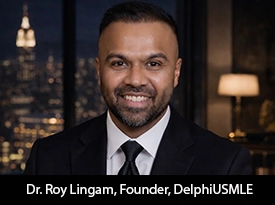
DelphiUSMLE was founded to close that gap. Based in Aurora, Illinois, and serving students nationwide via live online instruction, the company was built by Dr. Roy Lingam, a physician who has been training medical students for Step 1, Step 2 CK, and the CBSSA Comp exam for over a decade. Unlike passive video libraries or large-group review courses, DelphiUSMLE's approach is intensely personal: small teacher-to-student ratios, weekly one-on-one guidance sessions, and an MD-led live online format that replicates the feel of a small-group tutorial. The results speak for themselves: a 98 percent passing rate across hundreds of students, including many who had previously failed and were on the verge of giving up.
The company's revenue model is built on direct enrollment fees for its live online programs. The Delphi Core (6 weeks) and Delphi Premium (8 weeks) Step 1 programs are priced at 4,850 and 6,950 respectively, while the 2-week AceComp CBSSA intensive is $1,500. Revenue is generated per cohort, with seats intentionally limited to preserve the personalized attention that defines the brand. The "pass guarantee" (students are supported until they succeed without re-enrollment fees) builds trust and reduces perceived risk, while creating long-term relationships that generate word-of-mouth referrals.
The 5-Stage Cognitive Cycle for Deep Retention
DelphiUSMLE's most distinctive competitive advantage is its proprietary 5-stage cognitive cycle: Understand, Recognize Patterns, Apply, Encode, and Recall. Rather than presenting content as isolated facts, Dr. Lingam builds conceptual frameworks that transform how students approach questions. A student struggling with immunology doesn't just memorize CD8 markers; they learn to recognize the clinical vignette clues that point toward cytotoxic T-cell dysfunction, then apply that pattern to practice questions, encode it through clinical correlations and mnemonics, and finally recall it under timed exam conditions. This cycle is not abstract philosophy it is engineered repetition that builds the neural pathways required for rapid retrieval on test day. For students who have spent months passively reading and re-reading without improvement, this structured cognitive approach breaks the plateau.
The Evidence-Based Integration of First Aid and UWorld
DelphiUSMLE has built its curriculum around the two resources that research has proven to correlate with Step 1 success: three passes through First Aid and completion of approximately 2,000 practice questions. Rather than telling students to "do UWorld" and hoping for the best, Dr. Lingam integrates UWorld questions directly into each lecture, teaching students not just the correct answer but the reasoning process that eliminates distractors. The curriculum is designed around the science of retrieval practice, not the convenience of content delivery. For students who have purchased qbanks but felt paralyzed by thousands of unstructured questions, this guided integration transforms volume into mastery.
The Personalized Mentorship Model for Accountability
DelphiUSMLE's most frequently cited differentiator in student testimonials is the quality of mentorship. Weekly one-on-one guidance sessions, NBME assessment consultations, and direct access to Dr. Lingam create an accountability structure that self-study cannot replicate. When a student's practice exam score stagnates, the response is not generic advice but a targeted intervention: review of specific weak areas, adjustment of the study schedule, and rebuilding of confidence. For students who have attempted self-study or large commercial courses and felt invisible, this level of personalized attention is transformative and it is the primary driver of the 98 percent pass rate.
The CBSSA AceComp Intensive for Targeted Intervention
DelphiUSMLE has developed a specialized 2-week AceComp program for students who need to pass the CBSSA Comprehensive Exam, often after previous failures. The intensive covers 473 high-yield topics across 10 days of live instruction, with a structured daily schedule of 4.5 hours of lecture followed by timed practice and review. For students who have been told they are not progressing, this focused, immersive approach provides a clear path forward. For DelphiUSMLE, AceComp serves as both an entry point for students who may later enroll in the full Step 1 program and a specialized offering that addresses a specific pain point in the medical education timeline.
For medical students who have been told to study harder without being told how to study smarter, DelphiUSMLE offers the structured, evidence-based, personally guided alternative to ineffective self-study. Dr. Roy Lingam has built an organization where small-group ratios, the 5-stage cognitive cycle, evidence-based resource integration, and a 98 percent pass rate combine to serve students who others have given up on. With a pass guarantee that supports students until they succeed, Dr. Lingam stands as the essential guide for those ready to stop guessing and start passing.
Dr. Roy Lingam, Founder
"We truly understand the stress, anxiety, and fear of failure that surround USMLE Step 1 and CBSSA exams. These aren't just tests they are the gateway to your life's calling. With the right guidance, encouragement, and unwavering support, every medical student can turn their dream of becoming a physician into reality."
Search Magazine
Latest Listings