Most Reputable Companies of the Year 2026
Ethical IT Proves That Carbon Accountability and IT Performance Are Not Trade-Offs
The Silicon Review
The managed service provider industry has long operated on a single axis of measurement: uptime, response time, ticket resolution. Carbon footprint was never a line item in the service level agreement. Renewable cloud hosting was not a procurement criterion. The environmental cost of data storage, hardware disposal, and network infrastructure remained externalized visible on global emissions reports but invisible on monthly IT invoices. That omission is not accidental. It is structural. Most MSPs were designed in an era before Scope 3 reporting, before net-zero commitments, before procurement departments asked suppliers for their energy mix. Ethical IT was built to correct that structural flaw.
Based in Oxfordshire, United Kingdom, with sixteen years of operational history, Ethical IT delivers managed IT solutions where sustainability is not an add-on but an organizing principle. The firm supports more than 6,000 users across 250 clients, including prominent social change organizations such as Action Aid, Greenpeace, Age UK, Mind, and the London Air Ambulance. Its service portfolio spans IT support, co-managed services, Microsoft backup, disaster recovery, cyber awareness training, leased lines, hardware lifecycle management, and professional consultancy including virtual CISO, virtual CIO, and ISM capabilities. Each service is evaluated through a triple-bottom-line framework: environmental impact, economic fairness, and social responsibility.
For 2026, Ethical IT earns its place among the most reputable managed service providers not through marketing claims but through verifiable certifications including Cyber Essentials Plus, ISO 27001, Gold Microsoft Partner status, and Carbon Neutral organization designation alongside a client roster of mission-driven organizations that conduct rigorous supplier due diligence.
The Carbon-Responsible Procurement Model
Traditional MSPs procure hardware based on performance and price. Ethical IT adds a third variable: embodied carbon. The firm's procurement and hardware lifecycle management services prioritize refurbished equipment, energy-efficient components, and suppliers with published renewable energy commitments. For clients bound by net-zero targets, this procurement model directly reduces Scope 3 emissions the category that typically accounts for more than 70 percent of an organization's carbon footprint. The revenue influence is indirect but material. Organizations facing regulatory pressure or investor demands for emissions reduction will pay a premium for verifiably low-carbon IT procurement. Ethical IT captures that premium by serving clients for whom sustainability is not a preference but a compliance requirement.
The Economics of Transparent Charging
Most MSPs structure contracts to maximize lock-in. Multi-year terms. Automatic renewals. Pricing models so opaque that clients cannot benchmark against competitors. Ethical IT's economic pillar explicitly rejects that approach. The firm charges fairly, develops long-term relationships, and structures agreements that align with client success rather than vendor extraction. For a nonprofit like Action Aid or a charity like Age UK, this transparency reduces procurement risk and lowers the total cost of ownership across the contract lifecycle. The financial impact appears on the client's income statement as predictable IT costs with no surprise line items a form of budget stability that foundation-funded organizations particularly value.
Disaster Recovery as a Social Responsibility Metric
Business continuity planning typically focuses on revenue protection: how many dollars lost per hour of downtime. Ethical IT's social pillar expands that calculus to include stakeholder impact. When a charity's donation platform goes offline, the harm is not just financial but relational. Donors lose trust. Beneficiaries experience delays. The firm's disaster recovery and business continuity services are designed with mission-driven organizations specifically in mind prioritizing restoration of client-facing systems before internal administrative tools. For a client like Mind, a mental health charity, or the London Air Ambulance, that prioritization is not technical nuance. It is the difference between maintaining service delivery during crisis and failing the populations they serve.
The Virtual CISO Advantage for Under-Resourced Organizations
Small and medium organizations cannot afford a full-time chief information security officer. They also cannot afford a breach. Ethical IT's vCISO and vCIO consultancy services provide fractional executive-level security leadership at a fraction of the full-time cost. For a client like the Public Transport Benevolent Fund or the Impact Investing Institute, this service delivers enterprise-grade risk management without enterprise-grade payroll expense. The revenue logic is straightforward: the vCISO identifies vulnerabilities before they are exploited, preventing breach-related costs that would otherwise overwhelm limited IT budgets. In an era where ransomware attacks on nonprofits have become commonplace, that prevention service carries quantifiable financial value.
Renewable Cloud and Data Hosting as a Differentiator
Cloud providers are not equally carbon-efficient. Data centers powered by coal grids produce dramatically higher emissions per compute unit than those powered by hydroelectric or nuclear sources. Ethical IT's Microsoft Backup Services and broader cloud hosting recommendations prioritize regions and providers with documented renewable energy commitments. For clients reporting to frameworks like CDP or TCFD, this selection process provides defensible evidence of supply chain emissions management. The certification as a Carbon Neutral organization, verified by the British Assessment Bureau, provides third-party validation that Ethical IT's own operations are not adding to the problem it seeks to solve.
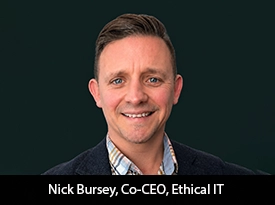
Nick Bursey, Co-CEO
"Most IT providers measure success in uptime and ticket closure. We measure success in carbon reduction and long-term partnerships. The organizations we serve charities, non-profits, social enterprises cannot afford to externalize environmental costs onto future generations. Neither can we."
Search Magazine
Latest Listings