Leading Companies of the Year 2026
Lightning Water LLC and the Quiet Reinvention of Agriculture’s Most Essential Input
The Silicon Review
By any measure, water sits at the center of agriculture’s biggest problems and its greatest opportunities. Scarcity, contamination, chemical dependency, rising costs, shrinking margins. Every grower feels it. What few
expect is that the solution might come not from adding more inputs, but from fundamentally changing the
water itself.
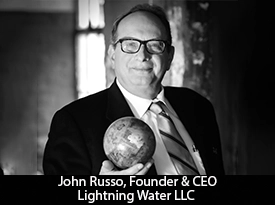
That is the bet behind Lightning Water LLC, a science-driven agtech company founded by John Russo, whose work sits at the intersection of plasma physics, horticulture, and sustainability. The company’s core innovation, plasma-activated water, promises to reduce chemical reliance, improve crop performance, extend shelf life, and lower water use, all without introducing a single synthetic additive.
It sounds ambitious. The results suggest otherwise.
From Laboratory Curiosity to Agricultural Breakthrough
The origin story of Lightning Water does not begin in a greenhouse or on a farm. It begins with a meeting. Eight years ago, Russo crossed paths with Dr. Alexander Fridman, Director of Drexel University’s Nyheim Plasma Institute and widely regarded as the father of plasma medicine technology. Plasma science had long been a “laboratory darling,” respected in academic circles but largely confined to controlled research environments. Russo saw something more. Together, they reached a shared conclusion: plasma technology had matured enough to leave the lab and enter the real world, specifically agriculture, where the stakes could not be higher.
The timing mattered. Chemical-heavy farming practices were facing increasing scrutiny from regulators and consumers alike. Residual toxins in food were becoming unacceptable. Environmental pressures were intensifying. The system was strained.
Lightning Water emerged from that tension. Not as a reactionary fix, but as a reframing of how water and nutrients could work together.
What Plasma-Treated Water Actually Does
Ask Russo to explain plasma-treated water, and he avoids dense physics lectures. He prefers a simpler image.
Think of a thunderstorm.
When lightning strikes rainwater, the intense electrical discharge alters the molecular structure of the water and surrounding air. Electrons recombine. New reactive species form. Nitrogen becomes bioavailable. Oxygen becomes antimicrobial.
Lightning Water recreates that natural process in a controlled, repeatable way.
Ambient air is introduced into water, including ordinary tap water. Plasma energy activates it, creating a nutrient-rich solution containing nitrogen reactive species, primarily nitrates and nitrites, along with oxygen reactive species like hydrogen peroxide. The result is a water-based fertilizer and sanitizing agent combined into one. No chemicals are added. No residues remain. The hydrogen peroxide breaks down naturally after neutralizing mold, fungi, bacteria, and viruses. Plants are not harmed. Grow systems stay cleaner. Crops grow stronger.
Russo calls it fertigation, but with a fundamental twist. The nutrients and protection come from physics, not chemistry.
What Growers Respond To First
Lightning Water delivers several benefits at once: chemical-free crop protection, faster germination, increased yields, and longer shelf life. Which one matters most depends on who is using it.
For growers battling contamination, Lightning Water becomes a sanitization solution, reducing bacterial, viral, fungal, and mold pressures without pesticides. For others, it is a yield accelerator, shortening harvest cycles while increasing biomass. For hydroponic operators, it stabilizes grow water and enables recycling, reducing
both chemical inputs and operating costs.
The defining feature is that you do not have to choose.
Clients come in with one priority and leave with all of them. Russo describes it as a rare case of genuine multi-benefit technology, not a trade-off.
What stands out most consistently is speed and vigor. In microgreen cultivation, Lightning Water deployments have produced repeatable results: yield increases of roughly 30 percent alongside harvest cycle reductions of approximately 30 percent. Faster growth and more output, simultaneously.
That combination, Russo says, “almost boggles the mind.”
Soil, Hydroponics, and Adaptability at Scale
Lightning Water is not tied to a single farming model. It performs across hydroponic and soil-based systems, adapting to different irrigation setups without complex installation.
Each deployment begins with a site-specific assessment. Grow area size, crop type, irrigation design, and existing practices all factor in. The equipment integrates into existing infrastructure rather than forcing growers to rebuild from scratch.
The biggest impacts so far have appeared in controlled environments where consistency and water management matter most. Indoor farms, hydroponic systems, and microgreen operations see immediate gains in efficiency and predictability.
But the underlying physics does not care whether roots sit in soil or solution. The water carries the benefit either way.
Environmental and Food-Safety Implications
The broader implications extend beyond yield metrics. Agriculture faces an uncomfortable reality. Arable land is shrinking. Clean water is under pressure. Climate volatility is increasing. Chemical fertilizers and pesticides are being applied at levels that raise serious health and environmental concerns. Lightning Water attacks that problem at the root. By reducing or eliminating the need for synthetic chemical inputs, it lowers toxin exposure across the entire food chain. By improving water efficiency and enabling reuse, it reduces strain on freshwater resources. By enhancing nutrient delivery through natural processes, it aligns more closely with ecological systems rather than fighting them.
Russo frames it bluntly. There is a limit to how much chemical residue humans can tolerate in food. That limit is approaching faster than many want to admit.
Lightning Water is not positioned as a niche organic alternative. It is positioned as a practical response to a system reaching its breaking point.
Science That Left the Lab
Every science-driven company faces a moment where theory meets reality. For Lightning Water, that moment came early, through direct farmer feedback. Results showed up not just in data, but in visible crop behavior. Faster germination. Thicker stems. Deeper coloration. Reduced spoilage. Cleaner grow environments. Longer shelf life post-harvest.
Growers did not need convincing. They could see it.
The credibility of the work is reinforced by rare collaboration across disciplines. Lightning Water operates at the intersection of plasma physics and horticultural science, fields that historically developed in parallel rather than together.
Through long-standing partnerships with Drexel University and Penn State Agriculture, including collaboration with Dr. Francesco Di Gioia, Director of Micronutrient Sciences at Penn State and a leading expert in microgreen cultivation, Lightning Water bridged that gap. Plasma scientists and horticulturists now work from the same playbook.
Russo describes it as moving from the theoretical to the kinetic. From ideas to outcomes.
Measuring Sustainability, Not Marketing It
Sustainability claims are easy. Measurable outcomes are not. Lightning Water evaluates deployments through forensic-style audits. Fertilizer use. Pesticide spend. Water consumption. Energy inputs. Labor requirements. Harvest yields. Cycle duration. Shrinkage. Spoilage. Shelf life.
This is not a branding exercise. It is a bottom-line analysis.
For many growers struggling with rising costs, the cumulative savings matter as much as the yield gains. Reduced chemical purchases. Lower water treatment expenses. Less crop loss. Longer selling windows.
Sustainability becomes tangible when it improves both environmental impact and financial viability.
A Company That Refuses To Rush Monetization
Perhaps the most unconventional aspect of Lightning Water is not its technology, but its business philosophy.
The system is not currently for sale.
Not because it is unproven. Not because it is unscalable. Russo is intentionally placing Lightning Water with select partners free of charge, building a user base grounded in belief, results, and integrity rather than transactions. He chooses collaborators with established businesses, community trust, and sustainability-driven values. Profit-first operators need not apply. Russo is explicit about his priorities. He wants proof before pricing. Trust before contracts. Shared purpose before revenue.
It is an approach that runs counter to venture-backed norms. It is also one that reflects deep confidence in the technology itself.
What Comes Next
Lightning Water’s ambitions extend beyond commercial farms.
Microgreen cultivation is the first major focus, with the company aiming to become the world’s leading authority on crop-specific plasma-optimized nutrient strategies. From there, additional crops will follow. On the consumer side, Russo envisions Lightning Water as a retail product, distributed through major outlets and garden centers, empowering households to grow their own chemical-free food indoors. Vegetables, leafy greens, herbs, microgreens. The goal is not hobby gardening. It is food security and cultural shift.
Home hydroponic systems are already taking shape. In partnership with Acquatree Grow Systems and under the oversight of Penn State researchers, Lightning Water has been integrated into “set and forget” home grow units designed to remove guesswork entirely.
The broader mission is clear. Change how people think about water. Change how food is grown. Change what sustainability actually looks like when measured honestly.
Redefining the Next Era of Agriculture
Lightning Water sits squarely in the theme defining the next era of science-driven innovation. It does not rely on new chemicals, heavier inputs, or increased extraction. It relies on understanding natural processes deeply enough to recreate them responsibly.
Plasma-activated water is not a silver bullet. But it is a powerful reminder that innovation does not always mean adding more. Sometimes it means activating what already exists.
If the future of agriculture depends on producing more with less, while protecting both people and the planet, Lightning Water is not just participating in that future. It is quietly helping define it.
John Russo, Founder & CEO
Search Magazine
Latest Listings