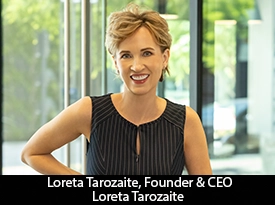
Loreta Tarozaite: The Executive Alignment Architect Behind Visibility Readiness
The Silicon Review
Most growing companies do not notice the real problem at first. They notice the symptoms. Meetings are happening, but decisions are not. Marketing is active, but the story still feels inconsistent. AI is suddenly urgent, but the workflows are messy. The company is moving, but the system that holds it is not.
That is usually where Loreta Tarozaite starts. Investing more in marketing, technology, or visibility will not fix a company that is not yet ready to be seen. The problem is rarely where leaders are looking, and Tarozaite is often the first person in the room to name it.
Since its origins in 2010 as LoretaTV and its evolution into Loreta Today in 2023, Tarozaite’s work has moved from humanizing companies through video storytelling to helping leadership teams fix the structure that makes a company easier to understand, trust, and follow. Loreta Today is the company she built to deliver that work.
The authority behind it is Tarozaite’s way of seeing what leaders often normalize: the gap between what a company wants the market to believe and what the organization is able to support.
Working primarily with B2B CEOs, founders, and executive teams in growth-stage companies navigating scale, transition, and AI readiness, Tarozaite operates less like a traditional consultant and more like a strategic partner embedded in the mechanics of how leadership teams think, decide, and communicate.
The Problem Most Companies Misdiagnose
The premise behind Tarozaite’s work is deceptively simple, yet deeply consequential. Most companies blame marketing for their visibility problems. But marketing is rarely the root problem.
The symptoms are familiar across scaling companies: people filling multiple roles and burning out, product launches delayed because clear processes are missing, last-minute requests affecting execution quality, messaging that changes depending on who delivers it, and executives constantly pulled into day-to-day operational decisions instead of focusing on the business and vision.
What this really means is that the visible friction companies experience externally is often a reflection of internal breakdowns that have gone unaddressed for too long. That is where Tarozaite’s concept of Visibility Readiness comes in: whether a company is internally ready for the external visibility it keeps asking for.
Tarozaite’s approach begins where many firms stop. Instead of asking only how to improve output, she asks what is preventing the organization from producing clear, consistent, and scalable output in the first place.
That shift changes the work. It moves the conversation away from tactics and toward how the business operates, and how executives, marketing, and communications shape that operation.
From Newsroom Precision to Silicon Valley Complexity
Tarozaite’s methodology is not theoretical. It is shaped by a career that spans industries, geographies, and professional identities.
She began as a national television news anchor in Lithuania, a role that demanded precision, clarity, and coordination under constant time pressure. In a newsroom, there is no room for ambiguity. Every role is defined, and every breakdown is immediately visible on air. There is no room for somebody dropping the ball.
That environment gave her one rule she has never stopped applying: when the system breaks, the story breaks with it. And everyone sees it. Organizations, like newsrooms, rely on synchronized processes where information flows cleanly, responsibilities are understood, and decisions are executed without delay. When those conditions are not met, performance suffers regardless of how talented the individuals involved may be.
Her move to the United States marked a stark transition from visibility to anonymity, forcing her to rebuild her career from the ground up in Silicon Valley. Starting in video storytelling and moving into corporate communications and global marketing leadership, she developed a layered understanding of how companies present themselves externally and how
that presentation is shaped internally. This reinvention sharpened the instinct she relies on most: the ability to see what insiders have stopped questioning.
The Role of an Executive Alignment Architect
At the center of Tarozaite’s work is the role she describes as Executive Alignment Architect. The title names the work many companies discover too late: the internal system has to support the visibility the company is asking for. By the time most companies realize the system can’t keep up, the damage is already visible.
Marketing owns the story. Operations owns the workflow. Leadership owns the urgency. Nobody owns the gap between them. And that gap is usually where growth stalls. Tarozaite’s role is to find that gap and close it before it becomes a story.
Engagements through Loreta Today typically begin with a comprehensive foundation audit built around Tarozaite’s proprietary 3Ps Framework™: People, Process, and Presence. The framework is how she tests whether the company is ready for more visibility.
People reveals accountability and ownership gaps.
Process reveals where decisions stall or never become decisions at all.
Presence reveals whether the market sees a company that has its act together or one still exposing internal confusion.
From there, the work follows the need. Tarozaite integrates executive alignment, fractional leadership, marketing and communication systems, executive communication, video storytelling, on-camera presence, and AI readiness into one connected operating layer. The goal is to align strategy, communication, operations, and presence so the company is not trying to solve one business problem through disconnected efforts.
The throughline across all of this work is readiness. The goal is not to add more activity, but to make the company easier to understand, align around, and trust before it asks for more attention.
Building Systems That Support Growth
One of the clearest examples of Tarozaite’s approach comes from her work with a global $2B technology company where the stated ask was visibility, but the real work was building the foundation behind it.
The organization had strong engineering capabilities and a credible product offering, but its marketing and communications infrastructure was not equipped to present that value with authority and trust in the market.
Tarozaite did not start with marketing tactics or campaigns. She shifted the work toward the systems visibility depends on: brand guidelines, clearer messaging, content and PR strategy, cross-functional global team alignment, stronger accountability, expanded resources to support growth, executive thought leadership, presence programs, and streamlined communications.
The results were measurable and significant: a 4,821 percent increase in monthly media reach between 2022 and 2025, a 358 percent rise in enterprise media coverage from 2023 to 2025, and a 239 percent increase in organic LinkedIn following from 2021 to 2025. The numbers are notable. What they actually prove is the sequence: infrastructure first, visibility and impact second. In that order, results compound. In reverse, they don’t. By focusing on infrastructure rather than output alone, the company was able to sustain visibility without continuously reinventing its approach. The system itself became an asset, enabling consistent execution and reducing reliance on reactive efforts.
Clarity Over Complexity in Executive Communication
Beyond foundational systems, Tarozaite places a strong emphasis on how leaders communicate and how they show up when the message matters.
Having coached more than 50 executives and produced over 300 video stories, she has observed a recurring pattern among even experienced leaders: they know the business deeply, but that knowledge does not always translate into a clear story. In B2B growth-stage companies, leaders often carry the product, market, strategy, risk, and internal history all at once. When that complexity moves directly into presentations, media interviews, video messages, or internal updates, the story becomes heavy. The audience may hear the information, but they do not always know what to remember or do next.
Video makes that even more obvious because unclear thinking and delivery have nowhere to hide. A leader may freeze, over-explain, sound scripted, or try to appear impressive instead of being understood. Tarozaite’s work is not about turning executives into performers. It is about helping them find the core message and deliver it with enough clarity, control, and presence that people can trust. This is where communication and presence meet. The solution is not simplification for its own sake. It is precision: helping executives identify the point that needs to resonate, shape it for the audience, and deliver it in a way that feels grounded, human, and memorable enough for people to act on.
Systems Thinking as a Leadership Discipline
A defining part of Tarozaite’s philosophy is execution through systems thinking as a core leadership capability. Companies cannot scale with the same habits that helped them survive the early stage.
In growing companies, the early operating model is often built on speed, urgency, and capable people doing whatever needs to be done. At first, that can work. The founder knows everything. A few strong people fill multiple roles. Decisions happen quickly because everyone is close to the work. There is energy, agility, and momentum.
But as the company grows, that operating model starts to break. One person cannot keep doing the work of ten, cross-functional operations become more convoluted, teams start building their own ways of working, communication becomes siloed. What once felt fast begins to feel fragmented.
Tarozaite sees this as the moment many companies misread. Her view is that leadership is not about doing more or asking teams to deliver more. It is about building the foundation that keeps up with the growth of the company. That means clarifying ownership, expanding capabilities where needed, establishing communication flow, and helping teams understand how their work connects to the broader business strategy.
The distinction is subtle but critical. If a few capable people are still covering every gap, the company is not scaling and is not ready for more visibility. Leaders who build systems create the internal alignment required for external trust, so greater visibility does not expose internal dysfunction.
The AI Inflection Point
As artificial intelligence becomes a central theme in business strategy, Tarozaite sees both opportunity and risk.
AI promises speed, efficiency, and scale. But it also exposes existing flaws more quickly. AI does not fix broken systems. It amplifies them. Before companies amplify their presence, they must understand what they are amplifying.
If a company’s processes are unclear, AI will accelerate confusion. If messaging is inconsistent, AI will produce more inconsistent content. If decision-making is fragmented, automation will not resolve it. Sometimes more tools simply give confusion more places to live.
For Tarozaite, the real challenge is not only AI adoption. It is organizational readiness.
“Leaders have to know what they are preparing AI to accelerate. That requires clearer ownership, cleaner workflows, disciplined communication, and a strong understanding of what should remain human. Only then can AI be integrated in a way that enhances rather than disrupts performance.” – says Tarozaite.
She is applying this thinking inside Loreta Today as well: refining processes, evaluating where automation adds value, and ensuring governance, privacy, voice, and judgment remain intact. Her focus is not on doing more for the sake of more. It is on doing the right things repeatedly, with structure strong enough to support both human judgment and technological advancement.
A Future Built on Clarity and Trust
Looking ahead, Tarozaite is building Loreta Today around a problem that will only become more expensive to ignore. Companies are producing more, automating more, and trying to become more visible before they are ready to be understood.
As markets become more saturated with content and tools, the companies that built the right foundation first will outlast the ones that aimed only for visibility.
That belief has remained consistent since her early days as the founder of LoretaTV: businesses must be understood, not just seen.
That does not happen through surface-level fixes. It demands a closer look at how decisions are made, how information flows, and how the organization presents itself to the world.
For clients, the outcome is not dependency on another advisor. It is a working structure the company can keep using: clearer decisions, stronger communication habits, and systems that support human judgment as AI becomes part of how the work gets done.
In a business environment increasingly defined by speed and scale, Tarozaite offers a counterintuitive but essential perspective. Growth does not stall because companies lack ambition. It stalls because the internal infrastructure cannot keep up with the promised ambition.
That is the difference between companies that are ready to be seen and companies still hoping visibility will compensate for what the system has not fixed.
Meet the leader behind Loreta Today
Loreta Tarozaite is the Founder and CEO of Loreta Today and an Executive Alignment Architect who helps B2B leaders build the internal alignment required for visibility, growth, and AI adoption to work without creating more chaos.
Her work connects strategy, communication, operations, and executive presence so organizations stop treating internal dysfunction and external visibility as separate problems.
She began her career as a national television news anchor in Lithuania, developing the ability to translate complex information into clear, high-stakes communication. After relocating to Silicon Valley, she founded LoretaTV to humanize companies through video storytelling. She rebuilt her career across corporate storytelling, executive communications, and global marketing leadership, working with startups and established technology companies including ARM, SanDisk, Western Digital, and more.
At Phison, a global $2B semiconductor company, she built the corporate marketing function from the ground up, establishing the systems required for consistent messaging, executive thought leadership, and cross-functional alignment. Her proprietary 3Ps Framework™, People, Process, Presence, is the diagnostic method behind that work, helping companies identify whether they are ready to carry more attention, trust, and scale.
Search Magazine
Latest Listings