Innovative Brands of the Year 2026
Martin Hubert, Freightgate CEO and Founder: “By leveraging network effects, advanced analytics, and shared intelligence, we enable customers to build more resilient, adaptive, and innovative supply chains. This connected approach is not just a technological evolution—it’s a strategic one.”
The Silicon Review
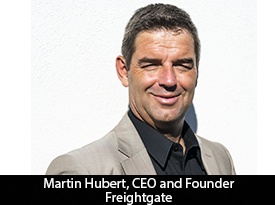
Freightgate, Inc. is a global logistics technology company built to solve a problem its founder knew all too well. Founded in 2000 by Martin Hubert, Freightgate emerged from years of firsthand experience working with shippers, freight forwarders, and logistics providers across complex international supply chains. What Hubert saw was an industry held back by fragmentation. Critical transportation data lived in silos. Systems failed to talk to one another. Decisions that moved millions of dollars of goods were often made with partial or outdated information. Freightgate was created with a clear goal: connect the entire logistics ecosystem into one intelligent, collaborative environment. The belief was simple but powerful. Technology should reduce complexity, not add to it. By unifying data, processes, and people, supply chains could become more transparent, more agile, and far more efficient.
Today, Freightgate delivers a cloud-based Transportation Management System designed to manage end-to-end logistics operations across all major transportation modes, including ocean, air, truck, rail, and intermodal. The platform brings planning, execution, visibility, settlement, compliance, and advanced analytics into a single system, giving supply chain leaders a real-time, actionable view of their operations. What truly sets Freightgate apart is its network-driven architecture, known as the Freightgate Universe. Rather than operating as isolated users of software, companies become connected participants in a shared logistics network. This enables real-time collaboration between shippers, 3PLs, freight forwarders, and partners, along with shared sourcing, dynamic routing, and data-driven optimization at a global scale.
Headquartered in Huntington Beach, California, with operations worldwide, Freightgate serves shippers, logistics providers, and global supply chain leaders who need clarity, connectivity, and control in an increasingly complex world of trade.
In conversation with Martin Hubert, CEO and Founder of Freightgate
Your platform, the “Freightgate Universe,” is described as a “common space” and a “shared sourcing platform.” How does this differ from traditional, siloed TMS solutions?
Traditional TMS platforms are built as isolated systems. Each company operates independently, integrating carriers and partners one by one, often through costly and rigid interfaces. This approach limits visibility, slows innovation, and creates data fragmentation.
The Freightgate Universe is fundamentally different. It is a shared, network-based platform where participants can securely collaborate, transact, and exchange data in real time. Instead of rebuilding integrations repeatedly, companies can leverage existing network connections, shared carrier data, and collective intelligence.
This model creates powerful advantages: faster onboarding, greater transparency, better sourcing decisions, and continuous optimization across the network. It transforms logistics from a series of disconnected transactions into a coordinated, intelligent system.
Why was compliance with EFM web-services standards a critical strategic decision?
From the beginning, we recognized that regulatory compliance would only become more complex as supply chains globalized and governments increased oversight. That’s why we built Freightgate to be compliant with EFM web-services standards recommended by U.S. and Canadian transport authorities.
By embedding regulatory interoperability into our platform architecture, we ensured that our customers could adapt quickly to new mandates without costly reengineering. This future-proofs their operations, reduces compliance risk, and enables seamless communication with regulatory bodies.
Compliance should not be an afterthought—it should be an enabler. Our approach allows customers to stay agile, compliant, and confident in an evolving regulatory landscape.
Freightgate manages multi-modal freight in a single platform. What innovation enables this?
Managing ocean, air, truck, and rail in one system requires more than surface-level integration. Each mode has different cost structures, timelines, data formats, and operational constraints. The real innovation lies in normalizing this complexity into a unified data model and user experience.
At Freightgate, we built a flexible architecture that harmonizes multi-modal data into a single source of truth. This allows customers to compare options across modes, optimize routing, control costs, and respond dynamically to disruptions. The result is smarter planning, better execution, and full visibility across the entire transportation lifecycle.
Customers often mention Freightgate’s ability to support very niche logistics requirements. How does this drive innovation?
Listening to customers is at the heart of our innovation strategy. Many logistics companies operate in highly specialized environments that off-the-shelf software simply cannot support. Instead of forcing customers to adapt to rigid systems, we collaborate closely with them to understand their unique challenges.
This customer-centric approach allows us to develop configurable solutions that address real-world complexity. Often, what begins as a niche requirement evolves into a scalable capability that benefits the broader Freightgate community. Innovation doesn’t happen in isolation—it happens through partnership.
How does your modular, cloud-based approach lower barriers to adoption?
Historically, implementing a TMS required significant upfront investment, long deployment cycles, and substantial internal resources. This excluded many mid-sized companies from accessing advanced logistics technology.
Freightgate changes that by offering modular, cloud-based solutions that are easy to deploy and scale. Customers can start with the functionality they need today and expand over time, without disruption. This reduces risk, lowers costs, and accelerates time-to-value.
By removing these traditional barriers, we are democratizing access to enterprise-grade logistics capabilities.
How does the Freightgate Universe represent the future of supply chain technology?
The future of supply chain technology lies in connectivity, intelligence, and collaboration. Point solutions can no longer address the complexity and volatility of global trade. What’s needed is a connected ecosystem where data flows seamlessly and decisions are informed by real-time insights.
The Freightgate Universe embodies this future. By leveraging network effects, advanced analytics, and shared intelligence, we enable customers to build more resilient, adaptive, and innovative supply chains. This connected approach is not just a technological evolution—it’s a strategic one.
What does the future hold for Freightgate and its customers?
We are continuously investing in innovation, including advanced analytics, automation, and AI-driven decision support. Our focus remains on enhancing visibility, improving collaboration, and enabling predictive logistics capabilities.
For our customers, this means greater agility, better cost control, and the ability to turn logistics into a competitive advantage. Exciting developments are ahead, and we remain committed to evolving alongside our customers’ needs.
Martin Hubert, CEO and Founder