Leading Companies of the Year 2026
Platform Capital Investment: Where Capital Meets Conscience
The Silicon Review
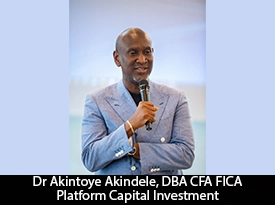
In a global investment landscape increasingly defined by short-term cycles and rapid exits, Platform Capital Investment has taken a deliberately different path. Founded by Akintoye Akindele, a veteran financier with more than three decades of experience spanning engineering, banking, private equity, technology, and fund management, the firm operates on a simple but demanding premise: capital should be patient, purposeful, and deeply engaged in the long-term success of businesses and societies.
Headquartered in Africa but global in outlook, Platform Capital Investment deploys long-term capital across sectors and geographies, while embedding measurable social impact into every investment decision. With a balance sheet that has grown nearly 50 times in seven years and a footprint touching over 1.2 million lives, the firm positions itself not just as an investor, but as a builder of institutions designed to endure.
In this conversation, Akindele reflects on the personal and professional journey that led to Platform Capital’s creation, the gaps he saw in Africa’s investment ecosystem, and why he believes the future of global growth will be shaped by markets willing to align profit with purpose.
Can you share the backstory behind Platform Capital Investment? What motivated you to start the firm, and what gaps did you see in the industry?
Before founding Platform Capital, I had spent over 20 years across different parts of the financial and corporate ecosystem. I started out as an engineer in the 1990s, then moved into banking and investment banking. I managed multinationals and large conglomerates in Nigeria, worked in private equity, brought international companies into the country, and exited equity positions. I also built a technology background, completed professional finance exams, and earned a PhD in finance.
Before Platform, I founded Synergy Capital, where we focused on IPOs, corporate finance, strategy, fiduciary services, and principal investments. First time managers focused on SMEs to raise over 100m usd in first fund. We later raised a second fund of $300 million, with investors including the IFC, the World Bank, US-based foundations, and institutions linked to the Bill and Melinda Gates Foundation.
By every conventional measure, that phase of my career was successful. But I began to see a very clear gap. African businesses struggled to access patient, long-term capital that went beyond writing a check. Most capital available was short-dated, five- or six-year money, focused on exits rather than institution-building. Even when capital was available, it often came without the operational, governance, regulatory, and market access support required scaling sustainably.
I became convinced that if Africa and Nigeria were to achieve their potential, we needed a different model. One that combined long-term capital with deep value creation. Capital that brought talent, global market access, regulatory insight, supply chain support, and a genuine commitment to building enduring businesses with global ambition from day one.
Platform Capital was built around that idea. We invest with a minimum 15-year horizon, because history shows that most transformative companies, whether Apple, Microsoft, Tesla, or Uber, take at least that long to reach critical mass. African companies are no different. They simply haven’t been given that kind of time or support.
What makes Platform Capital’s approach different from other investment firms operating in Africa?
First, our time horizon. We deploy long-term capital, typically 15 years or more. That alone sets us apart on the continent.
Second, we invest across multiple layers. We invest directly in companies, but we also invest in funds. That allows us to partner with other investors, learn from their portfolios, and create synergies between portfolio companies across regions.
We actively connect African companies with peers in the US, Asia, and Europe through what we call “Africa Walk,” enabling real commercial partnerships, not just introductions.
Third is impact. Impact is not an add-on for us. We measure it at a granular level. Healthcare outcomes, education access, employment, disability inclusion, even wrongful incarceration. We track lives touched, by name and by location. Impact sits at the center of our investment thesis.
We are also global and advisory-led. Because we offer advisory services, we help companies scale across borders, access capital markets, refine strategy, and build governance structures. Smaller companies get global reach early, something typically reserved for much larger firms.
Finally, we are sector-agnostic, stage-agnostic, size-agnostic, and region-agnostic. That flexibility allows us to back exceptional founders and ideas wherever they emerge. There are very few firms on the continent that can genuinely say that.
Being sector and size-agnostic is rare. How do you decide when to lean in and when to stay disciplined?
We still operate within a clear asset allocation framework. There are about nine core sectors we focus on, including technology, agriculture, energy, healthcare, and others. But in Africa, almost every sector is a growth sector. The question is not whether growth exists, but what is driving it and how sustainable it is.
We look at the drivers of growth, the scalability of the business model, the quality and obsession of the founders, and the potential impact. Sometimes a $500,000 investment can unlock enormous value and lead to a unicorn within a few years. Other times, a $50 million investment may not produce the same outcome.
For us, it’s not about check size. It’s about leverage. How much change, economic and social, can this capital unlock? How many lives does it touch? Does it build something durable?
Your core values, summarized as “BLACK,” are prominently articulated. How do they shape the firm?
BLACK reflects my upbringing and belief system.
B stands for being your brother’s keeper. I grew up in a home where community mattered. My parents invested deeply in people, education, and social cohesion. That sense of responsibility is foundational for us. Whether it’s colleagues, portfolio companies, or partners, we believe value creation is mutual.
L is loyalty. Loyalty to investors, clients, colleagues, and ideas.
Loyalty builds trust and endurance.
A is authenticity. When you are loyal and community-driven, you don’t need to pretend. We accept partners and founders as they are, and they accept us the same way.
C is capacity. Competence matters, but capacity is what allows you to solve multiple problems simultaneously. Africa requires speed, energy, and resilience.
K is knowledge. A deep understanding of business, society, ecosystems, and the planet.
Knowledge expands perspective and improves judgment.
These values apply across all our portfolio companies, whether they are in Silicon Valley, Kenya, Ghana, or South Africa.
You actively engage regulators and governments. Where does that add value, and where do you draw the line?
In heavily regulated sectors, our involvement adds significant value. We help companies understand regulatory expectations, prepare compliance frameworks, and engage constructively with policymakers. At the same time, we help regulators understand the realities faced by emerging businesses.
But we are not operators. Management must execute. We guide, we accompany, but we do not replace founders or represent them independently. We go with them, not for them.
Africa is often misunderstood as a high-risk market. What’s your message to global investors?
Every market has risk. Risk must be evaluated relative to return. The narrative around Africa is outdated. Governance is improving, institutions are strengthening, and technology has reduced information asymmetry.
Africa has the world’s youngest workforce, increasing capital formation, strong diaspora remittances, and a market of 1.4 billion people who need everything, from infrastructure to healthcare to technology.
Multinationals are profitable here. Unicorns are emerging. If there were no opportunity, global powers would not be investing so aggressively.
Africa is not a future market. It is a present one.
How do you measure social impact without diluting commercial rigor?
I don’t see impact as diluting returns. I see it as expanding the market. When you empower underserved communities, you increase purchasing power, inclusion, and long-term demand.
Impact also creates brand equity, customer loyalty, regulatory goodwill, and market differentiation. For our companies, impact becomes a competitive advantage, not a constraint.
What’s next for Platform Capital Investment?
We are building strong Asia-Africa trade corridors through the Asia-Africa Chamber of Commerce. We see major opportunities in healthcare, pharmaceuticals, technology transfer, and manufacturing.
We’re also investing in frontier technologies, including advanced mobility, climate tech, and health tech. Sectors like fashion, media, and entertainment will increasingly intersect with technology and unlock new forms of value across Africa’s young population.
If you look back one day, what do you want Platform Capital, and yourself, to be known for?
That capital and impact are twins. That financial returns and lives touched should move together. If you generate 50x returns, you should also transform millions of lives. I want our legacy to be simple and measurable: how much value we created, and how many lives we improved. Capital must have a soul.
Dr Akintoye Akindele, DBA CFA FICA
“I don’t see impact as diluting returns. I see it as expanding the market. When you empower underserved communities, you increase purchasing power, inclusion, and long-term demand.”
Search Magazine
Latest Listings