Fastest Growing Private Companies of the Year 2026
RDash Turns India's Construction Chaos into Governed, Measurable Execution at Scale
The Silicon Review
Construction has long operated as one of the least digitized major industries in the global economy, and the consequences compound at every stage. Budgets drift. Timelines slip. Vendors deliver against ambiguous specifications. Accountability dissolves into group chats and verbal agreements. For developers, contractors, and design studios managing dozens of concurrent sites, the absence of a shared operational record produces a form of structural risk that no amount of experience fully offsets. In a market as active as India's fit-out and commercial interiors sector, that fragmentation translates directly into lost margin and delayed delivery.
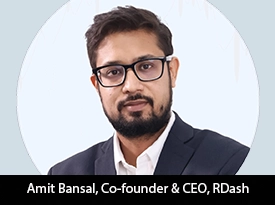
RDash was built to replace that fragmentation with infrastructure. Founded by Co-Founder and CEO Amit Bansal alongside Co-Founder and CPO Puneet Bansal and Co-Founder and CFO Amit Mishra, the company operates as a construction management operating system rather than a reporting dashboard. Its platform connects developers, contractors, and design studios onto a single environment where budgets, timelines, vendors, procurement, and site execution remain visible and auditable in real time. The company launched publicly in November 2022 after securing $10 million led by Stellaris Venture Partners and selection into Y Combinator.
That foundation has produced measurable commercial scale. More than 250 clients run projects on RDash, with over 9,000 completed projects and ₹500 crore in managed budgets. By May 2025, the ecosystem's financing arm, RFin, crossed ₹300 crore in disbursements. Supporting the platform is 91sqft, India's established name in commercial interiors, which contributes operational depth that pure software companies cannot replicate. Together these components form a trifecta spanning project management, fit-out execution, and asset-light financing an integrated model that has positioned RDash among the fastest-growing private companies in construction technology.
A Living Operating System Rather Than a Dashboard
RDash's defining architectural decision is its refusal to function as a passive reporting layer. The platform collapses spreadsheets, messaging threads, and siloed procurement into a single governed environment where stakeholders engage with live project realities from any location. Developers see budgets, timelines, and progress across residential, retail, and commercial sites without requesting updates. Design-build studios manage leads, generate automated quotations, track proposal workflows, and monitor design iterations continuously. Contractors log daily site reports, coordinate with vendors, and confirm that field execution aligns with plan. Every module from the Survey-to-Handover Project Tracker to the smart BOQ generator and Vendor Performance Ratings was built to interpret data rather than simply store it, which enables prevention of delays and cost overruns rather than post-mortem analysis.
PMO-as-a-Service and the Human Layer
Few construction platforms offer what RDash delivers through its PMO Services: a human-plus-technology layer that operates as an outsourced Chief Project Officer function. The team plans activity schedules, optimizes long-lead items, coordinates interdepartmental dependencies, and enforces audit protocols in real time. The outcomes are quantifiable a 12 percent reduction in overall project costs, full visibility across concurrent projects, and zero procurement leakages. The mechanism combines dynamic dashboards, live alerts, risk mitigation tooling, and structured vendor training that aligns suppliers with quality and pricing protocols. Runtime financial hygiene frameworks monitor scope creep, change orders, and unplanned expenditure, which keeps firms ahead of schedule rather than reacting to slippage. For a growing company, this model produces defensible results that support both retention and premium pricing.
Accountability Engineered Into the Workflow
Construction has historically operated as a black box where miscommunication and quality lapses remain difficult to attribute. RDash dismantles that opacity by automating routine tasks, contextualizing collaboration, and providing one-click access to audits, drawings, and design updates. Issues surface and resolve within context rather than across disconnected channels. Vendors carry performance ratings. Activities remain interdependent and tracked. Milestones carry timestamps and digital evidence rather than vague status descriptions. The result is a shift from reactive firefighting to proactive orchestration a cultural change that spreads through organizations as teams adjust to operating with visible accountability.
Leadership Discipline as an Operating Standard
RDash's leadership combines technical capability with on-ground industry experience, which shapes both product decisions and organizational culture. The founders approach the business as a culture-building exercise rather than a tool-building one, establishing expectations in which predictability functions as a baseline rather than an aspiration. Under this leadership, RDash has become a case study in founder-led execution ambitious in scope but grounded in operational reality. That combination of vision and discipline is what allows a company to scale without diluting the standards that produced its initial traction.
People as the Foundation of Platform Performance
RDash's strength extends beyond its technology into how it develops the people operating it. The company cultivates ownership, agility, and continuous learning, providing employees with autonomy, mentorship, and structured growth pathways. Leadership transparency and attention to work-life balance reinforce a culture in which team members remain aligned with the broader mission rather than simply executing tasks. For a company scaling rapidly across a demanding industry, that internal discipline translates directly into service consistency—the same standard applied to clients applies to how teams operate internally.
The Growth Logic of Governed Construction
RDash's expansion reflects accelerating demand for construction infrastructure that replaces fragmentation with measurable control. With more than 250 clients, 9,000 completed projects, ₹500 crore in managed budgets, and ₹300 crore disbursed through RFin, the company has established itself among the fastest-growing private companies in construction technology. The commercial logic is direct: unify stakeholders on a single operating system, embed accountability into every workflow, and pair software with the human governance that construction projects actually require. As India's construction and fit-out markets continue expanding, the value of that infrastructure strengthens.
Amit Bansal, Co-Founder & CEO