Scrut Automation Deploys AI Teammates to Do the Compliance Work Security Teams Keep Postponing
The Silicon Review
Compliance programs fail in predictable ways. A policy exists but nobody has checked whether it matches how systems actually operate. Evidence sits in a cloud console somewhere, undated and unattributed. A vendor gets onboarded without a security review, then turns out to hold regulated data. A customer questionnaire arrives and consumes two weeks of engineering time because nobody has consolidated the answers. None of these failures involve a sophisticated adversary. They involve routine work that never gets done because the people capable of doing it have more urgent obligations.
Scrut Automation was built to absorb that work. The platform combines governance, risk, and compliance foundation with a crew of specialized AI agents called Teammates, each assigned to a discrete function: drafting policies, collecting evidence from connected systems, running internal readiness assessments, correlating risk signals across cloud and vendor environments, and drafting security questionnaire responses from live compliance data. The platform supports more than 70 frameworks, including SOC 2, ISO 27001, HIPAA, GDPR, and PCI DSS, with integrations spanning more than 150 tools that security and engineering teams already operate.
The company emerged from a specific frustration. Its founders were building a previous startup when an enterprise buyer asked the question every growth-stage software company eventually faces: are you SOC 2 compliant? What followed was a tangle of consultants, spreadsheets, and stalled momentum that consumed months of engineering attention. They built automation to solve their own problem, and then recognized the problem was universal. That internal fix became Scrut Automation, now serving more than 2,500 customers with over 10 million assets monitored and a 4.9 out of 5 rating across more than 1,300 reviews.
Agentic Execution Rather Than Dashboard Reporting
Most GRC platforms provide visibility. They surface control status, track evidence gaps, and generate reports that describe what is wrong. That approach assumes someone has the capacity to act on what the dashboard reveals, which is precisely the assumption that fails in resource-constrained security teams. Scrut's Teammates invert that model by performing the underlying work rather than describing it. The Onboarding Analyst builds a context map of teams, systems, and owners, then auto-maps policy libraries and risk registers to controls while drafting the Statement of Applicability and System Description from live data. What previously consumed weeks now completes in a single session. The Policy Architect generates audit-ready policy drafts from current organizational data and continuously checks those policies against reality, flagging drift as it occurs rather than during the next audit cycle.
Evidence Collection as Continuous Infrastructure
The Evidence Collector pulls artifacts from AWS, GitHub, Okta, and more than 150 additional integrations, validates whether each item remains current, and flags gaps for human review. The company reports this reduces manual compliance work by roughly 80 percent. For engineering organizations, the significance extends beyond time savings. Compliance requests that arrive as interruptions, pulling developers away from product work to locate configuration screenshots, represent a measurable drag on shipping velocity. When evidence collection runs continuously in the background and surfaces only what requires human judgment, that interruption pattern disappears. One customer, Timeero, reported saving more than 20 hours per week on SOC 2 audit preparation.
Risk Detection and Vendor Intelligence
The Risk Analyst correlates signals across cloud configurations, access patterns, policies, and vendor relationships into suggested risks, then packages failed-test context and remediation scripts for delivery through MCP servers. The Vendor Risk Analyst discovers vendors, including unsanctioned AI tools that employees have adopted without review, sends tailored questionnaires, validates responses, and monitors for breaches continuously. Shadow AI governance has become a specific capability, addressing a governance gap that most organizations have not yet resolved. The Security Analyst runs agent-driven penetration testing with human verification on every finding, extending security validation from point-in-time assessment to continuous monitoring. The Internal Auditor runs readiness assessments ahead of the actual audit, producing severity-ranked findings with remediation steps.
Trust as a Revenue Function
The Trust Analyst drafts security questionnaire responses from live compliance state and maintains a branded trust center automatically. The commercial consequence is direct: enterprise deals stall when buyers cannot verify security posture, and questionnaire turnaround time frequently determines whether a procurement cycle advances or dies. Scrut reports that 80 percent of customers earned customer trust earlier in the sales cycle, and 73 percent credited Scrut-backed readiness with supporting fundraising. Compliance ceases to function as a gate and begins operating as a sales accelerator.
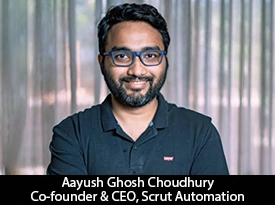
Aayush Ghosh Choudhury, Co-Founder and CEO
Aayush Ghosh Choudhury leads Scrut Automation as Co-Founder and CEO. His experience building a previous startup through the same compliance bottlenecks Scrut now addresses shaped the company's product direction, particularly the decision to build agentic execution rather than another reporting layer. Under his leadership, Scrut has scaled to more than 2,500 customers while maintaining ISO 42001 certification for AI management, with customer data never used to train shared models and AI functionality remaining opt-in and configurable.
The Growth Logic of Automated Compliance
Scrut Automation's expansion reflects accelerating demand for compliance infrastructure that reduces manual effort rather than documenting it. With more than 2,500 customers, 70-plus supported frameworks, and measurable outcomes across audit efficiency, trust acceleration, and engineering time recovered, the company has established itself among the innovative cybersecurity providers worth watching in 2026. The commercial logic is direct: compliance obligations continue multiplying, security teams remain understaffed, and the gap between the two requires automation that performs work rather than describing it.
Aayush Ghosh Choudhury, Co-Founder and CEO
"Compliance work does not fail because teams lack the tools to see the problem. It fails because seeing the problem is not the same as fixing it. We built Teammates to do the work, not describe it."
Search Magazine
Latest Listings