Innovative Brands of the Year 2026
Jorge Barragan, The Picklr Founder and CEO: “We’re hitting our stride, and the focus now is making sure that every club, whether it’s in Utah, Texas, or Tokyo, delivers the same experience. That consistency is what takes us from a great American concept to a truly global brand.”
The Silicon Review
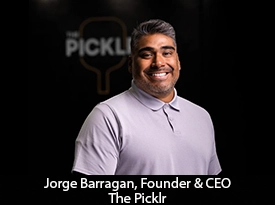
Long before pickleball became America’s fastest growing sport, Jorge Barragan saw something others missed. He did not just see a game. He saw a shift in how people connected. On courts tucked inside community gyms and church halls, he watched millennials linger long after matches ended, reluctant to leave the social gravity the sport created. Pickleball was not simply competition. It was community in its purest form. That realization became the foundation for The Picklr, a company built to solve a glaring disconnect between demand and experience. As the sport exploded in popularity, the places people played remained an afterthought. Temporary courts. Repurposed spaces. Facilities never designed for the pace, culture, or energy of modern pickleball. Players showed up anyway, but the environment lagged behind their enthusiasm.
The Picklr set out to change that by creating something entirely new: purpose built indoor pickleball clubs designed from the ground up. Each location brings every dimension of the sport under one roof, from organized leagues and tournaments to clinics, open play, and competitive events. But the physical courts are only part of the equation. The deeper mission is to create an ecosystem where connection happens naturally, where competition sharpens players, and where fun remains the constant thread tying it all together.
What Barragan understood early is now becoming obvious to the rest of the market. Pickleball is not just a pastime. It is a platform for community building. The Picklr is positioning itself at the center of that movement, turning a fragmented recreational activity into a structured, premium, and deeply social experience built for the next generation of players.
In conversation with Jorge Barragan, Founder and CEO of The Picklr
The Picklr has grown to over 500 locations sold. What was the core brand and operational innovation that made it so scalable?
Honestly, initially, it was a belief. People bought into the founder story, the vision, and the idea. There was no proven playbook yet, so franchisees had to trust where we were headed. That faith carried us further than I expected.
But belief only takes you so far. What makes us truly scalable today is the infrastructure we’ve built to support the growth. We created all the resources, systems, and support structures our franchisees need to run successful clubs, and we kept refining them as we learned. The result is that we’re now attracting a more sophisticated franchisee, one who isn’t just excited about pickleball, but who sees a maturing system they can build a business on.
The shift I’m most proud of is that we can no longer live off hype. The founder story carried us to a certain point, and now it’s time to show the world we are a mature, proven system.
Your model features dark walls and spotlighting as part of a premium indoor experience. How does this design philosophy elevate pickleball beyond a casual rec-center activity?
It starts with respect for the game. Pickleball has always had an uphill battle. It wasn’t taken seriously for a long time. If you let that narrative define the experience, you end up with courts thrown into a warehouse and call it a day.
We took the opposite approach. When you walk into a Picklr, everything is intentional. The dark walls, the court-level spotlighting, the pro-level surfaces, the custom furniture, the sound baffling. All of it was designed to make you feel something the moment you walk through the door. We wanted it to feel like Crypto Arena does when the lights go down. That same kind of emotional charge, that sense that this is a real place where real things happen. Pickleball deserves that.
You’ve secured partnerships with the PPA, Nike Sports Camps, and Drew Brees. How do these alliances create a competitive advantage that goes beyond court operations?
Each of these partnerships did something different for us, but they all pointed towards a greater feeling of legitimacy.
The PPA relationship was transformative for how the pickleball community saw us. The pro side needs amateurs to grow, and we create those players at the club level. We give them access to tournaments, competitive experiences, and a pathway toward the pro circuit.
Nike Sports Camps accelerated our commitment to youth development in a way that pushed us to build a true, legitimate pickleball academy experience. We have coaches, certifications, facilities, pros. Now we’re building the program.
And Drew Brees is a Hall of Famer who has spent his career giving back. For him to look at The Picklr and see alignment with his values, that means something. It strengthens our brand in a way that can’t be manufactured.
With over 139 years of combined franchise experience on your leadership team, how are you systematizing the playbook for opening a Picklr club at a global scale?
The word I keep coming back to is “reliable.” A reliable business is predictable, scalable, repeatable, and profitable. That’s the playbook we’re running Everything we build now has to pass through that lens.
What that means practically is that we’re standardizing everything: training, certifications, onboarding systems, performance benchmarks, dashboards that give franchisees real visibility into how to grow their business. I want a 16-year-old and a 60-year-old to be able to run one of our clubs successfully. That’s the bar.
We’re hitting our stride, and the focus now is making sure that every club, whether it’s in Utah, Texas, or Tokyo, delivers the same experience. That consistency is what takes us from a great American concept to a truly global brand.
Looking at the future of recreational sports, how does The Picklr’s tech-enabled, membership-based, multi-revenue stream model represents an innovative blueprint for building modern, sustainable athletic communities?
Recreational sports are moving from a “rent a court” model to a relationship model. For decades, facilities made money on transactions. You showed up, paid for time, and left. What we’re building is an ongoing connection with the player. Membership gives people a home base, programming gives them a path to improve, and community gives them a reason to stay.
Technology lets us understand how people actually play, how often they come, and what keeps them engaged so we can constantly refine the experience.
The big shift is that a club isn’t just a place anymore. It’s a platform that combines participation, development, and belonging. That’s what makes it sustainable for operators and meaningful for members.
What does the future hold for The Picklr and its customers?
Two weeks ago, we opened our first location outside of the United States, in Winnipeg, Canada. I got a photo from our partner there on opening day. Hundreds of shoes lined up at the entrance because people didn’t want to get the floors dirty. They took off their shoes, put on their court shoes, and walked in like it was sacred ground. That image stuck with me. It told me everything about what this game means to people when you give it the right home.
That’s what the future looks like, and it’s bigger than I think most people realize. We’re opening clubs in Australia and Japan, and targeting Europe this year. Pickleball is a global sport now with over 70M players, and The Picklr intends to be there every step of the way.
But what excites me most is the long game. There are serious conversations happening at the highest levels about pickleball becoming an Olympic sport at the 2032 Brisbane Games. When I think about the kids playing in our clubs today, I think their pathway to the Olympics could run right through a Picklr.
“When you walk into a Picklr, everything is intentional. The dark walls, the court-level spotlighting, the pro-level surfaces, the custom furniture, the sound baffling. All of it was designed to make you feel something the moment you walk through the door.”
“Technology lets us understand how people actually play, how often they come, and what keeps them engaged so we can constantly refine the experience.”
Jorge Barragan, Founder & CEO