The Vision Behind Vibrant Capital: Connecting Founders, CIOs, and Enterprise AI
The Silicon Review
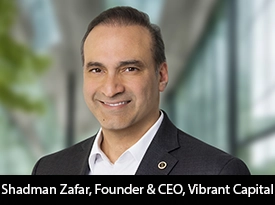
Founded in 2026 by CEO Shadman Zafar, Vibrant Capital is an AI investment and innovation platform built to accelerate enterprise AI adoption in industries where measurable outcomes matter most: financial services and insurance, healthcare and life sciences, industrial and manufacturing, transportation and logistics, and business and IT services. Headquartered in Dallas, Texas, it operates through three connected capabilities.
Vibrant Capital’s Growth Partners Network invests in AI-native companies that have already shown enterprise impact, helping them scale with guidance from CIOs who have deployed AI in regulated, operationally intensive environments. Vibrant Studio, the firm’s venture incubator, pairs founders with experienced operators to turn validated demand into production-ready systems that live inside real workflows. And the CIO Fellows Society, a nonprofit, convenes global CIOs to mentor emerging leaders, trade practical insights, and set standards for governing AI at enterprise scale. The Society is where the model starts; deliberately vendor-neutral, operator-led, and confidential, so its agenda reflects what institutions actually need rather than what anyone happens to be selling.
In conversation with Shadman Zafar, Founder and CEO of Vibrant Capital
You are building a network to help CIOs become “Chief Intelligence Orchestrators.” Why is this evolution so critical now, and what inspires you to invest in the education and community of technology leaders?
For thirty years, enterprise technology was deterministic. You could trace any output back to a defined input, which made it auditable by design. Generative AI breaks that contract because it’s probabilistic, context-sensitive, and emergent. You can’t govern it the way you governed an ERP (Enterprise Resource Planning) system, or lead it the way you led a technology team. So the title may still say Chief Information Officer, but the job is becoming Chief Intelligence Orchestrator. The job now looks more like conducting than puppeteering. You’re aligning people, data, and governance rather than pulling every individual string. It’s especially critical now because the mandate has already shifted while the role’s definition hasn’t. That’s why I’m passionate about investing in technology leaders’ education and community.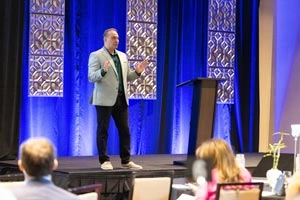
Your contrarian observation is that “the most important thing about AI is not intelligence, it is trust.” How did presenting to boards and answering regulators shape that conviction?
My years of presenting to boards and answering regulators taught me that intelligence is cheap and trust is expensive. In a boardroom, no one is impressed that the model is clever. They want to know what it earns and what happens if it fails. Regulators ask if you can prove it, and who is accountable. If you can’t answer those questions in language the board can act on, the smartest system in the world never ships. And you can’t answer them retroactively — demonstrating two years later how an output was produced is something you should build in while you’re still choosing the data.
If most AI failures are organizational rather than technical, what can a confidential peer community do that no individual leader — or vendor — can, when it comes to redesigning the enterprise itself?
When a deployment stalls, the instinct is to blame the model. Almost always the real problem is upstream of the model entirely. It’s the messy data, an unchanged process, or a team that never bought in. That kind of redesign can’t be purchased, and doing it in isolation is exhausting. A confidential peer community does what no vendor and no individual can. In a closed, vendor-free room, operators share the real friction. I like to call them “people with scars, not slogans.” You hear how a peer actually restructured a process, where they placed the guardrails, what they refused to automate, and what it cost. And because the Society is built for stewardship, that hard-won judgment doesn’t leave with one leader’s tenure. It’s mentored forward and written into playbooks the next CIO can adopt.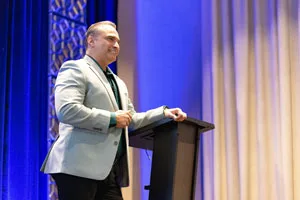
The CIO Fellows Society held its first executive conference in Dallas in June. What happened in that room that you couldn’t have anticipated?
First, the keynote kicked off without slides because the screen wouldn’t connect. So rather than stall, we just talked, and it really set the tone for the entire day. At the end of the conference, it occurred to me how little of the conversation was about technology. For example, in the morning we discussed governance hierarchy: human in the loop, on the loop, out of the loop. When asked how many companies default to the first as their policy, almost every hand went up. I referred to that approach as the “French fries of AI governance.” It’s comfort food: it goes down easy, and nothing about the enterprise actually gets healthier. The harder work is specifying the conditions under which a person should re-enter the loop, and that means redesigning the business process rather than adding an approval step. From there, the day included guidance on what boards actually need to hear, an honest accounting of security in which attackers hold the speed advantage because they carry no change-management queue, and what you build for when model capabilities and vendor pricing turn over every few months. Throughout it all, one interesting takeaway was that we spent an entire day discussing AI and rarely mentioned a model by name.
You describe a “Third Wave” of AI where demos are abundant but durable outcomes are rare. How is the Society’s reference architecture designed to separate durable patterns from the daily churn?
The first wave was access to models and the second was experimentation. The third is where value either compounds or evaporates, and most organizations are finding out which side of that line they’re on. New models, tools, and products now arrive at a dizzying pace, and no single CIO can vet it all. Chasing that daily churn is how organizations end up with a drawer full of pilots and nothing that scales. The Society’s answer is a peer-vetted filter. Our reference architecture — built by practitioners, for practitioners — separates the durable from the dated. We’re prescribing defaults for the things that don’t change month to month, including how you prepare data, how you structure retrieval, how you gate anything before it hits production. Specific model and product picks will be dated, tiered as Adopt, Trial, Assess, or Hold, and re-baselined on a known cadence. The promise isn’t “here’s the approved tool forever.” It’s “here’s a stable way to decide, plus current picks
your peers have run in production.”
Your platform includes Growth Partners, Vibrant Studio, and a CIO Network. How do you ensure these work together as one coherent system rather than three disconnected initiatives?
They only work if they feed each other, so I designed them as one loop rather than three business lines. The CIO Fellows Society surfaces the real, unmet demand — in other words, the friction operators actually live with. That demand tells our Growth Partners teams which AI-native companies are worth scaling, and gives those companies a credible path into enterprises through operators who have sat in the buyer’s chair. Where the demand exists but no company serves it well, Vibrant Studio builds one from scratch. And everything we learn deploying in the field flows back into the Society’s reference architecture and playbooks, which raises the quality of the next investment and the next build. Enterprise demand, founder creation, and responsible leadership are three points on one flywheel, not three separate programs competing for attention. My job is to keep that flywheel turning and make sure no part optimizes for itself at the expense of the whole.
What does the future hold for your company and its customers? Are exciting things on the way?
Yes — and I like to say “in the most unglamorous way possible.” The next wave won’t be won with hype. It’ll be won with results that compound week over week, with less friction in the handoffs and fewer exceptions to chase down. We’re expanding our Growth Partners and Studio portfolios, deepening our work across the U.S., Europe, and the Gulf, and helping the CIO Fellows Society ship its first reference architecture. For our customers, the frontier becomes something they operate day to day, not something they’re shown in a pitch. When the workflow improves, everything else will start to follow.
Meet the leader behind the success of Vibrant Capital
Shadman Zafar is the Founder and CEO of Vibrant Capital. A prolific inventor and technology leader, he is named on more than 100 patents and patent applications spanning finance, telecommunications, entertainment, technology, and design. He has held senior executive roles at Citigroup, JPMorgan Chase, Barclays, and Verizon, leading transformation programs and AI initiatives in some of the world’s most regulated industries and building high-performing engineering teams across continents. A board-level advisor, he founded Vibrant Capital to scale AI in the real economy — and the CIO Fellows Society to ensure the leaders steering that shift never have to face it alone.
“The next wave won’t be won with hype. It’ll be won with results that compound week over week, with less friction in the handoffs and fewer exceptions to chase down.”
Search Magazine
Latest Listings