>>
Industry>>
Space>>
For the first time, the Webb t...For the first time, the Webb telescope discovers critical molecules in space
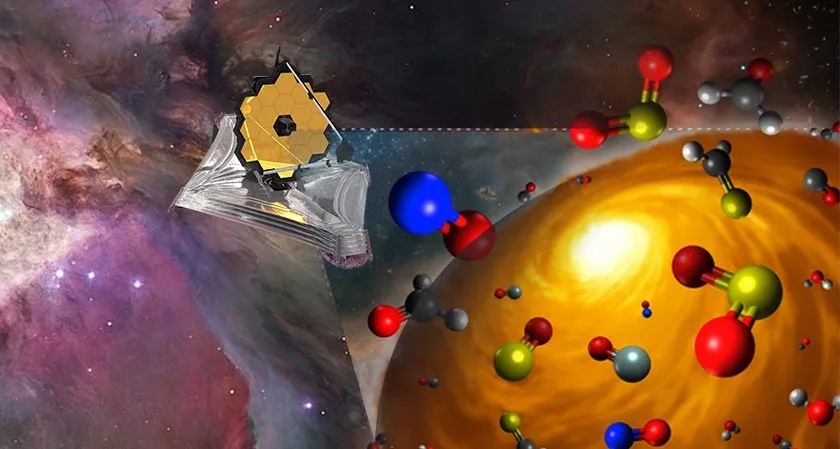
Astronomers find a critical carbon molecule in space for the first time using James Webb Space Telescope.
Using the James Webb Space Telescope, astronomers spotted a critical carbon molecule in space for the first time. According to NASA, the molecule, known as methyl cation, or CH3+, can be traced back to a newborn star system 1,350 light-years away from Earth in the Orion Nebula. Carbon molecules fascinate scientists because they serve as the foundation for all life as we know it. Methyl cation is regarded as an important component in the formation of more complex carbon-based compounds.
The Webb telescope's incredibly sensitive capabilities, which examine the cosmos in infrared light that is invisible to the human eye, are revealing more about organic chemistry in space. The satellite observatory discovered methyl cations in d203-506, a protoplanetary disk swirling around a young red dwarf star. These disks, which are mostly formed of gas and dust, are the leftovers of star formation. Planets are born in these huge star halos, resulting in the formation of planetary systems.
Understanding how life began and evolved on Earth could aid researchers in determining whether life exists elsewhere in the universe. According to the study, the researchers observed different molecules in the protoplanetary disk of d203-506 from those found in usual disks, and they did not detect any water. This discovery not only proves Webb's extraordinary sensitivity, but also confirms the previously assumed essential relevance of CH3+ in interstellar chemistry.