>>
Technology>>
Aerospace>>
Mobile Manufacturing in Aerosp...Mobile Manufacturing in Aerospace: How Far Can It Go?
Iryna Honcharuk, an EDM specialist, on where the model reaches its limits.
Compact, mobile production modules are getting more attention across manufacturing industries. Iryna Honcharuk, a specialist in electrical discharge machining (EDM) for aerospace components and in production process optimization, explains the challenges of applying this approach to truly complex parts.
Aerospace manufacturing is leaning more and more on digital and additive technologies to produce complex components. The next question is whether some of those processes can move out of large, specialized plants and into compact, distributed modules.
Making parts closer to where they'll be assembled, repaired, or used is especially appealing for aerospace. Aircraft, engines, satellites, and other complex systems are built from thousands of specialized components that go through a long chain of manufacturing, processing, inspection, and delivery. Moving even part of that chain closer to the point of use could cut lead times and reduce dependence on complex logistics.
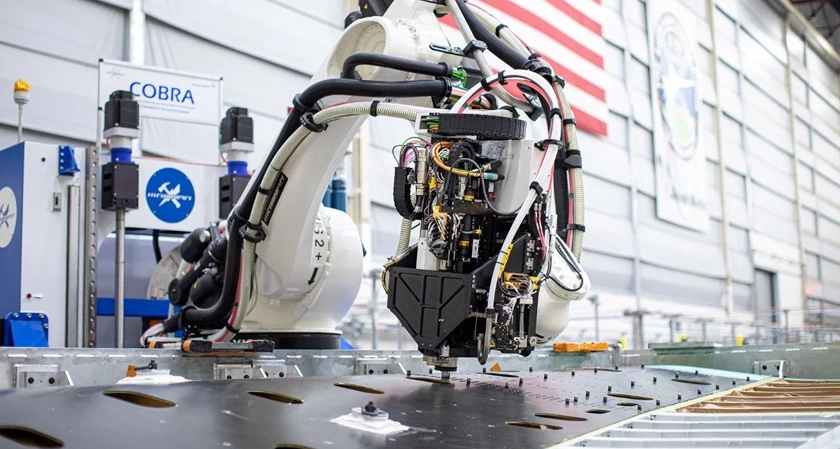
Technically, this scenario is no longer science fiction. Modern compact production systems can combine several operations – additive manufacturing, machining, and measuring the finished part – inside a single module. But being able to make a complex component once doesn't mean it can be made just as reliably anywhere.
For aerospace, the key question is different: can you guarantee that a part made on a different machine, in a different production environment, will have the same characteristics as one made at a permanent, certified facility?
That question sits at the core of how distributed manufacturing develops. If a part's quality can be verified independently of the specific machine and location that made it, then part of the process really can go mobile.
That's where the main technical barrier shows up.
A Complex Part Isn't Necessarily a Complex Shape
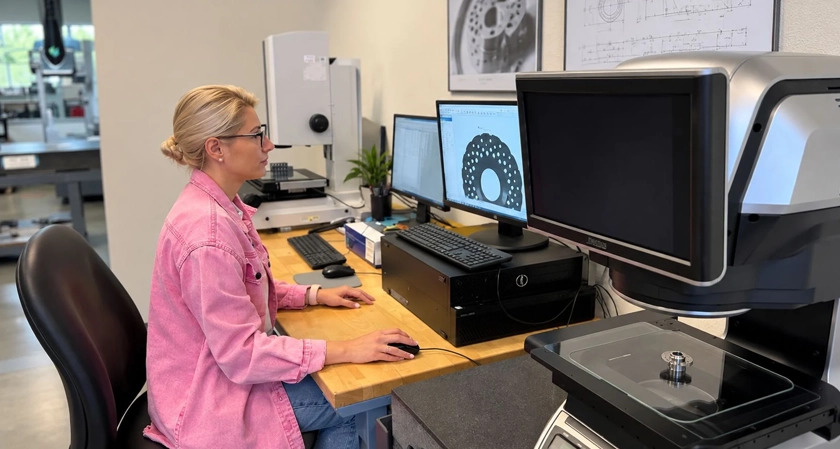
Iryna Honcharuk approaches this problem from the practical side. She works in wire EDM, EDM drilling, and process optimization for precision components in industries with strict quality requirements, including aerospace.
In her experience, a part's complexity comes down to a lot more than its geometry.
"You can make a part with a very unusual shape but relatively loose tolerances, and it'll end up simpler to produce than a small, plain-looking component where precision, surface quality, and material properties are all critical," Honcharuk explains.
In aerospace manufacturing, what matters most is the combination of factors: material, tolerances, surface condition, geometric accuracy, how the part is fixtured, the sequence of operations, and the ability to verify the result once machining is done. That's why mobile manufacturing can't be boiled down to the idea of "putting a modern machine in a shipping container."
"To move production somewhere else, you have to reproduce the whole process, not just the equipment," Honcharuk says. "That means machine setup, how the part is fixtured, the machining parameters, the sequence of operations, and how you check the result. Change any one of those elements, and the result can change too."
Why Identical Machines Don't Always Produce Identical Results
Iryna Honcharuk
In 2023 and 2024, Honcharuk worked on a problem involving electrical discharge machining of especially small, geometrically complex parts. The standard settings on Mitsubishi EDM Systems equipment couldn't deliver the combination of precision and surface quality the job required. The equipment was working properly; the problem was the scale of the process.
"Once the part got smaller, the standard settings stopped behaving the way they did on bigger components. We couldn't just change one parameter. We had to account for current, pulse duration, and cooling conditions all at once, and how they affect each other," she says.
The work produced a set of machining parameters that delivered stable, repeatable results.
That example is telling for mobile manufacturing: if a process needs this kind of fine-tuning even inside a permanent shop, moving the equipment to a different environment only adds more variables. Temperature, vibration, the condition of the machine, tooling, and even differences between two machines of the same model can all affect the outcome.
"Two identical machines don't automatically add up to two identical processes," Honcharuk notes. "In a regular shop, you can find and compensate for those differences gradually. In a mobile setup, you have to do that much faster. Aerospace components are especially sensitive to these deviations. An engine part, a control-system component, or a small high-precision piece can operate under cyclic loads, high temperatures, or vibration. Under those conditions, dimensions are only part of the picture. Surface condition, microdefects, and the stability of the production process itself matter too."
What Mobile Manufacturing Can Handle Today
That doesn't mean the mobile model is a poor fit for aerospace. Different categories of components will simply move toward it at different speeds.
"The easiest parts to move are the ones whose results you can reliably verify right there on site: prototypes, production tooling, some spare parts, ground-support equipment, and components with a straightforward measurement and acceptance process. It's harder with parts that the reliability of an aircraft or spacecraft directly depends on," she says.
For those components, checking dimensions isn't enough. They may call for nondestructive testing, material-property verification, surface analysis, physical testing, and full traceability of the production process.
That's the paradox of the mobile microfactory: the more critical the part, the more infrastructure you have to bring along with the machine.
Where the Real Limit Sits
The line for mobile manufacturing doesn't run between simple and complex parts. Modern equipment can already machine extremely complex components in the materials aerospace uses. The real limit shows up once keeping the process stable and verifying quality start to require the infrastructure of a full specialized facility.
"So the most realistic scenario for aerospace isn't replacing large plants outright – it's redistributing specific production stages. Some components could be made faster closer to where they're assembled, serviced, or tested, while the most critical operations stay at specialized facilities," Honcharuk explains.
That line may shift over time. The better equipment gets at monitoring machining parameters in real time, catching deviations, and connecting them to the finished part's characteristics, the less quality will depend on any particular building or production line.













Comments